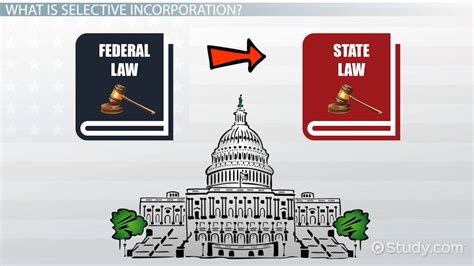
The concept of selective incorporation has been a cornerstone of American constitutional law since the early 20th century. It refers to the process by which the provisions of the Bill of Rights, originally intended to limit the powers of the federal government, are applied to the states through the Due Process Clause of the Fourteenth Amendment. This process has significantly expanded the protections afforded to individuals by incorporating various aspects of the Bill of Rights against state action. Here, we will explore 5 key ways in which selective incorporation has shaped constitutional law and the implications of these developments.
Historical Context and Evolution of Selective Incorporation
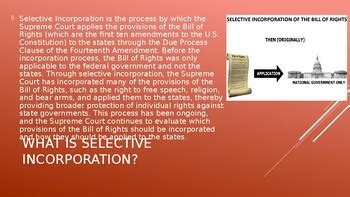
The Fourteenth Amendment, ratified in 1868, was designed to ensure that the newly freed slaves were granted the same rights as white citizens. The Due Process Clause of this amendment has been interpreted to include most of the provisions of the Bill of Rights, thereby limiting not just federal but also state actions. The Supreme Court’s decision in Gitlow v. New York (1925) marked the beginning of selective incorporation, as it applied the First Amendment’s freedom of speech clause to the states. Since then, the Court has continued to incorporate other amendments, often through a series of landmark cases that have refined the scope of constitutional protections.
1. Freedom of Speech and Expression
The freedom of speech and expression, guaranteed by the First Amendment, was one of the first rights to be incorporated against the states. The landmark case of Gitlow v. New York (1925) set the stage for subsequent decisions that have expanded and clarified the protections afforded to speech. This incorporation has been crucial in safeguarding political dissent, artistic expression, and the dissemination of information, ensuring that states cannot unduly restrict these fundamental freedoms. The Court has continued to refine its understanding of what constitutes protected speech, balancing the need to protect individual expression with the necessity of maintaining public order and morality.
| Case | Year | Outcome |
|---|---|---|
| Gitlow v. New York | 1925 | Established that the First Amendment applies to the states |
| New York Times Co. v. Sullivan | 1964 | Set a high standard for proving libel, protecting press freedom |
| Tinker v. Des Moines Independent Community School District | 1969 | Protected students' freedom of expression in public schools |

2. Right to a Fair Trial
The Sixth Amendment’s guarantee of a fair trial, including the right to a speedy and public trial by an impartial jury, has also been incorporated against the states. Cases such as Duncan v. Louisiana (1968) have ensured that these protections are available to defendants in state courts, safeguarding the integrity of the judicial process and the rights of the accused. This incorporation has been critical in preventing state abuses of power and in ensuring that justice is served in a fair and impartial manner.
3. Protection Against Unreasonable Searches and Seizures
The Fourth Amendment’s prohibition against unreasonable searches and seizures has been incorporated through cases like Mapp v. Ohio (1961), which applied the exclusionary rule to state proceedings. This ruling has meant that evidence obtained in violation of the Fourth Amendment cannot be used in state courts, providing a powerful deterrent against police misconduct and protecting individual privacy. The ongoing debate surrounding the balance between public safety and individual privacy rights underscores the complexity of applying this amendment in contemporary contexts.
4. Right to Equal Protection
The Equal Protection Clause of the Fourteenth Amendment, which guarantees that no state shall deny anyone equal protection under the law, has been instrumental in combating discrimination. Although not a direct result of selective incorporation, the clause’s application has been influenced by the process, as seen in landmark cases like Brown v. Board of Education (1954), which struck down racial segregation in public schools. The clause has been pivotal in advancing civil rights, ensuring that states cannot enact laws that arbitrarily discriminate against certain groups of people.
5. Right to Due Process
The Due Process Clause itself, found in both the Fifth and Fourteenth Amendments, has been a cornerstone of selective incorporation. It ensures that individuals are protected from arbitrary state action, guaranteeing procedural due process in administrative and judicial proceedings. Cases such as Goldberg v. Kelly (1970) have established that certain procedures must be followed before an individual can be deprived of a property interest, such as welfare benefits. This protection has been critical in safeguarding individual rights and preventing abuses of state power.
Key Points
- Selective incorporation has expanded individual rights by applying the Bill of Rights to state actions.
- The process began with the First Amendment and has included other rights such as a fair trial, protection against unreasonable searches, and due process.
- Landmark cases have refined the application of these rights, balancing individual freedoms with societal needs.
- The Equal Protection Clause has been crucial in combating discrimination and ensuring equal treatment under the law.
- Ongoing challenges and debates surround the application and limitation of these rights in contemporary society.
In conclusion, selective incorporation has fundamentally reshaped the landscape of American constitutional law, extending vital protections to individuals against state action. Through a series of judicial decisions, the Supreme Court has carefully balanced individual rights with societal interests, laying the groundwork for a more just and equitable society. As the nation continues to evolve, the principles of selective incorporation will remain essential in safeguarding the rights and freedoms that are at the heart of American democracy.
What is selective incorporation, and why is it important?
+Selective incorporation refers to the process by which the provisions of the Bill of Rights are applied to the states through the Due Process Clause of the Fourteenth Amendment. It is crucial because it expands individual rights and protections against state actions, ensuring a more uniform application of constitutional principles across the United States.
How has the Supreme Court approached selective incorporation over time?
+The Supreme Court has approached selective incorporation through a series of landmark cases, starting with the application of the First Amendment in Gitlow v. New York (1925). Over time, the Court has carefully considered which rights to incorporate and how to balance individual freedoms with societal interests, refining its approach through subsequent decisions.
What are some of the key rights that have been incorporated against the states?
+Key rights that have been incorporated include freedom of speech and expression, the right to a fair trial, protection against unreasonable searches and seizures, and the right to due process. These incorporations have significantly expanded the protections afforded to individuals and have been instrumental in advancing civil rights and combating discrimination.