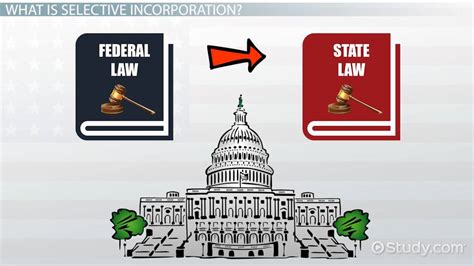
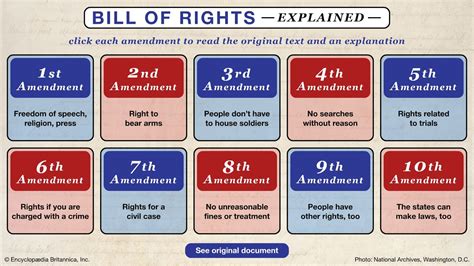
Selective incorporation is a fundamental concept in constitutional law, particularly within the context of the United States. It refers to the process by which certain provisions of the Bill of Rights, originally intended to limit the power of the federal government, have been applied to the states through the Fourteenth Amendment. This process has been pivotal in ensuring that individual rights are protected uniformly across the country. The incorporation of these rights has not been wholesale; rather, it has been selective, with different provisions being incorporated at different times through various Supreme Court decisions. Understanding how selective incorporation works requires examining the historical context, the legal mechanisms through which it occurs, and the implications of this process on individual rights and federalism.
The Conceptual Framework of Selective Incorporation
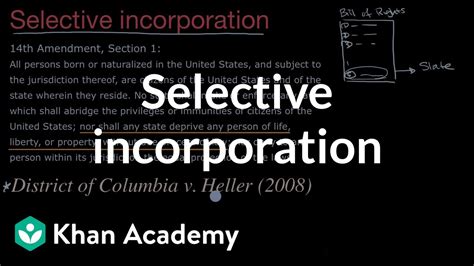
The Fourteenth Amendment, ratified in 1868, was designed to ensure that the former Confederate states would respect the rights of newly freed slaves. However, its broader implications soon became apparent, particularly through the Due Process Clause of the Fourteenth Amendment, which prohibits states from depriving anyone of “life, liberty, or property, without due process of law.” Over time, the Supreme Court has interpreted this clause to incorporate various provisions of the Bill of Rights, thereby applying them to the states. This process of selective incorporation has been guided by the Court’s determination of which rights are “fundamental” or “implicit in the concept of ordered liberty.”
The Historical Context and Key Cases
The journey of selective incorporation began with the Slaughter-House Cases (1873) but gained momentum with Gitlow v. New York (1925), where the Court first started to incorporate parts of the Bill of Rights through the Due Process Clause. Subsequent landmark cases, such as Near v. Minnesota (1931) for freedom of the press, Wolf v. Colorado (1949) for unreasonable searches and seizures, and Mapp v. Ohio (1961) for the exclusionary rule, have solidified the principle of selective incorporation. Each of these cases represents a significant step in the expansion of individual rights against state action, illustrating how the Court’s interpretation of the Due Process Clause has evolved over time.
| Case | Year | Right Incorporated |
|---|---|---|
| Gitlow v. New York | 1925 | Freedom of Speech |
| Near v. Minnesota | 1931 | Freedom of the Press |
| Wolf v. Colorado | 1949 | Protection against Unreasonable Searches and Seizures |
| Mapp v. Ohio | 1961 | Exclusionary Rule |
Implications and Criticisms of Selective Incorporation
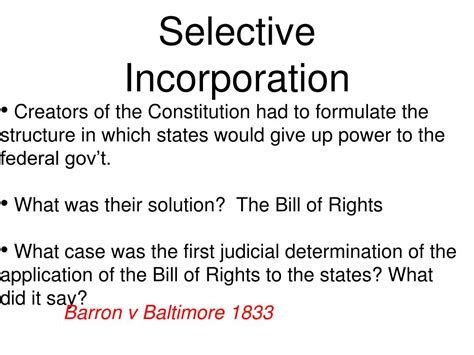
The selective incorporation doctrine has significant implications for federalism, individual rights, and the balance of power between the federal government and the states. Critics argue that it centralizes power, undermining the principle of federalism by imposing a uniform national standard on states. On the other hand, proponents see it as essential for protecting fundamental rights and ensuring that the Constitution remains a vibrant and relevant document. The debate surrounding selective incorporation highlights the ongoing tension between individual liberty and state sovereignty, a tension that is at the heart of American constitutional law.
Balancing Individual Rights and State Sovereignty
The Supreme Court’s approach to selective incorporation has been to balance the need to protect individual rights with the need to respect state sovereignty. This balance is delicate and has shifted over time, reflecting changing societal values and legal doctrines. The Court’s decisions have not been without controversy, with some arguing that the process of incorporation has gone too far, infringing on the rights of states to govern themselves, while others contend that it has not gone far enough, leaving some fundamental rights unprotected at the state level.
Key Points
- The selective incorporation doctrine applies parts of the Bill of Rights to the states through the Fourteenth Amendment's Due Process Clause.
- The process has been gradual, with different provisions being incorporated over time through significant Supreme Court decisions.
- Key cases like Gitlow v. New York, Near v. Minnesota, Wolf v. Colorado, and Mapp v. Ohio have expanded individual rights against state action.
- The doctrine has implications for federalism, individual rights, and the balance of power between the federal government and the states.
- Critics argue it centralizes power and undermines federalism, while proponents see it as crucial for protecting fundamental rights uniformly across the country.
In conclusion, selective incorporation is a vital concept in American constitutional law, reflecting the ongoing effort to balance individual rights with state sovereignty. Through a series of landmark cases, the Supreme Court has selectively incorporated provisions of the Bill of Rights, applying them to the states and thereby ensuring a more uniform protection of individual liberties. As the legal landscape continues to evolve, the doctrine of selective incorporation will remain a critical aspect of constitutional interpretation, influencing the relationship between the federal government, the states, and the individual.
What is the main purpose of selective incorporation?
+The main purpose of selective incorporation is to apply certain provisions of the Bill of Rights to the states, thereby protecting individual rights from state infringement and ensuring a more uniform application of constitutional protections across the United States.
Which Supreme Court case is often cited as the beginning of the selective incorporation process?
+Gitlow v. New York (1925) is often cited as a key case in the selective incorporation process, as it marked one of the first instances where the Court applied a provision of the Bill of Rights (freedom of speech) to the states through the Due Process Clause of the Fourteenth Amendment.
How does selective incorporation impact federalism in the United States?
+Selective incorporation can be seen as impacting federalism by limiting the autonomy of states to govern themselves in areas where the Court has applied Bill of Rights provisions. This centralizes power at the federal level, as states must comply with federally mandated protections, potentially undermining the principle of federalism.