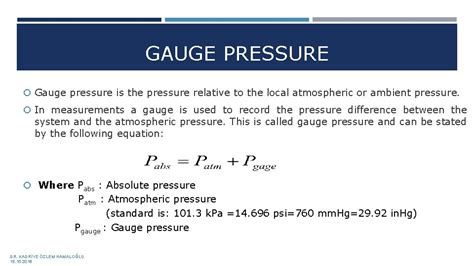
The concept of gauge pressure is fundamental in understanding various physical and engineering principles, particularly in the context of fluids and pressure measurements. Gauge pressure, often denoted as P_g, refers to the pressure relative to the surrounding atmospheric pressure. It is a crucial measure in many applications, including industrial processes, medical devices, and environmental monitoring. To calculate gauge pressure, one must understand the gauge pressure formula and its components.
Key Points
- The gauge pressure formula is P_g = P_a - P_atm, where P_g is the gauge pressure, P_a is the absolute pressure, and P_atm is the atmospheric pressure.
- Atmospheric pressure (P_atm) is approximately 101,325 Pascals at sea level but can vary based on location and weather conditions.
- Absolute pressure (P_a) includes both the gauge pressure and the atmospheric pressure, making it a measure of the total pressure relative to a vacuum.
- Gauge pressure measurements are commonly used in applications where the reference point is atmospheric pressure, such as in tire pressure gauges and blood pressure monitors.
- Understanding the difference between gauge and absolute pressure is critical in engineering and scientific applications to ensure accurate measurements and calculations.
Understanding Gauge Pressure
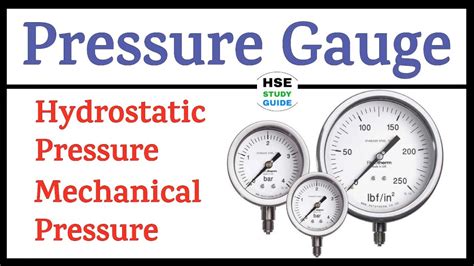
Gauge pressure is measured relative to the ambient atmospheric pressure. This means that if a system is at the same pressure as the atmosphere, its gauge pressure is zero. However, if the system’s pressure is higher or lower than the atmospheric pressure, the gauge pressure will be positive or negative, respectively. This concept is essential in various fields, including mechanical engineering, where the design of systems such as hydraulic and pneumatic circuits relies heavily on accurate pressure measurements.
Components of the Gauge Pressure Formula
The gauge pressure formula, P_g = P_a - P_atm, involves two key components: absolute pressure (P_a) and atmospheric pressure (P_atm). Absolute pressure is the total pressure measured relative to a perfect vacuum, encompassing both the gauge pressure and the atmospheric pressure. Atmospheric pressure, on the other hand, is the pressure exerted by the atmosphere at a given location and elevation. It is approximately 101,325 Pascals at sea level but can vary slightly depending on weather conditions and geographical location.
| Pressure Type | Description | Formula |
|---|---|---|
| Gauge Pressure (P_g) | Pressure relative to atmospheric pressure | P_g = P_a - P_atm |
| Absolute Pressure (P_a) | Total pressure relative to a vacuum | P_a = P_g + P_atm |
| Atmospheric Pressure (P_atm) | Pressure exerted by the atmosphere | P_atm ≈ 101,325 Pa at sea level |

Applications of Gauge Pressure

Gauge pressure has numerous practical applications across various industries. In the automotive sector, tire pressure gauges measure the air pressure in tires relative to atmospheric pressure, which is essential for safety, fuel efficiency, and tire longevity. Similarly, in medical settings, blood pressure monitors use gauge pressure measurements to assess a patient’s blood pressure relative to atmospheric pressure, providing vital information for healthcare professionals. Industrial processes, such as those involving pumps, valves, and piping systems, also rely on accurate gauge pressure measurements to ensure efficient and safe operation.
Calculating Gauge Pressure
To calculate gauge pressure using the formula P_g = P_a - P_atm, one must first know the absolute pressure and the atmospheric pressure. For example, if the absolute pressure of a system is 120,000 Pascals and the atmospheric pressure is 101,325 Pascals, the gauge pressure would be 18,675 Pascals (120,000 Pa - 101,325 Pa). This calculation is straightforward and demonstrates how the gauge pressure formula can be applied in practical scenarios.
Furthermore, understanding how to convert between gauge and absolute pressure is also vital. If the gauge pressure and atmospheric pressure are known, the absolute pressure can be calculated by adding these two values (P_a = P_g + P_atm). This conversion is necessary when designing systems that operate under pressures different from atmospheric conditions or when analyzing data from pressure sensors that may provide readings in either gauge or absolute pressure.
What is the primary difference between gauge pressure and absolute pressure?
+Gauge pressure is measured relative to atmospheric pressure, while absolute pressure is measured relative to a perfect vacuum. This means gauge pressure can be positive, negative, or zero, depending on whether it's above, below, or equal to atmospheric pressure, whereas absolute pressure is always positive or zero.
How do changes in atmospheric pressure affect gauge pressure measurements?
+Changes in atmospheric pressure can affect gauge pressure measurements because gauge pressure is the difference between absolute pressure and atmospheric pressure. An increase in atmospheric pressure will decrease the gauge pressure if the absolute pressure remains constant, and vice versa. This is why atmospheric conditions can influence pressure readings in various applications.
What are some common applications of gauge pressure measurements?
+Gauge pressure measurements are commonly used in tire pressure gauges, blood pressure monitors, industrial processes involving pumps and valves, and in environmental monitoring of water and gas pressures. These measurements are crucial for ensuring safety, efficiency, and proper operation in these applications.
In conclusion, the gauge pressure formula provides a simple yet powerful tool for understanding and calculating pressure in various contexts. By grasping the concepts of gauge pressure, absolute pressure, and atmospheric pressure, and how they relate to each other, individuals can better appreciate the intricacies of pressure measurements and their significance in both everyday applications and complex industrial processes. Whether it’s ensuring the correct tire pressure for a vehicle or monitoring blood pressure in a medical setting, understanding gauge pressure is essential for making informed decisions and taking appropriate actions.