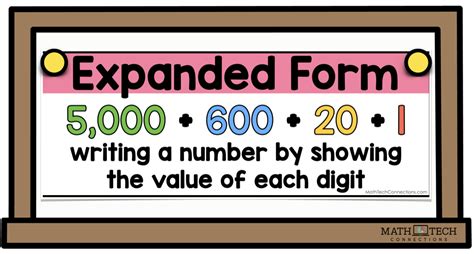
Expanded form is a mathematical representation that expresses a number as a sum of its individual digits, each multiplied by its corresponding place value. This concept is fundamental in understanding the structure of our decimal system and is widely used in various mathematical operations, such as addition, subtraction, multiplication, and division. In essence, expanded form provides a detailed breakdown of a number, illustrating how each digit contributes to the overall value.
Key Points
- Expanded form represents a number as a sum of its digits multiplied by their respective place values.
- This concept is crucial for understanding the decimal system and performing mathematical operations.
- Expanded form can be applied to both whole numbers and decimals, providing a comprehensive view of a number's structure.
- It is an essential tool for developing mathematical fluency and solving complex problems.
- Understanding expanded form enhances one's ability to analyze and manipulate numbers in various mathematical contexts.
Understanding Expanded Form
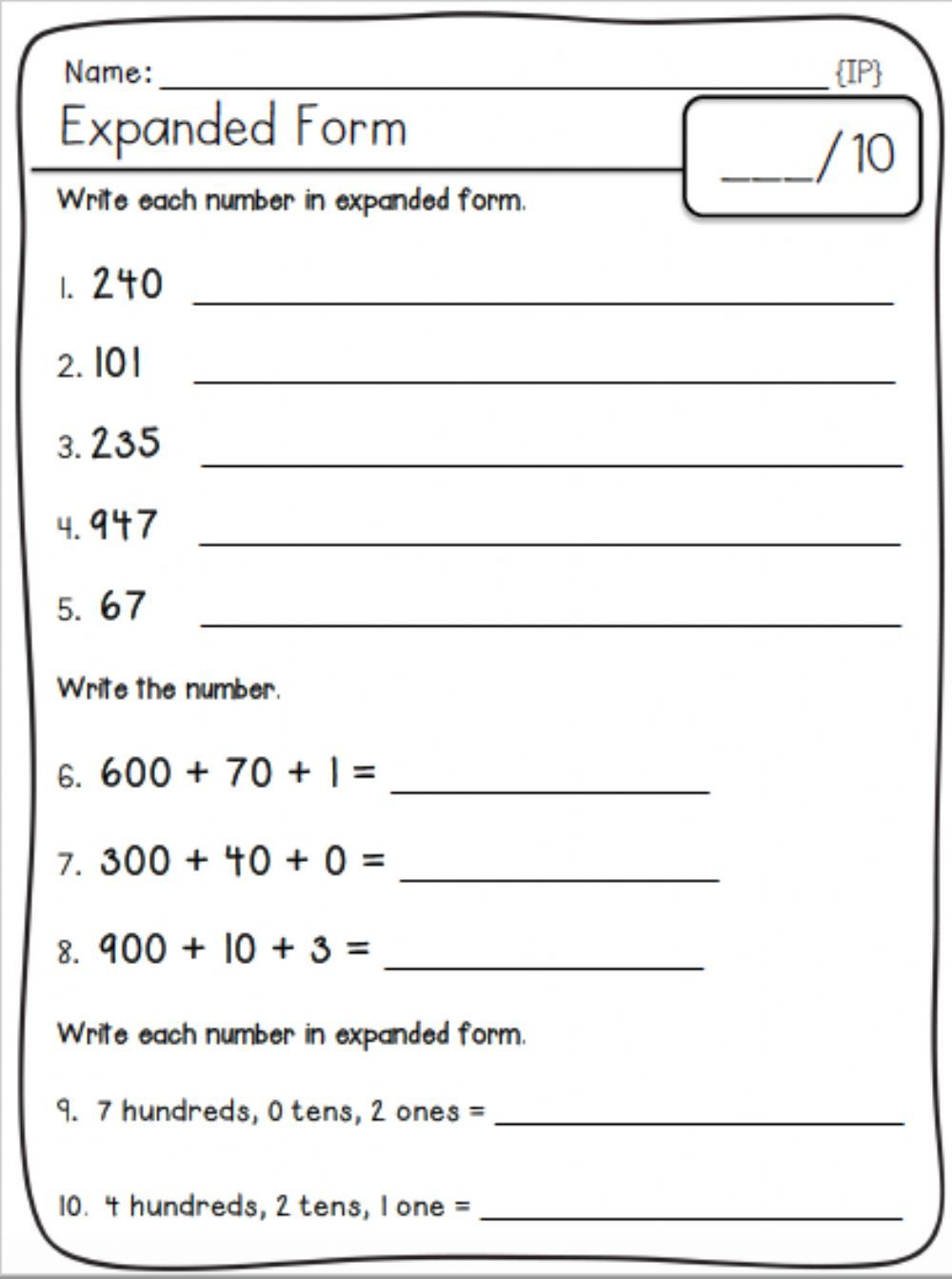
To grasp the concept of expanded form, it is essential to comprehend the idea of place value. In the decimal system, each digit in a number has a specific place value, which determines its contribution to the overall value of the number. The place values, starting from the right, are ones, tens, hundreds, thousands, and so on. By multiplying each digit by its corresponding place value and summing these products, we obtain the expanded form of the number.
Examples of Expanded Form
Consider the number 456. To express this number in expanded form, we multiply each digit by its respective place value: 4 (hundreds) × 100 = 400, 5 (tens) × 10 = 50, and 6 (ones) × 1 = 6. Adding these products together, we get 400 + 50 + 6 = 456. This illustrates how the expanded form represents the number as a sum of its individual digits, each multiplied by its corresponding place value.
| Number | Expanded Form |
|---|---|
| 123 | 100 × 1 + 10 × 2 + 1 × 3 = 100 + 20 + 3 = 123 |
| 789 | 100 × 7 + 10 × 8 + 1 × 9 = 700 + 80 + 9 = 789 |
| 2468 | 1000 × 2 + 100 × 4 + 10 × 6 + 1 × 8 = 2000 + 400 + 60 + 8 = 2468 |

Applications of Expanded Form
Expanded form has numerous applications in mathematics, including addition, subtraction, multiplication, and division. By representing numbers in expanded form, individuals can better understand the underlying structure of mathematical operations and develop more effective strategies for solving problems. Furthermore, expanded form is essential in algebra, where it is used to simplify expressions and solve equations.
Mathematical Operations with Expanded Form
When performing mathematical operations, such as addition and subtraction, expanded form can help individuals understand the process more intuitively. For example, when adding 345 and 279, representing the numbers in expanded form can facilitate the calculation: (300 + 40 + 5) + (200 + 70 + 9) = 300 + 200 + 40 + 70 + 5 + 9 = 624. This approach can enhance one’s understanding of the mathematical process and improve calculation accuracy.
What is the purpose of expanded form in mathematics?
+Expanded form is used to represent a number as a sum of its individual digits, each multiplied by its corresponding place value. This concept is essential for understanding the decimal system and performing various mathematical operations.
How does expanded form enhance mathematical fluency?
+By recognizing how each digit contributes to the overall value of a number, individuals can develop a deeper understanding of mathematical operations and improve their problem-solving skills. Expanded form provides a detailed breakdown of a number, facilitating more accurate and efficient calculations.
What are the applications of expanded form in algebra?
+Expanded form is used in algebra to simplify expressions and solve equations. By representing variables and constants in expanded form, individuals can better understand the underlying structure of algebraic expressions and develop more effective strategies for solving problems.
In conclusion, expanded form is a fundamental concept in mathematics that provides a detailed breakdown of a number, illustrating how each digit contributes to the overall value. By understanding expanded form, individuals can develop a deeper understanding of the decimal system, enhance their mathematical fluency, and improve their problem-solving skills. The applications of expanded form are numerous, ranging from basic arithmetic operations to advanced algebraic manipulations. As such, it is essential for individuals to grasp this concept and apply it effectively in various mathematical contexts.