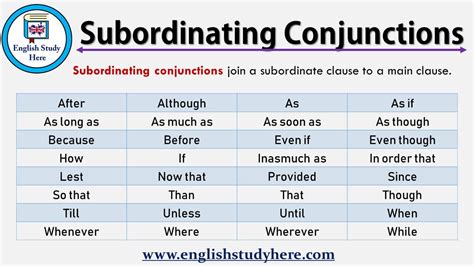
When constructing sentences, subordinate conjunctions play a crucial role in linking independent and dependent clauses, thereby enhancing the clarity and complexity of our expressions. These conjunctions indicate the relationship between the clauses they connect, such as time, cause, effect, or condition. Mastering the use of subordinate conjunctions is essential for effective communication in both writing and speaking. In this article, we will delve into five key tips for using subordinate conjunctions correctly and effectively.
Key Points
- Understanding the function of subordinate conjunctions in sentence structure
- Identifying common subordinate conjunctions and their meanings
- Placing subordinate clauses correctly within a sentence
- Avoiding common errors in using subordinate conjunctions
- Using subordinate conjunctions to enhance sentence variety and clarity
Understanding Subordinate Conjunctions
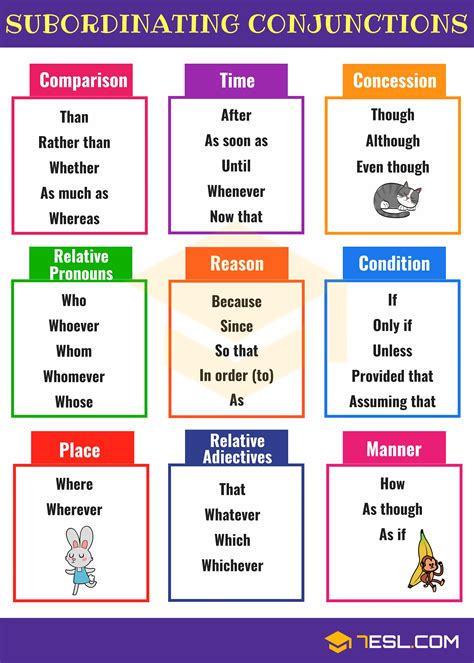
To begin with, it’s essential to understand what subordinate conjunctions are and how they function. Subordinate conjunctions introduce dependent clauses, which cannot stand alone as complete sentences. They provide additional information to the independent clause, indicating why, when, where, or under what conditions something happens. Common subordinate conjunctions include because, although, if, unless, until, and while. For instance, in the sentence “I went to the store because I needed milk,” “because I needed milk” is the dependent clause introduced by the subordinate conjunction “because,” explaining the reason for the action in the independent clause “I went to the store.”
Identifying and Using Subordinate Conjunctions Correctly
Identifying the correct subordinate conjunction to use depends on the relationship between the clauses. For example, time relationships are indicated by conjunctions like after, before, since, and until. Cause and effect relationships are shown with because, since, and so that. Condition is indicated by if and unless. Understanding these relationships and choosing the right conjunction is crucial for clear and accurate expression. For instance, “I will go for a walk after I finish my homework” uses “after” to indicate a time relationship between the two clauses.
| Conjunction | Relationship | Example |
|---|---|---|
| Because | Cause and Effect | I'm tired because I didn't sleep well. |
| Although | Contrast | I'm going to the party although I'm tired. |
| If | Condition | I will go if you come with me. |
Placing Subordinate Clauses Correctly
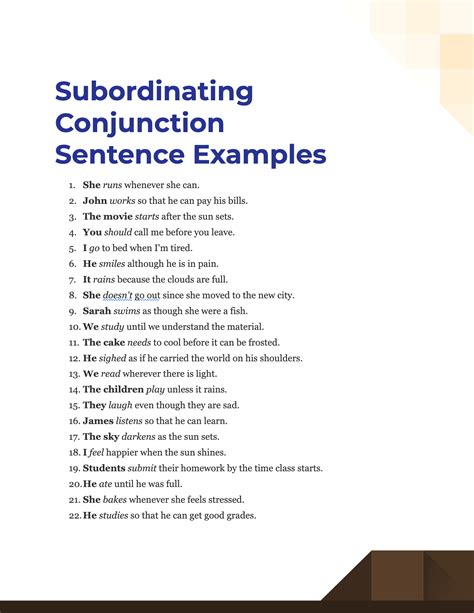
The placement of subordinate clauses within a sentence can significantly affect its clarity and emphasis. While it’s common to place the subordinate clause at the beginning of the sentence, it can also be placed after the independent clause, depending on the emphasis desired. For example, “Because I was tired, I went to bed early” places emphasis on the reason, whereas “I went to bed early because I was tired” emphasizes the action. However, starting a sentence with a subordinate clause can make it more engaging and varied, as seen in the sentence “Although it was raining, we decided to go for a walk.”
Avoiding Common Errors
A common error in using subordinate conjunctions is incorrect punctuation. Generally, when a subordinate clause precedes an independent clause, a comma is used after the subordinate clause. However, if the subordinate clause follows the independent clause, no comma is necessary unless the sentence would be unclear without it. Another error is using the wrong conjunction for the intended meaning, which can alter the interpretation of the sentence entirely. For instance, using “since” to indicate a cause instead of “because” can change the meaning of the sentence.
In conclusion, mastering the use of subordinate conjunctions is vital for effective and nuanced communication. By understanding the types of relationships these conjunctions indicate, using them correctly, placing subordinate clauses appropriately, avoiding errors, and employing them to enhance sentence variety, we can express our thoughts and ideas with greater precision and impact. Whether in formal writing or everyday conversation, the judicious use of subordinate conjunctions can elevate our language, making it more expressive, clear, and engaging.
What is the primary function of subordinate conjunctions in sentence structure?
+The primary function of subordinate conjunctions is to link independent and dependent clauses, indicating the relationship between them, such as time, cause, effect, or condition.
How do you choose the correct subordinate conjunction for a sentence?
+Choosing the correct subordinate conjunction depends on the relationship between the clauses. For example, use “because” for cause and effect, “if” for condition, and “after” for time relationships.
What is the importance of punctuation when using subordinate conjunctions?
+Punctuation, especially the use of commas, is crucial when using subordinate conjunctions to ensure clarity and correctness. Generally, a comma is used after a subordinate clause when it precedes an independent clause.