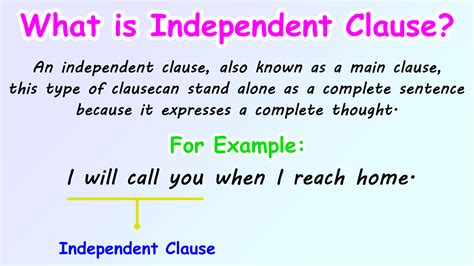
When exploring the fundamentals of sentence structure, understanding the concept of an independent clause is crucial. An independent clause, also known as a main clause, is a group of words that contains a subject and a predicate, expressing a complete thought. It can stand alone as a sentence because it contains both a subject (the doer of the action) and a verb (the action itself), and it expresses a complete thought. In this article, we will delve into five distinct ways to define and understand independent clauses, providing clarity on their role in constructing effective sentences.
Key Points
- Definition and basic structure of an independent clause
- Role of subject and predicate in forming an independent clause
- Distinguishing independent clauses from dependent clauses
- Using independent clauses to construct simple, compound, and complex sentences
- Importance of independent clauses in clear and effective communication
Understanding the Basic Structure

An independent clause is fundamentally composed of two main elements: a subject and a predicate. The subject is the noun or pronoun that the sentence is about, while the predicate tells us something about the subject and includes the verb. For example, in the sentence “The dog runs,” “The dog” is the subject, and “runs” is the predicate. This basic structure is essential for conveying complete thoughts and is the foundation upon which more complex sentences are built.
Subject and Predicate Relationship
The relationship between the subject and the predicate is critical in defining an independent clause. The subject performs the action described by the verb in the predicate. This relationship is what allows an independent clause to stand alone as a complete thought. Understanding this relationship is key to constructing grammatically correct and effective sentences.
| Component | Description |
|---|---|
| Subject | The noun or pronoun the sentence is about |
| Predicate | Tells us something about the subject and includes the verb |
Distinguishing from Dependent Clauses
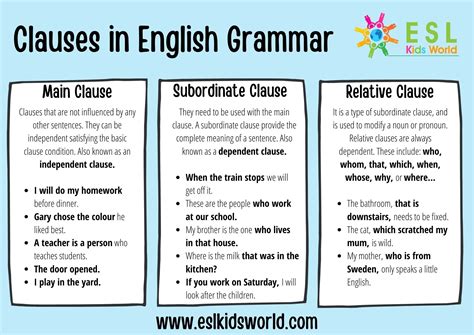
A crucial aspect of understanding independent clauses is being able to distinguish them from dependent clauses. A dependent clause, unlike an independent clause, cannot stand alone as a complete sentence. It does not express a complete thought, even though it has a subject and a verb, because it starts with a subordinating conjunction or relative pronoun that makes the clause unable to stand alone. For instance, “because I was tired” is a dependent clause because it cannot stand alone; it needs an independent clause to complete its meaning.
Constructing Sentences with Independent Clauses
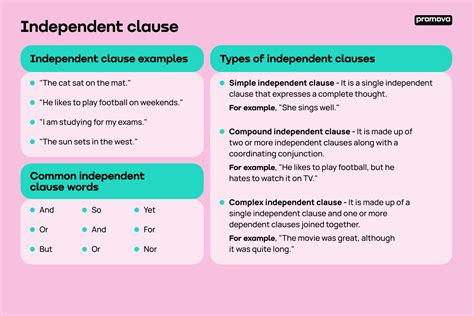
Independent clauses are the building blocks of sentences. A simple sentence consists of a single independent clause. For example, “She ate breakfast” is a simple sentence with one independent clause. Compound sentences are formed by joining two independent clauses with a conjunction, and complex sentences are formed by combining an independent clause with one or more dependent clauses. The ability to combine independent clauses in various ways allows for the creation of a wide range of sentence structures, each suited to different communicative purposes.
Importance in Clear Communication
The importance of independent clauses in clear and effective communication cannot be overstated. They provide the framework for expressing complete thoughts and ideas. Without a clear understanding of independent clauses, sentences can become confusing or incomplete, leading to misunderstandings. By mastering the use of independent clauses, individuals can improve their writing and speaking skills, ensuring that their messages are conveyed with clarity and precision.
What is the primary function of an independent clause in a sentence?
+The primary function of an independent clause is to express a complete thought or idea. It contains a subject and a predicate and can stand alone as a sentence.
How do you distinguish an independent clause from a dependent clause?
+An independent clause can stand alone as a complete thought and contains a subject and a verb. A dependent clause, on the other hand, cannot stand alone because it does not express a complete thought, often starting with a subordinating conjunction or relative pronoun.
What role do independent clauses play in constructing complex sentences?
+Independent clauses are essential in constructing complex sentences as they provide the main clause around which one or more dependent clauses are structured. The independent clause serves as the backbone of the sentence, providing the core idea, while the dependent clause(s) add additional information or modify the main clause.
In conclusion, understanding independent clauses is fundamental to effective communication in writing and speaking. By grasping the structure, function, and importance of independent clauses, individuals can enhance their ability to express thoughts clearly and construct sentences that convey meaning with precision and impact.