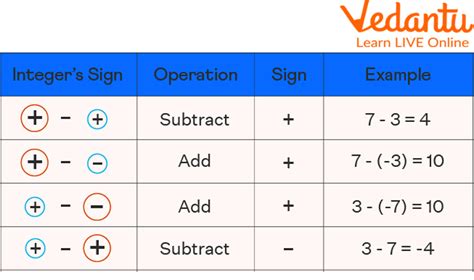
Subtracting negative integers is a fundamental concept in mathematics that can often seem confusing, especially for those new to the subject. However, understanding the basic principles behind this operation can make it straightforward and easy to apply in various mathematical contexts. In essence, subtracting a negative integer is equivalent to adding a positive integer. This principle is based on the concept that subtracting a negative is the same as adding a positive, due to the way numbers are arranged on the number line and how operations between them are defined.
Understanding the Basics of Negative Integers
Before diving into the subtraction of negative integers, it’s crucial to understand what negative integers are. Negative integers are whole numbers that are less than zero. They are represented on the number line to the left of zero. The concept of negative integers extends the set of integers (which includes…,-3, -2, -1, 0, 1, 2, 3,…) to allow for quantities less than zero. This extension is vital for performing arithmetic operations that result in values less than zero, such as debts, temperatures below freezing, or positions to the left of a reference point.
Key Principles for Subtracting Negative Integers
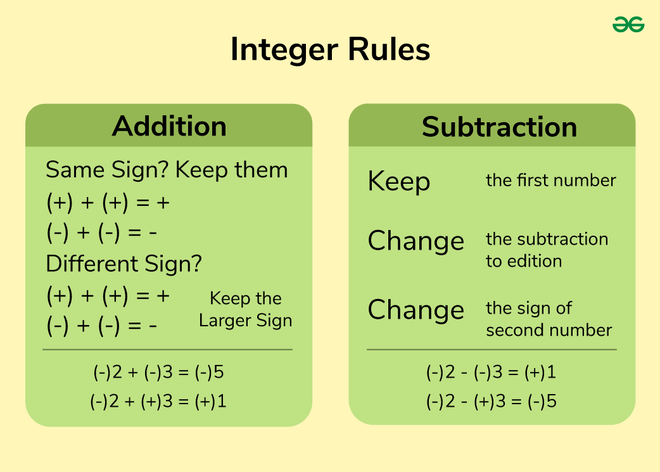
When subtracting a negative integer, you are essentially adding a positive integer. This can be remembered by the rule that subtracting a negative is the same as adding a positive. Mathematically, this can be represented as: a - (-b) = a + b, where ‘a’ and ‘b’ are integers. For example, if you want to subtract -5 from 3, you apply this rule: 3 - (-5) = 3 + 5 = 8.
Key Points
- Subtracting a negative integer is equivalent to adding its positive counterpart.
- The rule for subtracting a negative is: a - (-b) = a + b.
- Understanding the number line and the positioning of negative integers can help in visualizing these operations.
- Practice with examples can reinforce the concept and make it easier to apply in different scenarios.
- Subtracting negative integers is a fundamental skill required for more complex mathematical operations and real-world applications.
5 Ways to Approach Subtracting Negative Integers
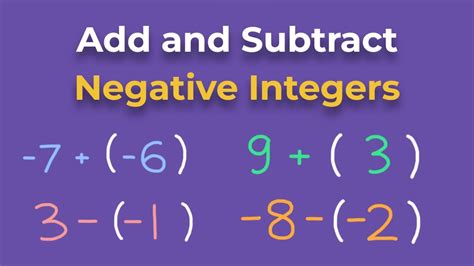
There are several approaches to understanding and performing the subtraction of negative integers, reflecting different learning styles and mathematical foundations. Here are five ways to approach this concept:
1. Number Line Approach
Using a number line can be a visual and intuitive way to understand the subtraction of negative integers. By moving to the right when adding and to the left when subtracting, and considering that moving to the right when subtracting a negative (since it’s equivalent to adding), you can visually represent the operation. For instance, starting at 0 and subtracting -3 means moving 3 units to the right, ending at 3.
2. Algebraic Approach
From an algebraic standpoint, the rule a - (-b) = a + b provides a straightforward method for subtracting negative integers. This rule can be applied universally, regardless of the specific values of ‘a’ and ‘b’. It’s a direct and efficient way to compute such operations without needing to visualize the number line.
3. Practical Application Approach
Learning through practical examples can make the concept more relatable and easier to grasp. For example, if you have 10 and someone owes you 5, subtracting the debt (-5) from your current amount is equivalent to adding 5 to your 10, resulting in 15. This approach helps in understanding the real-world implications of subtracting negative integers.
4. Pattern Recognition Approach
By observing patterns in the results of subtracting negative integers, one can develop an intuitive sense of how the operations work. For instance, recognizing that subtracting a larger negative number results in a larger positive increase can help in quickly estimating the outcomes of such operations without detailed calculation.
5. Conceptual Understanding Approach
Delving into the conceptual underpinnings of why subtracting a negative integer equates to adding a positive one can provide a deep understanding of the subject. This involves exploring the definitions of addition and subtraction in the context of negative numbers and how these operations are defined to maintain consistency across the number system.
| Operation | Example | Result |
|---|---|---|
| Subtracting a negative integer | 5 - (-3) | 5 + 3 = 8 |
| Subtracting a positive integer | 5 - 3 | 2 |
| Adding a negative integer | 5 + (-3) | 5 - 3 = 2 |
| Adding a positive integer | 5 + 3 | 8 |
In conclusion, subtracting negative integers, while initially seeming complex, can be approached through various methods, each catering to different learning preferences and mathematical backgrounds. By understanding the principle that subtracting a negative is equivalent to adding a positive, and applying this rule consistently, one can master this fundamental mathematical operation.
What is the rule for subtracting negative integers?
+The rule is: a - (-b) = a + b, where ‘a’ and ‘b’ are integers. This means subtracting a negative integer is the same as adding its positive counterpart.
How does the number line help in understanding the subtraction of negative integers?
+The number line provides a visual representation where moving to the right represents addition and moving to the left represents subtraction. Subtracting a negative integer means moving to the right, which is equivalent to adding a positive integer.
Can you provide an example of a real-world application of subtracting negative integers?
+Consider a scenario where you have a bank account with 100, and then you deposit 50 and later someone refunds you 20 that they owed you. If you initially had a -20 debt (which is equivalent to owing 20), subtracting this debt (or having it refunded) is like adding 20 to your account. So, if you started with 100, added 50 (making 150), and then had the -20 debt subtracted (which is adding 20), you end up with 150 + 20 = 170.