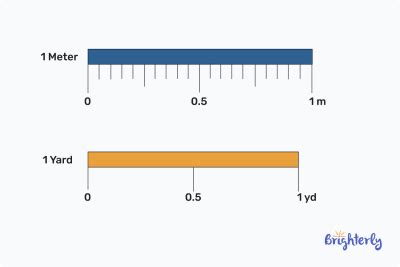
The distinction between a meter and a yard is a fundamental concept in the realm of measurement, particularly in the context of the metric and imperial systems. Understanding the difference between these two units of length is crucial for accurate conversions and applications in various fields, including science, engineering, and everyday life. In this article, we will delve into the definitions, historical backgrounds, and practical differences between meters and yards, providing a comprehensive overview for those seeking to grasp these essential units of measurement.
Definitions and Historical Background
A meter is defined as the fundamental unit of length in the International System of Units (SI), equivalent to the distance traveled by light in a vacuum during a time interval of 1⁄299,792,458 of a second. This definition, adopted in 1983, replaced the previous standard based on a physical prototype, ensuring a more precise and consistent measurement. The meter has its roots in the French Revolution, where it was introduced as part of the metric system aimed at standardizing measurements across France and eventually the world.
In contrast, a yard is a unit of length in the imperial and United States customary systems, defined as equal to 3 feet or 36 inches. Historically, the yard has its origins in the length of a stride or the distance from the tip of the nose to the end of the thumb of King Henry I of England, as legend has it. Over time, the definition has been standardized, but it remains a part of systems that have not been universally adopted like the metric system.
Conversion Between Meters and Yards
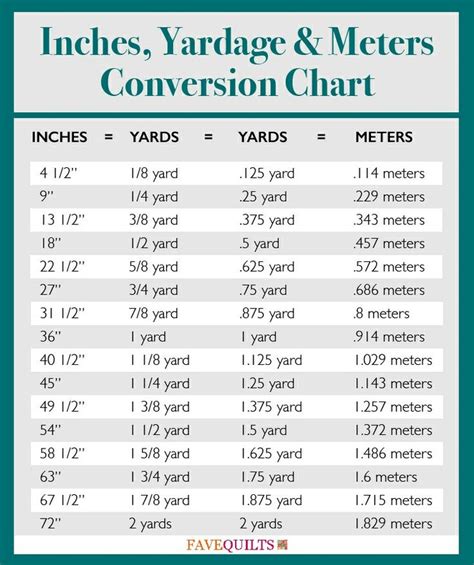
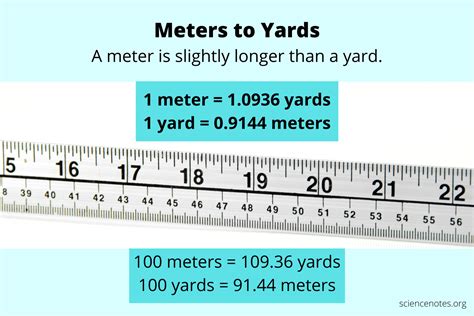
Given that 1 yard equals 3 feet and 1 meter equals approximately 3.28084 feet, converting between meters and yards involves a straightforward calculation. To convert meters to yards, one would divide the number of meters by 0.9144 (since 1 yard = 0.9144 meters), and to convert yards to meters, one would multiply the number of yards by 0.9144. Understanding these conversion factors is vital for international trade, science, and any activity requiring precise length measurements across different systems.
| Unit | Conversion Factor |
|---|---|
| 1 Meter | ≈ 1.09361 Yards |
| 1 Yard | ≈ 0.9144 Meters |
Practical Applications and Differences
In practical terms, the difference between meters and yards can significantly impact various activities, from construction and sports to scientific research. For instance, in track and field events, distances are often measured in meters for international competitions, adhering to the global standard. In contrast, in American football, yards are the standard unit, reflecting the sport’s origins and primary audience in the United States.
Furthermore, the precision offered by the metric system, with its base unit of the meter, is particularly advantageous in scientific and engineering applications where small discrepancies can have considerable effects. The use of meters also simplifies calculations and conversions within the SI system, as all other units of length (such as kilometers and millimeters) are derived from it.
Key Points
- The meter is the fundamental unit of length in the metric system, defined precisely in terms of the speed of light.
- A yard is a unit of length in the imperial and US customary systems, equal to 3 feet or 36 inches.
- Conversions between meters and yards are necessary for international communication and trade, using the factor 1 yard ≈ 0.9144 meters.
- The choice between meters and yards depends on the context, with meters preferred in scientific and international applications, and yards sometimes used in everyday applications in certain countries.
- The precision and universality of the meter make it particularly suitable for scientific research and global communication.
Future Implications and Adoption
As the world becomes increasingly interconnected, the importance of a universal measurement system, such as the metric system with the meter as its base unit of length, cannot be overstated. Efforts to adopt the metric system globally continue, with the aim of simplifying international trade, scientific collaboration, and everyday communication. Understanding and appreciating the differences between meters and yards, as well as other units within different systems, will remain crucial for navigating this transition and ensuring precision in all applications.
In conclusion, the distinction between meters and yards is not merely a matter of different units but reflects broader systems of measurement with their own histories, advantages, and spheres of influence. By grasping these differences and the contexts in which each is used, individuals can better navigate the complex landscape of international measurement, contributing to more effective communication and collaboration across borders and disciplines.
What is the primary difference between a meter and a yard?
+The primary difference lies in their definitions and the systems they belong to: the meter is the base unit of length in the metric system, while the yard is a unit of length in the imperial and US customary systems.
How do I convert meters to yards?
+To convert meters to yards, divide the number of meters by 0.9144.
Why is the meter preferred in scientific applications?
+The meter is preferred due to its precision, the universality of the metric system, and the ease of conversions within the SI system.