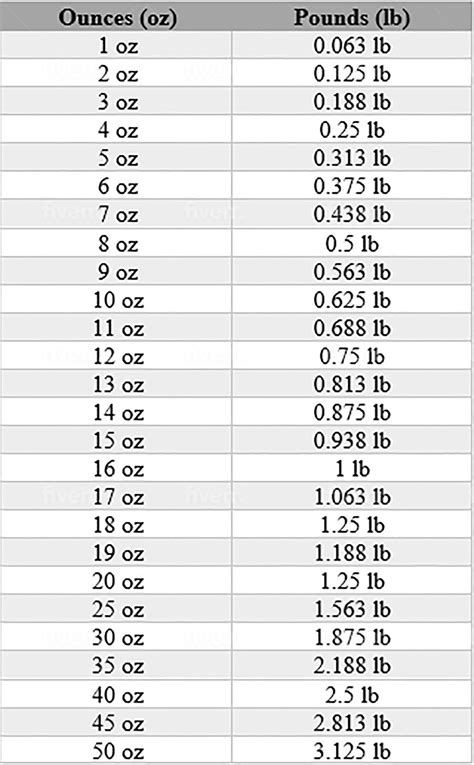
The relationship between ounces and pounds is a fundamental concept in the United States customary and British imperial systems of measurement. Understanding this relationship is crucial for various everyday applications, including cooking, commerce, and science. One of the most basic and essential conversions to know is that 1 pound is equal to 16 ounces. This conversion factor is widely used and accepted, making it a cornerstone of weight measurement in these systems.
Historical Context and Development
The origins of the pound and ounce date back to ancient times, with roots in the Roman libra (pound) and uncia (ounce). Over the centuries, these units of measurement have evolved, with various countries adopting slightly different standards. The most commonly used standards today are the avoirdupois system for general commerce and the troy system for precious metals and gems. In the avoirdupois system, which is the focus of the 16oz to 1-pound conversion, 1 pound is divided into 16 equal parts called ounces.
Avoirdupois System Basics
The avoirdupois system is used for everyday weight measurements in many English-speaking countries. It includes units such as the ounce (oz), pound (lb), and ton. The basic conversion rates within this system are as follows: 1 pound equals 16 ounces, 1 ounce equals 16 drachms (though drachms are less commonly used), and 1 ton equals 2,000 pounds. Understanding these relationships is essential for accurately converting between different units of weight.
| Unit of Measurement | Conversion Rate |
|---|---|
| 1 Pound (lb) | 16 Ounces (oz) |
| 1 Ounce (oz) | 28.3495 Grams (g) |
| 1 Ton | 2,000 Pounds (lb) |

Practical Applications
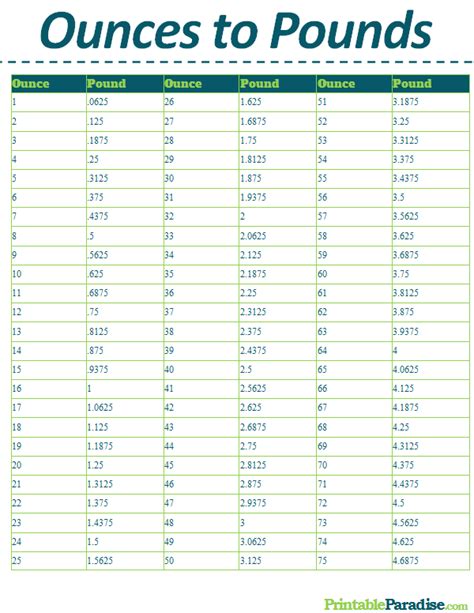
The conversion of 16 ounces to 1 pound has numerous practical applications. In cooking, recipes often list ingredients in ounces or pounds, requiring the cook to understand these conversions to accurately measure out the ingredients. In commerce, especially in retail and wholesale, understanding weight conversions is critical for pricing, inventory management, and shipping calculations. Moreover, in science and technology, precise measurements are essential, and conversions between different units of measurement are frequently necessary.
Conversion Challenges and Solutions
Despite the straightforward nature of the 16oz to 1-pound conversion, challenges can arise, especially when dealing with fractions of pounds or ounces. For example, converting 0.5 pounds to ounces requires multiplying 0.5 by 16, resulting in 8 ounces. Similarly, converting 8 ounces to pounds involves dividing 8 by 16, which equals 0.5 pounds. Utilizing conversion charts or calculators can simplify these processes, especially for more complex conversions involving other units.
Key Points
- The conversion rate of 1 pound to 16 ounces is a fundamental principle in the avoirdupois system of measurement.
- Understanding this conversion is crucial for various applications, including cooking, commerce, and science.
- The avoirdupois system includes units such as the ounce, pound, and ton, with defined conversion rates between them.
- Converting between the customary and metric systems requires knowledge of conversion factors, such as 1 ounce being approximately equal to 28.3495 grams.
- Practical applications of the 16oz to 1-pound conversion include recipe preparation, inventory management, and scientific measurements.
In conclusion, the relationship between ounces and pounds, specifically the conversion of 16 ounces to 1 pound, is a foundational element of measurement in the United States customary and British imperial systems. This conversion has broad implications and applications across different fields, from everyday cooking and shopping to scientific research and international trade. Mastering these conversions not only enhances one's ability to work accurately with different units of measurement but also facilitates smoother interactions across cultures and industries that rely on these systems.
What is the basic unit conversion in the avoirdupois system regarding pounds and ounces?
+In the avoirdupois system, 1 pound is equal to 16 ounces. This is a fundamental conversion used in various applications, including commerce, cooking, and science.
How does the metric system relate to the customary system in terms of ounces and pounds?
+The metric system and the customary system are two different systems of measurement. While the customary system uses units like ounces and pounds, the metric system uses grams and kilograms. 1 ounce is approximately equal to 28.3495 grams, and 1 pound is approximately equal to 453.592 grams.
What are some practical applications of understanding the 16oz to 1-pound conversion?
+Practical applications include cooking (where recipes often list ingredients in ounces or pounds), commerce (for pricing and inventory management), and science (where precise measurements are crucial). Understanding this conversion facilitates accurate measurements and calculations in these and other fields.