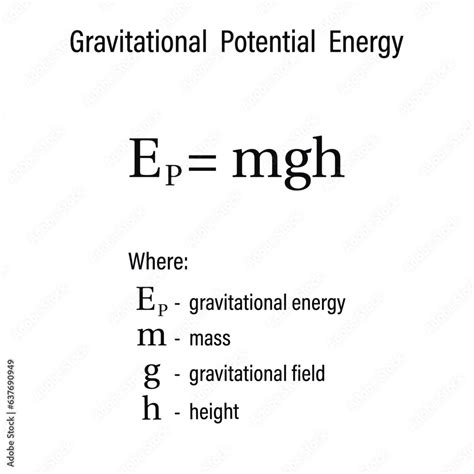
Gravitational energy, a fundamental concept in physics, has far-reaching implications across various fields, from astronomy to engineering. It is the energy an object possesses due to its position within a gravitational field. The strength of this field depends on the mass of the objects involved and the distance between them. Understanding gravitational energy is crucial for explaining phenomena such as the orbits of planets, the behavior of stars, and even the potential for harnessing energy from gravitational forces. In this article, we will explore five ways gravitational energy impacts our understanding and interaction with the universe.
Key Points
- Gravitational energy plays a crucial role in the formation and stability of celestial bodies.
- The gravitational binding energy of a star determines its life cycle and eventual death.
- Gravitational waves, a prediction of Einstein's theory of general relativity, offer a new window into the universe.
- Gravitational energy can be harnessed in innovative ways, such as through gravitational potential energy in tall structures.
- Research into gravitational energy has significant implications for our understanding of the universe's evolution and the search for renewable energy sources.
1. Celestial Mechanics and Orbits

The study of gravitational energy is essential for understanding celestial mechanics, which deals with the motions of celestial objects. The gravitational potential energy of an object in a gravitational field is given by the formula U = -\frac{GMm}{r}, where G is the gravitational constant, M and m are the masses of the two objects, and r is the distance between their centers. This concept is vital for calculating the orbits of planets, moons, and artificial satellites. For instance, the gravitational energy between the Earth and the Moon not only keeps the Moon in orbit but also causes the tides on Earth, illustrating the significant effects of gravitational interactions on our daily lives.
Gravitational Binding Energy
Gravitational binding energy is the energy required to disassemble a celestial body, such as a star or a planet, into its constituent parts, which would then be infinitely separated. This concept is crucial for understanding the life cycles of stars. For example, the gravitational binding energy of a star determines its ability to sustain nuclear fusion in its core. As a star ages and its fuel is depleted, changes in its gravitational binding energy can lead to significant alterations in its structure and eventual death, whether through a supernova explosion or the collapse into a black hole.
| Celestial Body | Gravitational Binding Energy |
|---|---|
| Earth | $2.24 \times 10^{32}$ J |
| Sun | $3.81 \times 10^{41}$ J |
2. Gravitational Waves

Gravitational waves are ripples in the fabric of spacetime produced by violent cosmic events, such as the collision of two black holes or neutron stars. Predicted by Albert Einstein’s theory of general relativity over a century ago, these waves were first directly detected in 2015 by the Laser Interferometer Gravitational-Wave Observatory (LIGO). The detection of gravitational waves has opened a new window into the universe, allowing us to study cosmic phenomena in ways previously impossible. This area of research not only expands our understanding of gravity and spacetime but also provides insights into the most extreme objects in the universe.
Harnessing Gravitational Energy
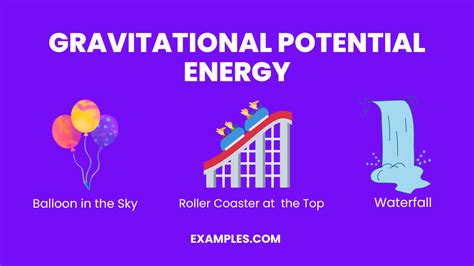
While the direct harnessing of gravitational energy on a large scale remains a subject of speculation and research, there are innovative approaches to utilizing gravitational potential energy. For example, tall structures like skyscrapers or specialized towers could potentially be used to generate electricity by harnessing the gravitational potential energy of descending masses. Although the efficiency and practicality of such systems are still being explored, they represent creative ways to think about energy production in the context of gravitational forces.
3. Implications for Renewable Energy
The pursuit of understanding and harnessing gravitational energy has broader implications for the search for renewable and sustainable energy sources. As the world continues to grapple with the challenges of climate change and energy security, exploring unconventional sources of energy, including those related to gravitational forces, becomes increasingly important. While gravitational energy may not provide a direct solution to our current energy needs, the advancements in technology and understanding derived from its study could lead to breakthroughs in other areas of renewable energy research.
Forward-Looking Perspectives
Looking ahead, research into gravitational energy and its applications is poised to continue making significant contributions to our understanding of the universe and the laws of physics. From the formation of galaxies to the life cycles of stars, gravitational energy plays a pivotal role. Furthermore, the technological innovations driven by the pursuit of gravitational wave detection and the potential harnessing of gravitational energy will likely have spin-off benefits across various scientific and engineering disciplines, underscoring the interconnected nature of scientific inquiry and technological advancement.
What is gravitational energy, and how does it affect celestial bodies?
+Gravitational energy is the energy an object possesses due to its position within a gravitational field. It significantly affects the orbits, formation, and stability of celestial bodies, influencing phenomena such as planetary orbits and the life cycles of stars.
How are gravitational waves detected, and what do they tell us about the universe?
+Gravitational waves are detected using highly sensitive instruments like LIGO, which measure the minute distortions these waves cause in spacetime. Their detection has confirmed a key prediction of general relativity and offers a new way to observe cosmic events, such as black hole mergers, providing insights into the universe’s most extreme phenomena.
Can gravitational energy be harnessed for practical use, and what are the challenges involved?
+While the direct harnessing of gravitational energy for practical use is still largely speculative, concepts like generating electricity from gravitational potential energy in tall structures are being explored. The main challenges include the efficiency of energy conversion, the scalability of such systems, and the technological hurdles in designing and building structures that can effectively harness gravitational energy.