The Spanish language is known for its complex grammar and conjugation rules, and one of the most commonly used verbs in Spanish is "estar". Estar is a verb that means "to be" and is used to describe the current state or condition of something or someone. Mastering the estar conjugation is essential for anyone learning Spanish, as it is used in a wide range of situations and contexts. In this article, we will explore the different ways to conjugate the verb estar, including the present, preterite, imperfect, and future tenses.
Understanding the Basics of Estar Conjugation
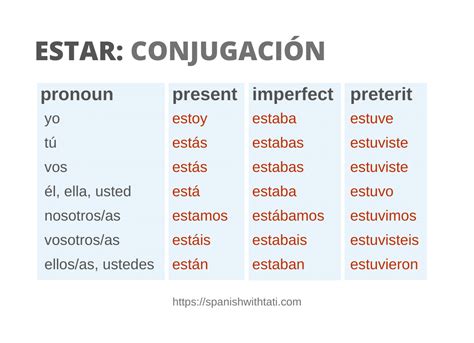
Before diving into the different tenses, it’s essential to understand the basics of estar conjugation. The verb estar is a irregular verb, which means that its conjugation does not follow the usual patterns of regular verbs. However, with practice and patience, you can master the estar conjugation and improve your Spanish language skills. The present tense of estar is conjugated as follows: yo estoy, tú estás, él/ella/usted está, nosotros/nosotras estamos, vosotros/vosotras estáis, and ellos/ellas/ustedes están.
Key Points
- The verb estar is used to describe the current state or condition of something or someone.
- The present tense of estar is conjugated as follows: yo estoy, tú estás, él/ella/usted está, nosotros/nosotras estamos, vosotros/vosotras estáis, and ellos/ellas/ustedes están.
- The preterite tense of estar is used to describe completed actions in the past.
- The imperfect tense of estar is used to describe ongoing or repeated actions in the past.
- The future tense of estar is used to describe future actions or events.
Conjugating Estar in the Present Tense
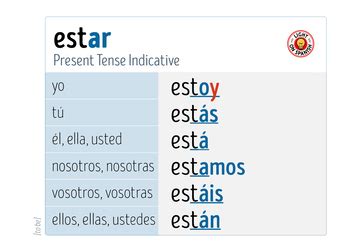
The present tense of estar is used to describe the current state or condition of something or someone. For example, “yo estoy cansado” means “I am tired”. The conjugation of estar in the present tense is as follows:
| Subject | Conjugation |
|---|---|
| Yo | estoy |
| Tú | estás |
| Él/Ella/Usted | está |
| Nosotros/Nosotras | estamos |
| Vosotros/Vosotras | estáis |
| Ellos/Ellas/Ustedes | están |
Conjugating Estar in the Preterite Tense
The preterite tense of estar is used to describe completed actions in the past. For example, “yo estuve cansado” means “I was tired”. The conjugation of estar in the preterite tense is as follows:
| Subject | Conjugation |
|---|---|
| Yo | estuve |
| Tú | estuviste |
| Él/Ella/Usted | estuvo |
| Nosotros/Nosotras | estuvimos |
| Vosotros/Vosotras | estuvisteis |
| Ellos/Ellas/Ustedes | estuvieron |
Conjugating Estar in the Imperfect Tense
The imperfect tense of estar is used to describe ongoing or repeated actions in the past. For example, “yo estaba cansado” means “I was tired”. The conjugation of estar in the imperfect tense is as follows:
| Subject | Conjugation |
|---|---|
| Yo | estaba |
| Tú | estabas |
| Él/Ella/Usted | estaba |
| Nosotros/Nosotras | estábamos |
| Vosotros/Vosotras | estabais |
| Ellos/Ellas/Ustedes | estaban |
Conjugating Estar in the Future Tense
The future tense of estar is used to describe future actions or events. For example, “yo estaré cansado” means “I will be tired”. The conjugation of estar in the future tense is as follows:
| Subject | Conjugation |
|---|---|
| Yo | estaré |
| Tú | estarás |
| Él/Ella/Usted | estará |
| Nosotros/Nosotras | estaremos |
| Vosotros/Vosotras | estaréis |
| Ellos/Ellas/Ustedes | estarán |
What is the difference between the verbs ser and estar?
+The verb ser is used to describe permanent or inherent qualities, while the verb estar is used to describe temporary or changing conditions.
How do I conjugate the verb estar in the present tense?
+The conjugation of estar in the present tense is as follows: yo estoy, tú estás, él/ella/usted está, nosotros/nosotras estamos, vosotros/vosotras estáis, and ellos/ellas/ustedes están.
What is the imperfect tense of estar used for?
+The imperfect tense of estar is used to describe ongoing or repeated actions in the past.
In conclusion, mastering the estar conjugation is essential for anyone learning Spanish. With practice and patience, you can improve your Spanish language skills and become more confident in your ability to communicate effectively. Remember to focus on the different tenses and conjugations, and don’t be afraid to make mistakes. ¡Buena suerte!