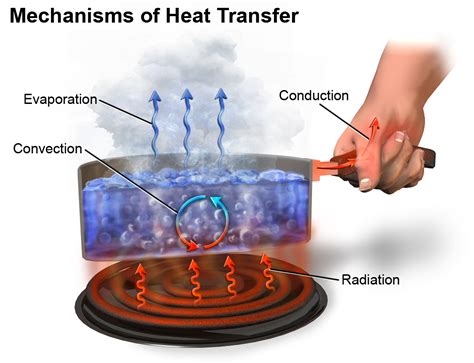
Convection is a fundamental concept in physics and engineering, playing a crucial role in the transfer of heat and energy. It is a process where heat is transferred through the movement of fluids, which can be liquids or gases. This movement is driven by differences in density, which are caused by variations in temperature. As a fluid is heated, it becomes less dense than its surroundings and rises, creating a cycle of circulation that facilitates the transfer of heat. Convection can be observed in various natural phenomena and is also harnessed in numerous technological applications.
Types of Convection

There are two primary types of convection: natural convection and forced convection. Natural convection occurs when the movement of fluids is driven solely by the buoyancy forces resulting from density differences. An example of natural convection is the rising of warm air in a room, which is then replaced by cooler air moving in to take its place. Forced convection, on the other hand, involves the use of external forces, such as fans or pumps, to enhance the movement of fluids and thereby increase the rate of heat transfer. This can be seen in the cooling systems of electronic devices, where fans are used to blow air over heat sinks to dissipate heat more efficiently.
Natural Convection Examples
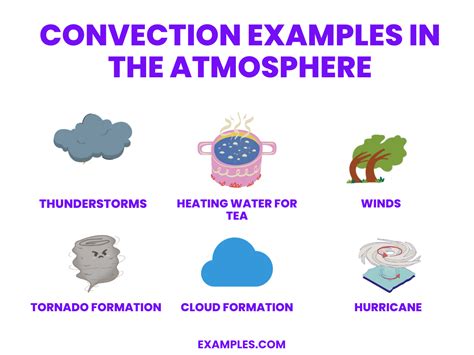
Natural convection is ubiquitous in nature and is responsible for many of the phenomena we observe. One of the most dramatic examples is the formation of thunderstorms. As the sun heats the ground, it warms the air closest to the Earth’s surface. This warm air, being less dense than the cooler air above it, rises and cools, eventually condensing into clouds. If conditions are right, these clouds can develop into thunderstorms. Another example of natural convection can be seen in the movement of ocean currents. The thermohaline circulation, for instance, is a global circulation of water that is driven by changes in temperature and salinity, which affect the density of seawater.
| Type of Convection | Description | Example |
|---|---|---|
| Natural Convection | Driven by buoyancy forces | Rising of warm air in a room |
| Forced Convection | Enhanced by external forces | Cooling systems in electronic devices |
Forced Convection Examples
Forced convection is widely used in engineering and technology to enhance the efficiency of heat transfer. In the automotive industry, for example, radiators use forced convection to cool the engine. A pump circulates coolant through the engine and then through the radiator, where it is cooled by air flowing over the radiator’s surface, which is often facilitated by a fan. Similarly, in aerospace engineering, forced convection is used in the cooling systems of aircraft and spacecraft to manage the high temperatures generated during flight and operation in space.
Applications of Convection
The applications of convection are diverse and range from large-scale industrial processes to everyday household appliances. In heating, ventilation, and air conditioning (HVAC) systems, convection plays a key role in the distribution of warm or cool air throughout buildings. Additionally, convection ovens cook food more evenly and quickly than traditional ovens by using fans to circulate hot air around the food. Understanding and manipulating convection is also critical in the field of materials science, where it is used to grow crystals and manufacture various types of materials.
Key Points
- Convection is a process of heat transfer through the movement of fluids.
- There are two main types of convection: natural and forced convection.
- Natural convection occurs due to density differences caused by temperature variations.
- Forced convection involves the use of external forces to enhance fluid movement and heat transfer.
- Convection has numerous applications in engineering, technology, and natural phenomena.
In conclusion, convection is a vital process that underpins many natural and technological phenomena. Its understanding and application are crucial for advancing various fields of science and engineering, from meteorology and oceanography to materials science and aerospace engineering. By recognizing the principles of convection and how it operates in different contexts, we can develop more efficient systems, predict and manage environmental changes, and harness its power to improve our daily lives.
What is the primary driver of natural convection?
+The primary driver of natural convection is the difference in density among fluids due to variations in temperature.
How does forced convection differ from natural convection?
+Forced convection differs from natural convection in that it uses external forces, such as fans or pumps, to enhance the movement of fluids and increase the rate of heat transfer.
What are some common applications of convection in everyday life?
+Common applications of convection include HVAC systems, convection ovens, and the cooling systems of electronic devices and vehicles.