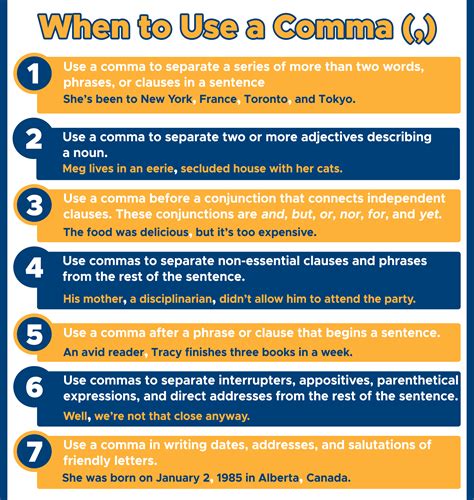
The comma is a punctuation mark that is often used to separate items in a list, to set off nonessential clauses, and to indicate pauses in sentences. However, it can be tricky to use correctly, and there are several common mistakes that people make when using commas.
Basic Rules for Using Commas
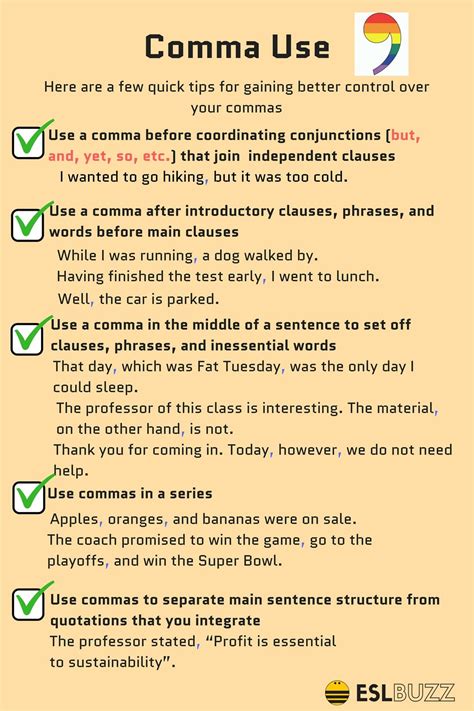
There are several basic rules for using commas, including: using commas to separate items in a list, using commas to set off nonessential clauses, and using commas to indicate pauses in sentences. For example, if you are listing three or more items, you should use commas to separate each item, like this: apples, bananas, and oranges. You should also use commas to set off nonessential clauses, which are clauses that provide additional information but are not essential to the meaning of the sentence. For instance, the phrase “who lives in New York” is a nonessential clause in the sentence “My friend, who lives in New York, is a doctor.”
Using Commas to Separate Items in a List
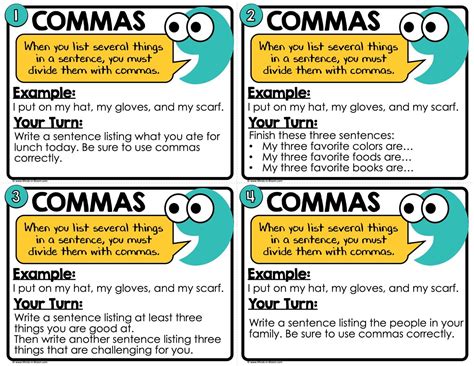
When listing three or more items, it is generally recommended to use commas to separate each item, and to use “and” before the last item. This is known as the Oxford comma, or the serial comma. For example: “I like eating apples, bananas, and oranges.” However, some style guides, such as the AP Stylebook, recommend against using the Oxford comma, unless it is necessary to avoid confusion. In that case, the sentence would be written as: “I like eating apples, bananas and oranges.”
Using Commas to Set Off Nonessential Clauses
Nonessential clauses are clauses that provide additional information but are not essential to the meaning of the sentence. These clauses should be set off with commas, unless they are essential to the meaning of the sentence. For example: “The book, which is on the bestseller list, is a thrilling page-turner.” In this sentence, the clause “which is on the bestseller list” is nonessential, because the sentence still makes sense without it. However, if the clause is essential to the meaning of the sentence, it should not be set off with commas. For instance: “The book that is on the bestseller list is a thrilling page-turner.” In this sentence, the clause “that is on the bestseller list” is essential, because it specifies which book is being referred to.
| Type of Clause | Example |
|---|---|
| Nonessential clause | The book, which is on the bestseller list, is a thrilling page-turner. |
| Essential clause | The book that is on the bestseller list is a thrilling page-turner. |
Common Mistakes to Avoid
There are several common mistakes that people make when using commas, including: using commas to separate two independent clauses, using commas to set off essential clauses, and using too many commas in a sentence. For example, the sentence “I went to the store, and I bought some milk” is incorrect, because it uses a comma to separate two independent clauses. Instead, the sentence should be written as: “I went to the store, and I bought some milk” should be written as two separate sentences: “I went to the store. I bought some milk.” Alternatively, the sentence could be written as: “I went to the store and bought some milk,” without a comma.
Using Commas to Separate Independent Clauses
When two independent clauses are joined by a conjunction, such as “and” or “but,” a comma is generally used before the conjunction. However, if the two clauses are short and closely related, a comma may not be necessary. For example: “I went to the store and bought some milk.” In this sentence, the two clauses are short and closely related, so a comma is not necessary. However, if the clauses are longer or more complex, a comma may be necessary to avoid confusion. For instance: “I went to the store, and I bought some milk, eggs, and bread.” In this sentence, the comma before “and” helps to separate the two independent clauses and avoid confusion.
Key Points
- Use commas to separate items in a list, and to set off nonessential clauses.
- Use the Oxford comma, or serial comma, to separate items in a list, unless it is not necessary to avoid confusion.
- Set off nonessential clauses with commas, unless they are essential to the meaning of the sentence.
- Avoid using commas to separate two independent clauses, unless they are joined by a conjunction.
- Use commas to indicate pauses in sentences, and to separate clauses and phrases.
Conclusion
In conclusion, using commas correctly is an important part of writing clearly and effectively. By following the basic rules for using commas, and avoiding common mistakes, writers can ensure that their writing is easy to understand and free of errors. Whether you are writing a letter, an email, or a report, using commas correctly can help you to communicate your message more effectively, and to avoid confusion. By taking the time to learn the rules for using commas, and to practice using them correctly, writers can improve their writing skills and become more effective communicators.
What is the Oxford comma, and when should it be used?
+The Oxford comma, also known as the serial comma, is a comma used after the penultimate item in a list of three or more items. It should be used to avoid confusion, and to make the list clearer. For example: “I like eating apples, bananas, and oranges.” In this sentence, the Oxford comma helps to separate the items in the list and avoid confusion.
How do I know when to use a comma to separate two independent clauses?
+A comma should be used to separate two independent clauses when they are joined by a conjunction, such as “and” or “but.” However, if the two clauses are short and closely related, a comma may not be necessary. For example: “I went to the store and bought some milk.” In this sentence, the two clauses are short and closely related, so a comma is not necessary. However, if the clauses are longer or more complex, a comma may be necessary to avoid confusion.
What is a nonessential clause, and how should it be set off?
+A nonessential clause is a clause that provides additional information but is not essential to the meaning of the sentence. It should be set off with commas, unless it is essential to the meaning of the sentence. For example: “The book, which is on the bestseller list, is a thrilling page-turner.” In this sentence, the clause “which is on the bestseller list” is nonessential, because the sentence still makes sense without it.