The Virginia Plan, also known as the Randolph Plan, was a pivotal proposal presented by Edmund Randolph, the Governor of Virginia, at the Constitutional Convention in Philadelphia on May 29, 1787. This plan played a crucial role in shaping the United States' federal government, as it outlined a framework for a strong central authority and a system of representation that would balance the interests of large and small states alike. Randolph's proposal was the first comprehensive plan to be put forth at the convention, and it served as a foundation for the subsequent discussions and debates that ultimately led to the creation of the United States Constitution.
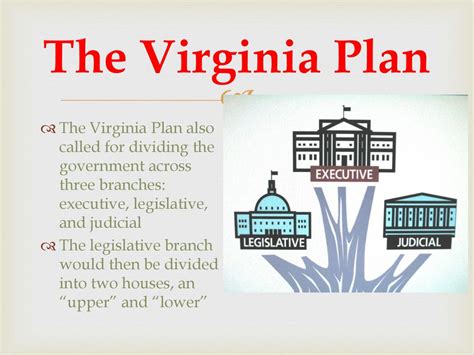
The Virginia Plan consisted of 15 resolutions, which aimed to establish a federal system with three branches of government: legislative, executive, and judicial. The plan called for a bicameral legislature, with both houses being elected by the people, either directly or indirectly. The lower house, known as the House of Representatives, would have its members elected by the people for a term of three years, while the upper house, known as the Senate, would have its members chosen by the state legislatures for a term of seven years. This bicameral system was designed to provide a balance between the interests of the people and the states, as well as to prevent any one branch of government from becoming too powerful.
Key Components of the Virginia Plan
The Virginia Plan also proposed the creation of a strong executive branch, headed by a single president who would serve as the commander-in-chief of the armed forces and have the power to negotiate treaties and appoint federal officials. The plan also called for the establishment of a national judiciary, which would have the power to decide cases involving federal laws and the Constitution. The Virginia Plan's emphasis on a strong central government was a significant departure from the Articles of Confederation, which had proven inadequate for managing the newly independent nation.
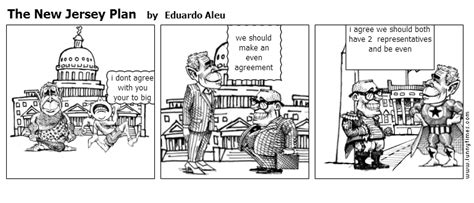
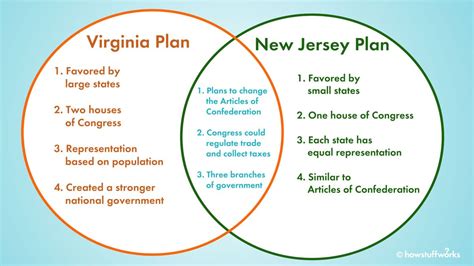
One of the most contentious aspects of the Virginia Plan was its proposal for representation in the legislature. The plan called for representation to be based on population, with larger states having more representatives in both the House and the Senate. This proposal was met with resistance from smaller states, which feared that they would be overshadowed by their larger counterparts. The issue of representation would ultimately be resolved through the Great Compromise, also known as the Connecticut Compromise, which established the current system of equal representation in the Senate and proportional representation in the House of Representatives.
Historical Context and Evolution
The Virginia Plan was not created in a vacuum; it was the product of a long process of political and social development in the American colonies. The plan's emphasis on federalism and representation reflected the colonists' experiences with British rule and their desire for a more balanced system of government. The plan also drew on the ideas of Enlightenment thinkers, such as John Locke and Montesquieu, who had written extensively on the importance of separation of powers and representation in a republican government.
Over time, the Virginia Plan has been subject to various interpretations and critiques. Some have seen it as a bold attempt to create a strong central government, while others have viewed it as an elitist proposal that failed to adequately represent the interests of smaller states and ordinary citizens. Despite these criticisms, the Virginia Plan remains an important milestone in American history, as it laid the groundwork for the creation of the United States Constitution and the federal system of government that has endured to this day.
| Component | Description |
|---|---|
| Legislative Branch | Bicameral legislature with House of Representatives and Senate |
| Executive Branch | Single president serving as commander-in-chief and head of state |
| Judicial Branch | National judiciary with power to decide cases involving federal laws and Constitution |
| Representation | Representation based on population, with larger states having more representatives |
Key Points
- The Virginia Plan was a comprehensive proposal for a federal system of government presented at the Constitutional Convention in 1787.
- The plan called for a bicameral legislature, a strong executive branch, and a national judiciary.
- Representation in the legislature was to be based on population, with larger states having more representatives.
- The plan was subject to various critiques and interpretations, but it laid the groundwork for the creation of the United States Constitution.
- The Virginia Plan's emphasis on federalism and representation reflects a deep understanding of the complexities of governance and the need for a balanced system.
In conclusion, the Virginia Plan was a pivotal moment in American history, as it proposed a framework for a federal system of government that would balance the interests of large and small states alike. While the plan was subject to various critiques and interpretations, it laid the groundwork for the creation of the United States Constitution and the federal system of government that has endured to this day. As we continue to navigate the complexities of governance and representation, the Virginia Plan remains an important reminder of the need for a balanced system that takes into account the interests of different states and citizens.
What was the main objective of the Virginia Plan?
+The main objective of the Virginia Plan was to establish a federal system of government with three branches: legislative, executive, and judicial.
How did the Virginia Plan propose to balance the interests of large and small states?
+The Virginia Plan proposed to balance the interests of large and small states through a bicameral legislature, with representation in the House of Representatives based on population and equal representation in the Senate.
What was the significance of the Virginia Plan in American history?
+The Virginia Plan was significant in American history because it laid the groundwork for the creation of the United States Constitution and the federal system of government that has endured to this day.