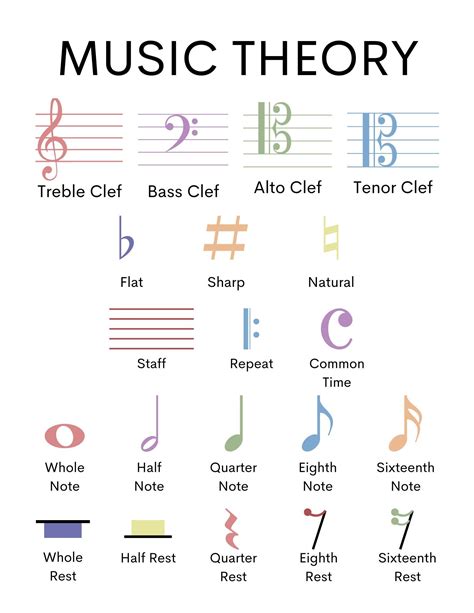
Music theory is the foundation upon which all music is built. It provides a framework for understanding the language of music, including the basics of pitch, rhythm, melody, harmony, and structure. For musicians, composers, and music enthusiasts alike, a solid grasp of music theory is essential for creating, performing, and appreciating music. In this article, we will delve into the fundamentals of music theory, exploring the key concepts and principles that underlie the world of music.
Key Points
- Understanding the basics of pitch, including notes, scales, and intervals
- Recognizing the importance of rhythm and meter in music
- Learning about melody and harmony, including chord progressions and voice leading
- Exploring musical structure, including form, phrasing, and articulation
- Applying music theory principles to real-world musical examples
Understanding Pitch
Pitch is a fundamental aspect of music, referring to the perceived highness or lowness of a sound. The Western musical tradition recognizes 12 distinct pitches within an octave, represented by the letters A, A#, B, C, C#, D, D#, E, F, F#, G, and G#. These pitches can be arranged in various scales, including major, minor, and modal scales. Intervals, which are the building blocks of harmony, are created by combining two or more pitches. Understanding intervals is crucial for composing and improvising music, as well as for analyzing and appreciating the music of others.
Scales and Modes
Scales and modes are essential components of music theory, providing a framework for understanding the relationships between pitches. The major and minor scales are the most commonly used scales in Western music, with the major scale consisting of seven natural pitches within an octave and the minor scale consisting of seven pitches with a flatted third and seventh scale degree. Modes, on the other hand, are scales that use the same pitches as a major or minor scale but with a different tonal center. For example, the Dorian mode uses the same pitches as the C major scale but with a tonal center of D. Understanding scales and modes is vital for creating music that sounds coherent and expressive.
| Scale Type | Pitch Pattern |
|---|---|
| Major | W-W-H-W-W-W-H (whole-whole-half-whole-whole-whole-half) |
| Natural Minor | W-H-W-W-H-W-W (whole-half-whole-whole-half-whole-whole) |
| Dorian | W-H-W-W-W-H-W (whole-half-whole-whole-whole-half-whole) |
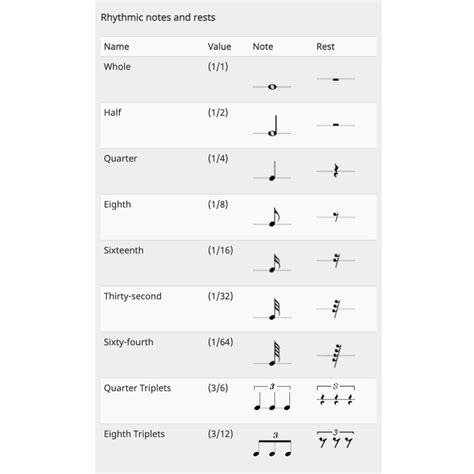
Rhythm and Meter

Rhythm and meter are essential elements of music, providing a sense of forward motion and structure. Rhythm refers to the pattern of duration and accentuation of sounds, while meter refers to the organization of rhythm into repeating patterns of strong and weak beats. Time signatures, which consist of a top number and a bottom number, indicate the meter of a piece and help musicians keep track of the rhythm. Common time signatures include 4⁄4, 3⁄4, and 6⁄8, each with its own unique rhythmic feel.
Meter and Time Signatures
Meter and time signatures are critical components of music theory, as they provide a framework for understanding the rhythmic structure of a piece. The top number of a time signature indicates the number of beats in a measure, while the bottom number indicates the type of note that receives one beat. For example, a time signature of 4⁄4 indicates that there are four beats in a measure and that the quarter note receives one beat. Understanding meter and time signatures is vital for performing music accurately and expressively.
What is the difference between rhythm and meter?
+Rhythm refers to the pattern of duration and accentuation of sounds, while meter refers to the organization of rhythm into repeating patterns of strong and weak beats.
How do time signatures affect the rhythm of a piece?
+Time signatures indicate the meter of a piece and help musicians keep track of the rhythm. The top number of a time signature indicates the number of beats in a measure, while the bottom number indicates the type of note that receives one beat.
Melody and Harmony
Melody and harmony are interdependent elements of music, working together to create a cohesive and expressive sound. Melody refers to the succession of pitches heard in a musical line, while harmony refers to the combination of multiple pitches sounding simultaneously. Chord progressions, which are series of harmonies played in succession, are a fundamental element of music theory. Understanding how to construct and use chord progressions effectively is crucial for creating music that sounds coherent and engaging.
Chord Progressions and Voice Leading
Chord progressions and voice leading are critical components of music theory, as they provide a framework for understanding the harmonic structure of a piece. Chord progressions are created by combining multiple chords in a specific order, while voice leading refers to the movement of individual voices within a harmony. Understanding how to construct and use chord progressions effectively, as well as how to apply voice leading principles, is vital for creating music that sounds coherent and expressive.
In conclusion, music theory provides a rich and complex framework for understanding the language of music. By grasping the fundamentals of pitch, rhythm, melody, harmony, and structure, musicians and music enthusiasts can gain a deeper appreciation for the music they love and create music that is coherent, expressive, and engaging. Whether you are a seasoned musician or just starting out, music theory is an essential tool for unlocking the full potential of music.