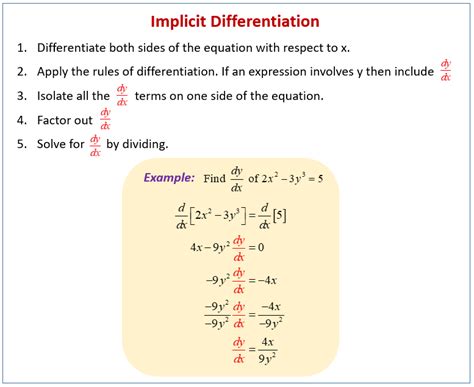
Implicit differentiation is a powerful technique used in calculus to find the derivative of a function that is defined implicitly by an equation. Unlike explicit differentiation, where the function is given explicitly in terms of the variable, implicit differentiation allows us to find the derivative of a function that is defined implicitly, without having to first solve the equation for the variable. This technique is particularly useful when dealing with equations that involve multiple variables or when the equation is difficult to solve explicitly.
Introduction to Implicit Differentiation
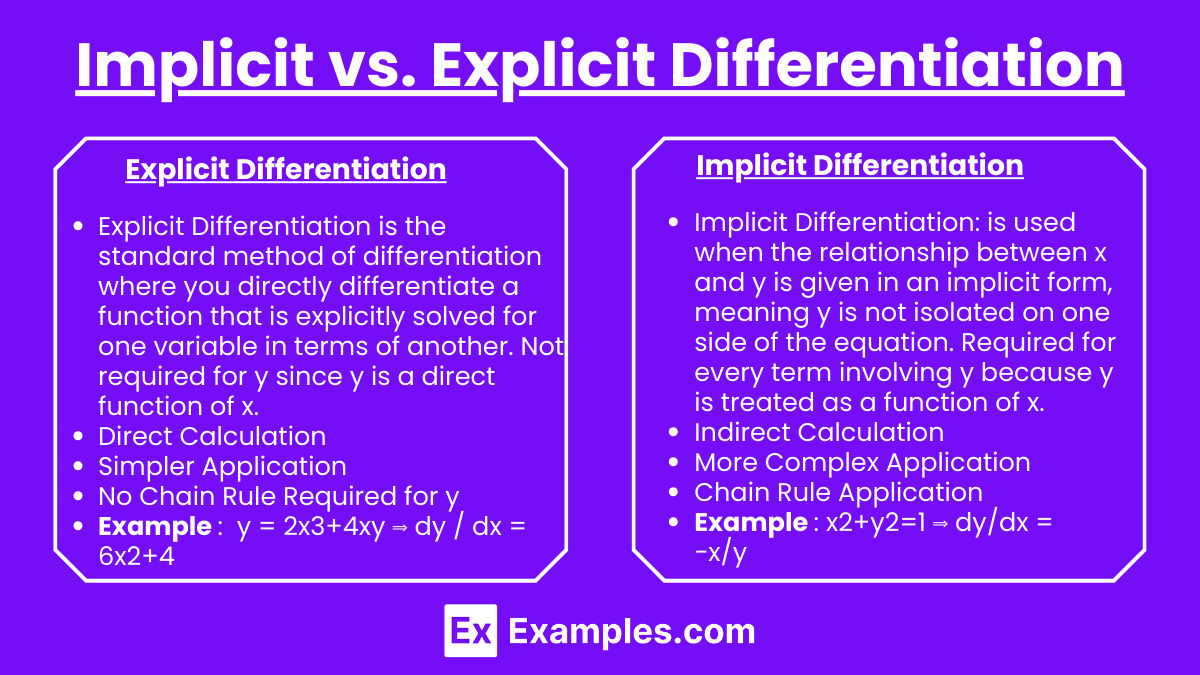
Implicit differentiation is based on the concept of differentiating both sides of an equation with respect to one of the variables. The chain rule and the product rule are used extensively in this process. To differentiate an equation implicitly, we start by differentiating both sides of the equation with respect to the variable of interest. This will involve differentiating any constants as zero, since the derivative of a constant is zero, and applying the chain rule and product rule as needed to the terms involving the variable.
Key Steps in Implicit Differentiation
The process of implicit differentiation involves several key steps: 1. Differentiate Both Sides: Differentiate both sides of the given equation with respect to the variable of interest. 2. Apply Differentiation Rules: Apply the appropriate differentiation rules (such as the chain rule, product rule, and quotient rule) to each term on both sides of the equation. 3. Solve for the Derivative: Manipulate the resulting equation to solve for the derivative of the function, which is usually represented as dy/dx. 4. Interpret the Result: Interpret the derivative in the context of the original problem.| Rule | Description |
|---|---|
| Chain Rule | If y = f(u) and u = g(x), then dy/dx = f'(u) * g'(x) |
| Product Rule | If y = u*v, then dy/dx = u*(dv/dx) + v*(du/dx) |
| Quotient Rule | If y = u/v, then dy/dx = (v*(du/dx) - u*(dv/dx)) / v^2 |
Practical Applications of Implicit Differentiation
Implicit differentiation has numerous practical applications in physics, engineering, economics, and other fields where the relationships between variables are often defined implicitly. For example, in physics, the equation for the trajectory of a projectile under the influence of gravity can be differentiated implicitly to find the velocity and acceleration of the projectile at any point in time.
Example: Finding the Derivative of an Implicit Function
Consider the equation x^2 + y^2 = 25, which defines a circle of radius 5 centered at the origin. To find the derivative dy/dx using implicit differentiation, we differentiate both sides of the equation with respect to x, applying the chain rule to the y terms: [2x + 2y\frac{dy}{dx} = 0] Solving for dy/dx gives: [\frac{dy}{dx} = -\frac{x}{y}] This derivative represents the slope of the tangent line to the circle at any point (x, y) on the circle.Key Points
- Implicit differentiation is used to find the derivative of a function defined implicitly by an equation.
- The process involves differentiating both sides of the equation with respect to the variable of interest and applying the chain rule and product rule as needed.
- Implicit differentiation is particularly useful for equations involving multiple variables or equations that are difficult to solve explicitly.
- The derivative found through implicit differentiation can be used to study the behavior of the function, such as finding maxima and minima, or determining the slope of tangent lines.
- Practical applications of implicit differentiation are found in various fields, including physics, engineering, and economics.
Challenges and Considerations in Implicit Differentiation
While implicit differentiation is a powerful tool, there are challenges and considerations to keep in mind. One of the main challenges is ensuring that the steps of differentiation are applied correctly, particularly when dealing with complex equations. Additionally, implicit differentiation assumes that the derivative exists, which may not always be the case. Therefore, it’s essential to check the conditions under which the derivative is defined and to consider any potential singularities or points of discontinuity.Conclusion
Implicit differentiation is a fundamental technique in calculus that allows for the differentiation of functions defined implicitly by equations. By understanding and applying the principles of implicit differentiation, we can uncover the derivatives of complex functions and explore their properties and behaviors. Whether in the realm of theoretical mathematics or in practical applications across various disciplines, implicit differentiation stands as a testament to the power and versatility of calculus in analyzing and describing the world around us.What is implicit differentiation used for?
+Implicit differentiation is used to find the derivative of a function that is defined implicitly by an equation. It’s particularly useful for equations involving multiple variables or equations that are difficult to solve explicitly.
How does implicit differentiation differ from explicit differentiation?
+Implicit differentiation differs from explicit differentiation in that it involves differentiating both sides of an equation with respect to a variable without first solving the equation for the variable. Explicit differentiation, on the other hand, involves differentiating a function that is explicitly given in terms of the variable.
What are some common applications of implicit differentiation?
+Implicit differentiation has applications in physics, engineering, economics, and other fields where relationships between variables are often defined implicitly. Examples include finding the trajectory of a projectile, studying economic models, and analyzing complex systems in engineering.