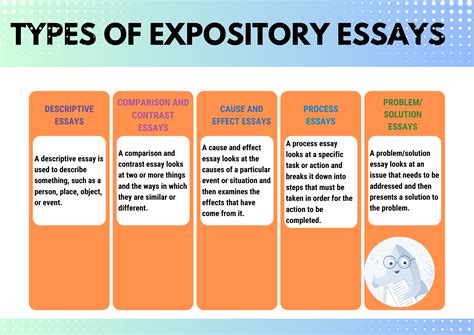
Expository writing is a type of writing that aims to explain, describe, or inform readers about a particular topic or subject. It is a crucial skill for writers, as it enables them to convey complex information in a clear and concise manner. In this article, we will explore five tips for effective expository writing, providing readers with the tools they need to craft well-structured and engaging pieces of writing.
Tip 1: Define Your Purpose and Audience
Before starting to write, it is essential to define the purpose and audience of your text. What is the main topic you want to address? Who are your readers, and what do they want to know about the subject? Understanding your audience’s needs and expectations will help you tailor your writing style, tone, and language to effectively communicate your message. For instance, if you are writing for a general audience, you may need to use simpler language and provide more background information, whereas a specialized audience may require more technical terms and in-depth analysis.
Identifying Your Audience
Identifying your audience is critical in expository writing. You need to consider their level of knowledge, interests, and expectations. Ask yourself questions like: What are their goals and motivations? What are their pain points, and how can you address them? By understanding your audience, you can create content that resonates with them and provides value. For example, if you are writing about a complex scientific topic, you may need to use analogies or metaphors to explain technical concepts in a way that is easy for non-experts to understand.
| Audience Characteristics | Writing Strategies |
|---|---|
| General audience | Use simple language, provide background information, and avoid technical jargon |
| Specialized audience | Use technical terms, provide in-depth analysis, and assume prior knowledge |
Tip 2: Organize Your Ideas
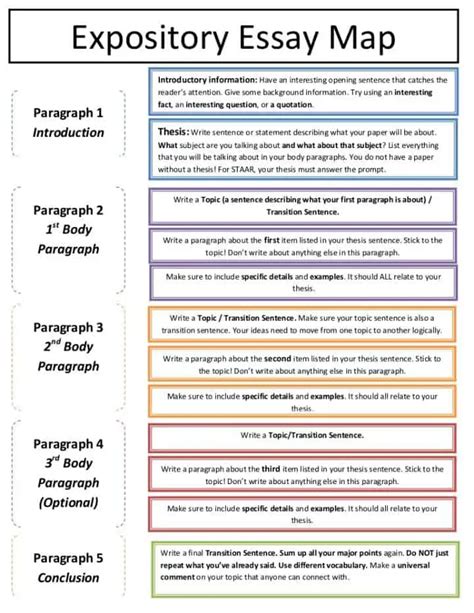
Once you have defined your purpose and audience, it’s time to organize your ideas. Create an outline to structure your writing and ensure that your ideas flow logically. Start by brainstorming and listing down all the points you want to cover. Then, group related ideas together, and create a hierarchical structure. This will help you to stay focused and avoid unnecessary tangents. For instance, you can use the MECE (Mutually Exclusive, Collectively Exhaustive) principle to categorize your ideas and ensure that they are comprehensive and well-organized.
Creating an Outline
Creating an outline is a crucial step in expository writing. It helps you to visualize your ideas, identify gaps in your argument, and ensure that your writing is coherent and well-structured. Use headings, subheadings, and bullet points to break down your content and make it easier to read. For example, you can use a mind mapping tool to create a visual representation of your ideas and identify relationships between them.
Key Points
- Define your purpose and audience to tailor your writing style and tone
- Organize your ideas using an outline to ensure logical flow and coherence
- Use evidence-based research to support your arguments and add credibility
- Use clear and concise language to convey complex information
- Edit and revise your work to ensure accuracy, clarity, and engagement
Tip 3: Use Evidence-Based Research
Expository writing relies heavily on evidence-based research. You need to support your arguments with credible sources, such as academic journals, books, and primary data. This will help you to build credibility and trust with your readers. Use quotes, statistics, and examples to illustrate your points and make your writing more engaging. For instance, you can use a systematic review of existing literature to identify patterns and trends in your topic and provide a comprehensive overview of the subject.
Conducting Research
Conducting research is a critical component of expository writing. You need to evaluate sources critically, identify biases and limitations, and use credible sources to support your arguments. Use online databases, libraries, and academic search engines to find relevant sources, and take notes to organize your ideas and avoid plagiarism.
| Research Strategies | Benefits |
|---|---|
| Systematic review | Provides a comprehensive overview of the topic, identifies patterns and trends, and helps to identify gaps in existing research |
| Primary data collection | Provides original insights, allows for tailored research questions, and enables the collection of unique data |
Tip 4: Use Clear and Concise Language
Expository writing requires clear and concise language. Avoid using jargon, technical terms, or complex sentences that may confuse your readers. Use simple language, active voice, and shorter sentences to convey complex information. For example, you can use the Flesch-Kincaid readability test to evaluate the readability of your text and ensure that it is accessible to your target audience.
Improving Clarity
Improving clarity is essential in expository writing. You need to avoid ambiguity, use precise language, and provide definitions for technical terms. Use examples, analogies, and metaphors to explain complex concepts, and use visual aids, such as diagrams, charts, and infographics, to illustrate your points and make your writing more engaging.
Tip 5: Edit and Revise
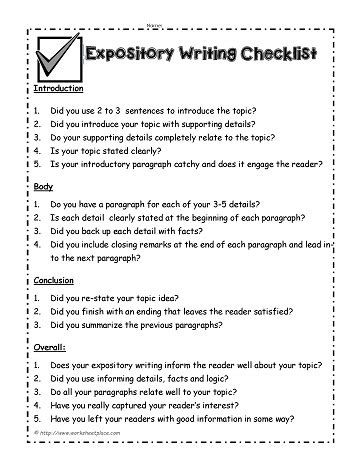
Finally, editing and revising are crucial steps in expository writing. Once you have completed your first draft, review your work, and make revisions to ensure accuracy, clarity, and engagement. Check for grammar, punctuation, and spelling errors, and use feedback from peers or editors to improve your writing. For instance, you can use a writing style guide, such as the APA or MLA style guide, to ensure consistency in formatting, citations, and references.
Revising Your Work
Revising your work is an essential step in expository writing. You need to evaluate your writing critically, identify areas for improvement, and make revisions to ensure that your writing is effective and engaging. Use a checklist to evaluate your writing, and make revisions to ensure that your writing meets the needs and expectations of your audience.
What is the purpose of expository writing?
+The purpose of expository writing is to explain, describe, or inform readers about a particular topic or subject. It aims to provide readers with a clear understanding of the topic, using evidence-based research and clear language.
How do I organize my ideas in expository writing?
+To organize your ideas in expository writing, create an outline to structure your writing and ensure that your ideas flow logically. Start by brainstorming and listing down all the points you want to cover, then group related ideas together, and create a hierarchical structure.
What is the importance of evidence-based research in expository writing?
+Evidence-based research is crucial in expository writing, as it helps to build credibility and trust with readers. It provides a foundation for your arguments, and helps to support your claims with credible sources, such as academic journals, books, and primary data.
In conclusion, expository writing is a critical skill for writers, as it enables them to convey complex information in a clear and concise manner. By following the five tips outlined in this article, you can create well-structured and engaging pieces of writing that provide value to your readers. Remember to define your purpose and audience, organize your ideas, use evidence-based research, use clear and concise language, and edit and revise your work to ensure accuracy, clarity, and engagement.