
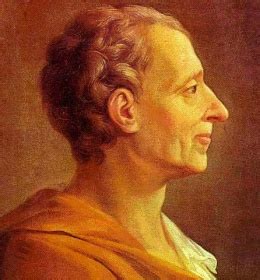
Charles-Louis de Secondat, Baron de La Brède et de Montesquieu, was a French philosopher, jurist, and political thinker who is widely regarded as one of the most influential figures in the development of modern political theory. Born in 1689 in La Brède, France, Montesquieu's work had a profound impact on the Enlightenment and the formation of democratic governments. His most famous work, "The Spirit of the Laws," published in 1748, is a comprehensive treatise on political philosophy, jurisprudence, and sociology. In this article, we will delve into Montesquieu's beliefs and explore their significance in the context of modern politics and governance.
Separation of Powers
One of Montesquieu’s most enduring contributions to political theory is the concept of the separation of powers. He argued that power should be divided among three branches of government: the legislative, executive, and judicial. This division, he believed, would prevent any one branch from becoming too powerful and abusing its authority. Montesquieu’s idea was influenced by the British system of government, which he observed during his travels to England. He was impressed by the checks and balances that existed between the monarch, the Parliament, and the judiciary, and he sought to adapt this model to the French context. The separation of powers has since become a cornerstone of democratic governance, and its influence can be seen in the constitutions of many countries, including the United States.
Checks and Balances
Montesquieu’s concept of checks and balances is closely related to the separation of powers. He argued that each branch of government should have some ability to limit the actions of the other branches, preventing any one branch from dominating the others. For example, the legislative branch might have the power to approve or reject the executive’s appointments, while the judicial branch might have the power to declare laws passed by the legislative branch as unconstitutional. This system of checks and balances, Montesquieu believed, would help to prevent the abuse of power and protect individual liberties. In practice, the system of checks and balances has proven to be an effective way to prevent the concentration of power and ensure that government remains accountable to the people.
| Branch of Government | Powers | Checks and Balances |
|---|---|---|
| Legislative | Lawmaking, approval of appointments | Can reject executive's appointments, can be dissolved by executive in some systems |
| Executive | Execution of laws, command of military | Can veto laws passed by legislative, can be impeached by legislative |
| Judicial | Interpretation of laws, resolution of disputes | Can declare laws as unconstitutional, can be appointed by executive and approved by legislative |
Types of Government

Montesquieu also wrote extensively about the different types of government that exist, and he developed a classification system that is still used today. He identified three main types of government: republican, monarchical, and despotic. Republican governments, he argued, are characterized by the rule of law and the protection of individual rights. Monarchical governments, on the other hand, are characterized by the rule of a single person, who may or may not be constrained by laws and institutions. Despotic governments, which Montesquieu considered to be the worst type of government, are characterized by the arbitrary rule of a single person, who is not constrained by laws or institutions. Montesquieu believed that the best type of government is a republican government, which balances the power of the ruler with the protection of individual rights and the rule of law.
Republican Government
Montesquieu’s ideas about republican government were influenced by the ancient Greek and Roman republics, as well as the modern republics of his time, such as the Dutch Republic and the Swiss Confederation. He believed that a republican government should be characterized by a system of representation, in which citizens elect representatives to make decisions on their behalf. He also believed that a republican government should have a strong system of laws and institutions, which would protect individual rights and prevent the abuse of power. In practice, republican governments have proven to be a durable and effective form of government, as they provide a balance between the power of the ruler and the protection of individual rights.
Key Points
- Montesquieu believed in the importance of dividing power among different branches of government to prevent the abuse of authority.
- He argued that a system of checks and balances is necessary to prevent any one branch of government from dominating the others.
- Montesquieu identified three main types of government: republican, monarchical, and despotic.
- He believed that a republican government, which balances the power of the ruler with the protection of individual rights and the rule of law, is the best type of government.
- His ideas about the separation of powers and checks and balances have had a profound impact on modern democracy.
Critique of Absolutism
Montesquieu was a strong critic of absolutism, which he believed was a system of government that was prone to abuse and tyranny. He argued that absolute monarchs, who had complete control over the government and the people, were often arbitrary and cruel in their rule. He believed that absolutism was incompatible with the principles of justice and equality, and that it led to the suppression of individual rights and freedoms. In contrast, Montesquieu believed that a system of government that was based on the rule of law, the protection of individual rights, and the division of power was more conducive to liberty and prosperity.
Limitations of Absolutism
Montesquieu’s critique of absolutism was based on his observation of the absolute monarchies of his time, such as the French monarchy under Louis XIV. He argued that absolute monarchs were often isolated from their people and were more concerned with maintaining their own power and privilege than with the welfare of their subjects. He believed that this led to a lack of accountability and a lack of responsiveness to the needs and concerns of the people. In practice, the limitations of absolutism have been demonstrated by the many revolutions and rebellions that have occurred throughout history, as people have risen up against tyrannical rulers and demanded greater freedom and accountability.
What is the main difference between a republican government and a monarchical government?
+A republican government is characterized by the rule of law and the protection of individual rights, while a monarchical government is characterized by the rule of a single person, who may or may not be constrained by laws and institutions.
What is the purpose of the system of checks and balances in a government?
+The purpose of the system of checks and balances is to prevent any one branch of government from dominating the others, and to ensure that power is divided and accountability is maintained.
What type of government did Montesquieu believe was the best?
+Montesquieu believed that a republican government, which balances the power of the ruler with the protection of individual rights and the rule of law, is the best type of government.
In conclusion, Montesquieu’s beliefs about the separation of powers, checks and balances, and the types of government have had a profound impact on modern democracy. His emphasis on the importance of dividing power, protecting individual rights, and promoting accountability has helped to shape the course of political history. As we continue to navigate the complexities of modern governance, Montesquieu’s ideas remain a powerful reminder of the importance of protecting liberty, promoting justice, and ensuring that power is exercised in a responsible and accountable manner.

