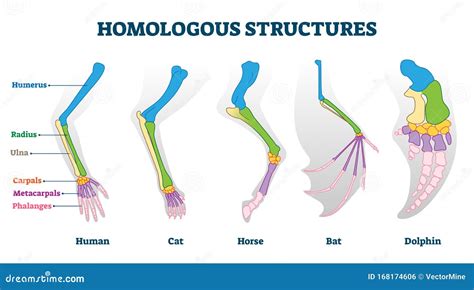
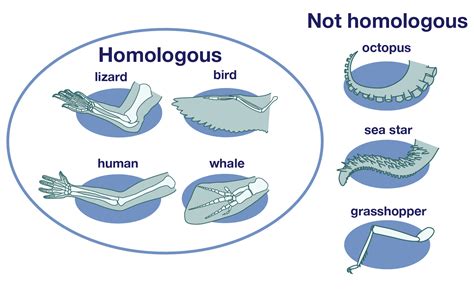
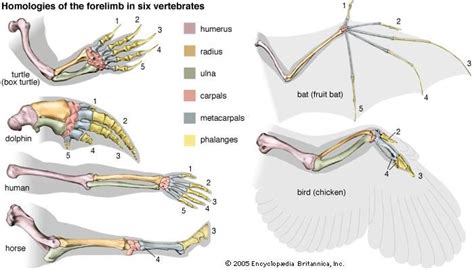
Homologous structures are a fundamental concept in biology, specifically in the fields of comparative anatomy and evolutionary biology. These structures refer to body parts or organs that are similar in different species, indicating a common ancestor. Despite their similarities, homologous structures may not necessarily have the same function in different organisms. For instance, the forelimbs of vertebrates, such as the human arm, the wing of a bird, and the flipper of a whale, are homologous structures. They all originate from the same embryonic tissue and have similar bone structures, despite being adapted for different purposes, like walking, flying, or swimming.
The concept of homologous structures is crucial for understanding the evolutionary relationships between different species. By comparing the anatomical features of various organisms, scientists can infer how closely related they are and how they have evolved over time. This field of study, known as comparative anatomy, provides valuable insights into the history of life on Earth and the processes that have shaped the diversity of species we see today. Homologous structures are not limited to visible body parts; they can also be found at the molecular level, such as in DNA sequences or protein structures, further solidifying the connection between different species.
Key Points
- Homologous structures are similar body parts or organs found in different species, indicating a common ancestor.
- These structures may not have the same function in different organisms but share a common origin and similar characteristics.
- The study of homologous structures is essential for understanding evolutionary relationships and the history of species diversification.
- Comparative anatomy and molecular biology provide evidence of homologous structures at both the macroscopic and microscopic levels.
- Understanding homologous structures helps in tracing the evolutionary pathways of different species and their adaptations to various environments.
Evolutionary Significance of Homologous Structures
The presence of homologous structures across different species is a strong evidence of evolution. It suggests that these species have evolved from a common ancestor, with their body parts adapting to perform different functions over time. This adaptation is driven by the process of natural selection, where environmental pressures favor the survival and reproduction of individuals with traits better suited to their environment. For example, the evolution of the eye in different species, despite its complexity, shows a gradient of developmental stages, indicating a common ancestry and gradual adaptation to environmental demands.
Homologous Structures at the Molecular Level
Beyond the visible anatomical features, homologous structures can also be identified at the molecular level. Genes and proteins that are similar across different species but may have different functions are considered homologous. These molecular homologies provide a deeper insight into the evolutionary relationships between organisms and can reveal the genetic basis of their adaptations. For instance, the genes involved in the development of the forelimbs in vertebrates are similar, reflecting their common evolutionary origin. Similarly, proteins with similar structures but different functions in different organisms are homologous, indicating a shared ancestry.
| Organism | Homologous Structure | Function |
|---|---|---|
| Human | Forearm | Manipulation and movement |
| Bird | Wing | Flight |
| Whale | Flipper | Swimming and maneuverability |

Applications of Homologous Structures in Science
The concept of homologous structures has numerous applications in scientific research and everyday life. In medicine, understanding the homologous structures between humans and model organisms like mice can help in the development of new treatments and drugs. In agriculture, recognizing the homologies between different plant species can aid in breeding programs aimed at improving crop yields and disease resistance. Moreover, the study of homologous structures contributes to conservation efforts by highlighting the evolutionary uniqueness of certain species and the importance of preserving biodiversity.
Challenges and Future Directions
Despite the significance of homologous structures in evolutionary biology, there are challenges in identifying and interpreting these structures, especially in distantly related species. Advances in molecular biology and bioinformatics have provided powerful tools for detecting homologies at the genetic and protein levels. However, integrating these data with morphological and anatomical information remains a complex task. Future research directions include the development of more sophisticated computational methods for comparing genomic and anatomical data across species, as well as experimental approaches to study the developmental and functional aspects of homologous structures.
What are homologous structures, and why are they important in biology?
+Homologous structures are body parts or organs that are similar in different species, indicating a common ancestor. They are crucial for understanding evolutionary relationships, tracing the history of species diversification, and recognizing the adaptations of different organisms to their environments.
How do scientists identify homologous structures at the molecular level?
+Scientists identify homologous structures at the molecular level by comparing the DNA sequences or protein structures of different species. Similarities in these sequences or structures, despite functional differences, indicate a common evolutionary origin.
What are some practical applications of the concept of homologous structures?
+The concept of homologous structures has applications in medicine, agriculture, and conservation biology. It aids in the development of new treatments, improves crop breeding programs, and highlights the importance of preserving biodiversity.
In conclusion, homologous structures are a cornerstone of evolutionary biology, providing insights into the common ancestry of different species and their adaptations over time. The study of these structures, from the anatomical to the molecular level, continues to evolve, offering new perspectives on the history of life on Earth and the complex interrelationships between species. As our understanding of homologous structures deepens, so does our appreciation for the unity and diversity of life, guiding us toward a more nuanced comprehension of the natural world and our place within it.