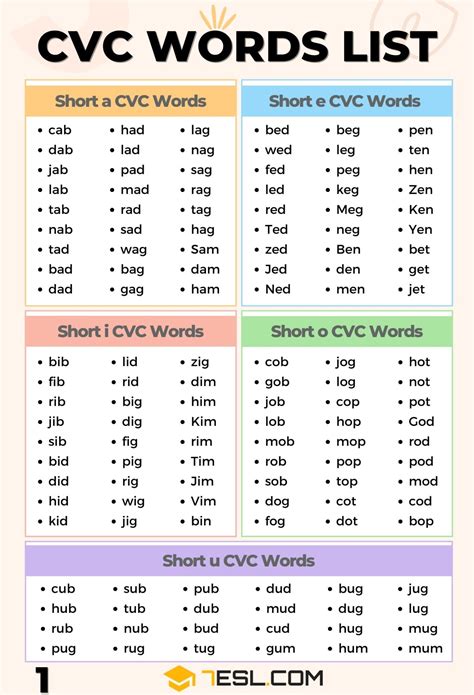
When it comes to understanding and working with CVC (Consonant-Vowel-Consonant) words, having a solid foundation is crucial. CVC words are a fundamental part of early reading and writing skills, as they introduce children to the concept of word families and phonetic patterns. In this article, we will delve into 5 CVC word tips that are designed to help educators, parents, and learners navigate the world of CVC words with confidence and accuracy.
Key Points
- Understanding the structure of CVC words, including the consonant-vowel-consonant pattern
- Identifying and utilizing word families to enhance reading and spelling skills
- Practicing phonemic awareness to distinguish between different sounds within CVC words
- Creating interactive and engaging activities to teach CVC words
- Adapting instruction to meet the diverse needs of learners
Introduction to CVC Words
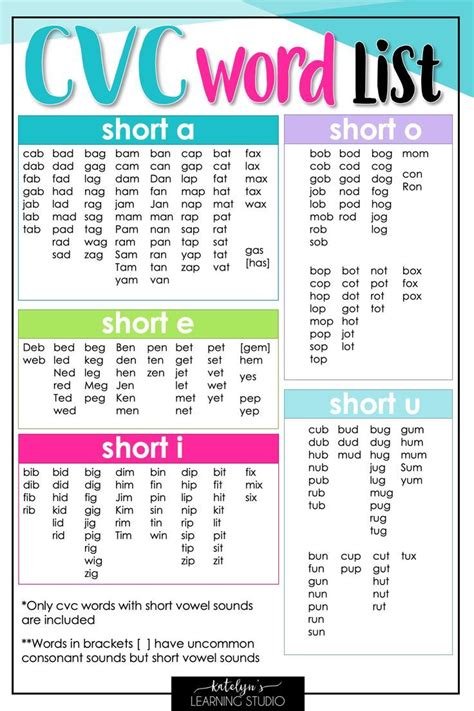
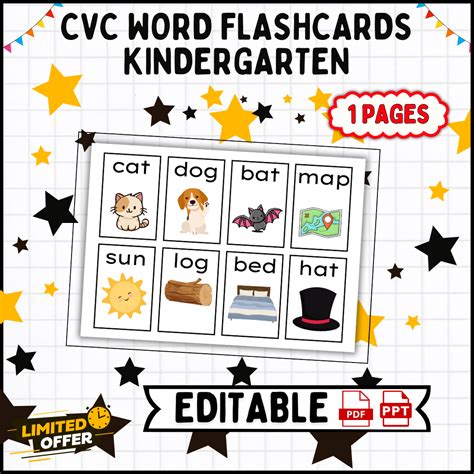
CVC words follow a specific pattern where a consonant is followed by a vowel and then another consonant. Examples include “cat,” “dog,” and “sun.” This pattern is essential for early readers to recognize, as it helps them decode words more efficiently. By understanding the CVC pattern, learners can begin to read and spell a wide range of words, laying the groundwork for more complex literacy skills.
Tip 1: Mastering Word Families
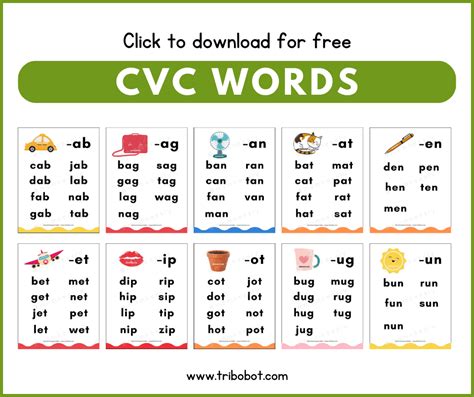
Word families are groups of words that share the same ending sound. For example, the “-at” family includes words like “cat,” “hat,” and “mat.” By learning these word families, learners can quickly recognize and read a multitude of CVC words. This approach also aids in spelling, as changing the initial consonant can create a new word within the same family.
| Word Family | Examples |
|---|---|
| -at | cat, hat, mat, sat |
| -an | can, fan, man, van |
| -in | bin, pin, sin, win |
Enhancing Phonemic Awareness
Phonemic awareness is the ability to hear and manipulate individual sounds (phonemes) within words. For CVC words, this means being able to identify the beginning, middle, and ending sounds. Activities such as segmenting words into their individual sounds and then blending them back together can significantly enhance phonemic awareness and, by extension, the ability to read and spell CVC words accurately.
Tip 2: Engaging Activities for CVC Words
Teaching CVC words can be engaging and fun with the right activities. For instance, creating word walls with CVC words, playing matching games where learners match words with their pictures, and conducting scavenger hunts for objects whose names are CVC words can make learning interactive and enjoyable. Additionally, incorporating technology, such as educational apps and games, can provide a modern and captivating way to practice CVC word recognition and spelling.
Adapting Instruction for Diverse Learners
Every learner is unique, with their own strengths, challenges, and learning styles. When teaching CVC words, it’s essential to adapt instruction to meet these diverse needs. For learners who are struggling, providing extra support through one-on-one practice or using multisensory approaches (e.g., tracing words in sand or shaving cream) can be beneficial. For advanced learners, introducing more complex word patterns or encouraging them to create their own CVC words can foster a deeper understanding and engagement with the material.
Tip 3: Incorporating Technology and Games
Technology offers a wealth of resources for teaching CVC words, from interactive worksheets and quizzes to educational games and apps. These tools can make learning CVC words not only fun but also accessible, as they can be used anywhere and at any time. Furthermore, many of these resources provide immediate feedback and tracking, allowing educators and parents to monitor progress and identify areas where additional support may be needed.
Conclusion and Future Directions
In conclusion, mastering CVC words is a critical step in the development of reading and spelling skills. By understanding the structure of CVC words, utilizing word families, practicing phonemic awareness, creating engaging activities, and adapting instruction to meet the needs of diverse learners, educators and parents can provide a robust foundation for literacy. As technology continues to evolve, it will be exciting to see how new tools and resources can further enhance the teaching and learning of CVC words, making the process more efficient, enjoyable, and effective for all involved.
What is the significance of word families in learning CVC words?
+Word families are significant because they allow learners to recognize patterns and decode words more efficiently. By knowing one word in a family, learners can easily read and spell other words in the same family by changing the initial consonant.
How can technology enhance the learning of CVC words?
+Technology can enhance the learning of CVC words through interactive games, quizzes, and activities that make practice fun and engaging. It also provides immediate feedback and tracking, which can be invaluable for monitoring progress and identifying areas for additional support.
What strategies can be used to support learners who are struggling with CVC words?
+Strategies to support struggling learners include providing one-on-one practice, using multisensory approaches, and incorporating real-life objects and images to make learning more tangible and engaging. Additionally, breaking down words into their individual sounds and then blending them back together can help improve phonemic awareness and decoding skills.