The realm of scientific inquiry and experimentation is deeply rooted in the understanding and manipulation of controls and variables. These fundamental concepts are the backbone of any research study, allowing investigators to isolate the effects of specific factors and draw meaningful conclusions. In this article, we will delve into the world of controls and variables, exploring their definitions, types, and roles in the scientific method.
Understanding Controls
A control, in the context of scientific research, refers to a standard or baseline condition against which the effects of an independent variable are measured. Controls are essential for establishing a reference point, enabling researchers to compare the outcomes of an experiment or study to a known, unchanged state. By maintaining all other factors constant, except for the variable being tested, scientists can attribute any observed changes to the manipulation of that variable. For instance, in a study examining the impact of a new fertilizer on plant growth, the control group would receive the standard, currently used fertilizer, while the experimental group would receive the new fertilizer. This setup allows researchers to isolate the effect of the new fertilizer on plant growth, relative to the established baseline.
Types of Controls
There are several types of controls used in research, each serving a distinct purpose. Positive controls are used to verify that an experiment is working as expected, by including a condition known to produce a certain outcome. Negative controls, on the other hand, are used to test for the absence of an effect, where the expected outcome is no change. Placebo controls involve the use of a sham treatment, which appears identical to the actual treatment but lacks the active ingredient, allowing researchers to account for any placebo effect. Understanding the different types of controls and their applications is crucial for designing and interpreting experiments effectively.
| Control Type | Description |
|---|---|
| Positive Control | Verifies experiment is working as expected |
| Negative Control | Tests for absence of an effect |
| Placebo Control | Accounts for placebo effect with sham treatment |
Exploring Variables
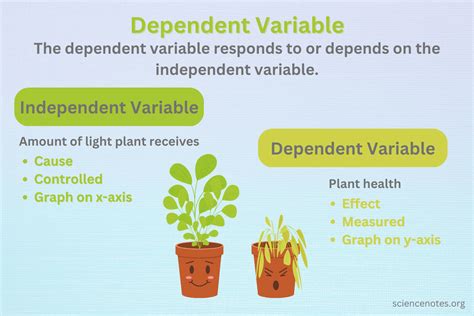
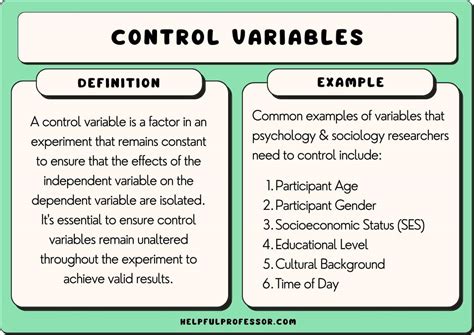
A variable, in the context of scientific research, refers to a factor or characteristic that can be measured, manipulated, or controlled. Variables are the building blocks of any experiment, and understanding their roles and interactions is crucial for drawing meaningful conclusions. There are several types of variables, including independent variables, which are manipulated by the researcher to observe their effect, dependent variables, which are measured in response to changes made to the independent variable, and controlled variables, which are held constant to prevent their influence on the outcome.
Types of Variables
The classification of variables into independent, dependent, and controlled categories is essential for designing and interpreting experiments. Independent variables are the factors manipulated by the researcher, such as the amount of fertilizer applied to plants. Dependent variables are the outcomes measured in response to changes made to the independent variable, such as the resulting plant growth. Controlled variables are the factors held constant to prevent their influence on the outcome, such as the amount of water and sunlight provided to the plants. Understanding the relationships between these variables is critical for drawing meaningful conclusions and making informed decisions.
Key Points
- Controls are standard or baseline conditions against which the effects of an independent variable are measured.
- Variables are factors or characteristics that can be measured, manipulated, or controlled.
- Independent variables are manipulated by the researcher to observe their effect.
- Dependent variables are measured in response to changes made to the independent variable.
- Controlled variables are held constant to prevent their influence on the outcome.
Applications and Implications
The understanding and manipulation of controls and variables have far-reaching implications in various fields, including science, engineering, and medicine. By controlling for extraneous factors and manipulating independent variables, researchers can isolate the effects of specific factors and draw meaningful conclusions. This knowledge can be applied to develop new technologies, improve existing processes, and inform decision-making. For instance, in the field of medicine, understanding the effects of different medications on patient outcomes requires careful control of variables and consideration of potential confounding factors.
Best Practices for Working with Controls and Variables
When working with controls and variables, it is essential to follow best practices to ensure the validity and reliability of experimental results. This includes careful planning and design of the experiment, precise measurement and control of variables, and rigorous data analysis and interpretation. Additionally, researchers should be aware of potential sources of error and take steps to minimize their impact. By following these guidelines and staying up-to-date with the latest research and methodologies, scientists can ensure that their experiments are well-designed, well-executed, and informative.
What is the purpose of a control group in an experiment?
+The control group provides a standard or baseline condition against which the effects of an independent variable are measured, allowing researchers to compare the outcomes of an experiment to a known, unchanged state.
What is the difference between an independent variable and a dependent variable?
+An independent variable is a factor manipulated by the researcher to observe its effect, while a dependent variable is the outcome measured in response to changes made to the independent variable.
Why is it important to control for extraneous factors in an experiment?
+Controlling for extraneous factors helps to prevent their influence on the outcome, allowing researchers to isolate the effect of the independent variable and draw meaningful conclusions.
Meta description: “Discover the fundamentals of controls and variables in scientific research, including types, applications, and best practices for ensuring validity and reliability.”