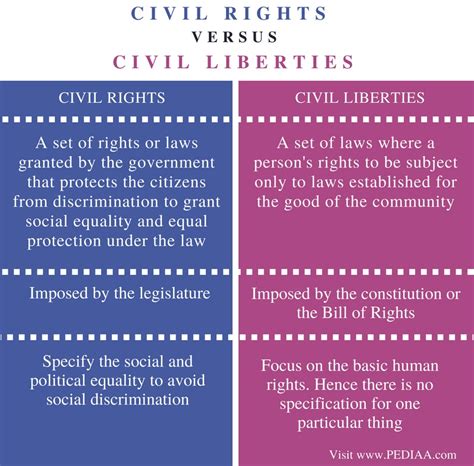
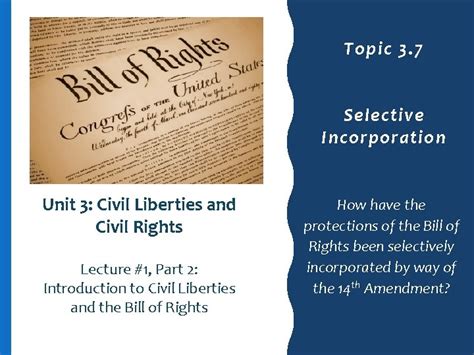
Civil liberties are fundamental rights and freedoms that are guaranteed to individuals by a country's constitution or laws, protecting them from unwarranted government interference or restriction. These liberties are essential components of a democratic society, ensuring that citizens can live their lives with dignity, freedom, and autonomy. The concept of civil liberties has evolved over time, influenced by historical events, social movements, and judicial decisions. In the United States, for example, the Bill of Rights, which comprises the first ten amendments to the Constitution, outlines specific civil liberties that are protected, such as freedom of speech, press, and assembly.
The scope of civil liberties is broad, encompassing various aspects of individual freedom, including the right to privacy, freedom from unreasonable search and seizure, and the right to a fair trial. These liberties are not absolute, however, and are subject to reasonable limitations and restrictions to balance individual rights with the need to maintain public order, safety, and national security. The judiciary plays a crucial role in interpreting the scope and limits of civil liberties, often through landmark court decisions that set legal precedents. For instance, the U.S. Supreme Court's decision in Marbury v. Madison (1803) established the principle of judicial review, which has been instrumental in safeguarding civil liberties by ensuring that government actions comply with constitutional requirements.
Key Points
- Civil liberties are fundamental rights and freedoms guaranteed by a country's constitution or laws.
- These liberties protect individuals from unwarranted government interference or restriction.
- The scope of civil liberties includes freedom of speech, press, assembly, privacy, and the right to a fair trial.
- Civil liberties are subject to reasonable limitations and restrictions to balance individual rights with public needs.
- The judiciary plays a critical role in interpreting and safeguarding civil liberties through legal precedents.
Types of Civil Liberties
Civil liberties can be categorized into several types, each protecting different aspects of individual freedom and dignity. Freedom of expression, which includes freedom of speech, press, and assembly, is a cornerstone of democratic societies, enabling citizens to express their opinions, critique government policies, and participate in the political process. Freedom of religion ensures that individuals can practice their faith without fear of persecution or discrimination, while the right to privacy protects individuals from unwarranted intrusions into their personal lives.
Due process rights, which include the right to a fair trial, the right to confront witnesses, and protection against self-incrimination, are essential for ensuring that individuals are treated fairly and justly by the legal system. The right to bear arms, as guaranteed by the Second Amendment in the United States, is another civil liberty that has been the subject of much debate and legal interpretation. Understanding the nuances and complexities of these liberties is crucial for appreciating the delicate balance between individual rights and the responsibilities of citizens in a democratic society.
Evolution of Civil Liberties
The evolution of civil liberties has been marked by significant milestones and challenges. Historically, the Magnacarta (1215) in England is considered one of the earliest documents to establish the principle of due process and limit the power of the monarch. In the United States, the Civil Rights Movement of the 1950s and 1960s played a pivotal role in expanding civil liberties, particularly for African Americans, through landmark legislation such as the Civil Rights Act of 1964 and the Voting Rights Act of 1965.
More recently, the Patriot Act (2001) and subsequent legal and policy changes have raised complex questions about the balance between national security and individual civil liberties, especially in the context of surveillance, detention, and due process. The ongoing debates and legal challenges surrounding these issues underscore the dynamic nature of civil liberties and the need for continuous vigilance and advocacy to protect these fundamental rights.
| Historical Document | Year | Significance |
|---|---|---|
| Magna Carta | 1215 | Established due process and limited monarch's power |
| U.S. Bill of Rights | 1791 | Guaranteed specific civil liberties to U.S. citizens |
| Civil Rights Act | 1964 | Outlawed discrimination based on race, color, religion, sex, or national origin |
| Patriot Act | 2001 | Expanded surveillance powers of law enforcement agencies |
Challenges to Civil Liberties
Despite their importance, civil liberties face numerous challenges and controversies. The war on terror has led to significant expansions of government surveillance and detention powers, raising concerns about the erosion of due process rights and privacy. Technological advancements have also created new challenges, as governments and corporations increasingly collect and analyze personal data, potentially infringing on individuals’ right to privacy.
Social media and freedom of speech present another complex issue, as the spread of misinformation and hate speech has led to calls for greater regulation, which must be balanced against the need to protect freedom of expression. Furthermore, economic inequalities can impact the ability of individuals to fully exercise their civil liberties, highlighting the need for policies that address these disparities and ensure equal access to justice and political participation.
Future of Civil Liberties
The future of civil liberties is uncertain and will be shaped by how societies respond to current and emerging challenges. Advances in technology will continue to pose significant questions about privacy, surveillance, and the potential for abuse of power. Global events and conflicts will also influence the trajectory of civil liberties, as governments may be tempted to sacrifice individual rights in the name of national security or public order.
However, there are also reasons for optimism. Civil society movements and human rights organizations continue to advocate for the expansion and protection of civil liberties, using legal, political, and social means to hold governments accountable. Moreover, international cooperation and the development of global human rights standards can provide a framework for protecting civil liberties across borders, promoting a more just and equitable world for all.
What are the primary types of civil liberties?
+The primary types of civil liberties include freedom of expression, freedom of religion, the right to privacy, due process rights, and the right to bear arms, among others.
How have civil liberties evolved over time?
+Civil liberties have evolved significantly over time, influenced by historical documents like the Magna Carta, landmark court decisions, social movements such as the Civil Rights Movement, and legislative actions like the Civil Rights Act of 1964.
What challenges do civil liberties face in the contemporary world?
+Civil liberties face challenges from the war on terror, technological advancements, social media, economic inequalities, and global events, which can lead to the erosion of individual rights and freedoms.
In conclusion, civil liberties are the cornerstone of democratic societies, ensuring that individuals can enjoy freedom, dignity, and autonomy. Understanding the complexities, challenges, and future directions of civil liberties requires a deep appreciation of their historical development, legal framework, and the ongoing struggles to protect and expand these fundamental rights. As societies continue to evolve, the protection and promotion of civil liberties will remain a critical task, necessitating the engagement and vigilance of citizens, policymakers, and legal scholars alike.