The quintessential portrayal of wealth and class in F. Scott Fitzgerald's The Great Gatsby is vividly encapsulated in the contrasting neighborhoods of West Egg and East Egg. These two fictional communities, situated on the north shore of Long Island, New York, serve as the backdrop for the novel's exploration of the American Dream, social stratification, and the corrupting influence of wealth. To fully appreciate the nuances of Fitzgerald's work, it is essential to delve into the distinct characteristics of West Egg and East Egg, examining their historical context, architectural styles, and the social dynamics that define their respective inhabitants.
Historical Context and Architectural Styles
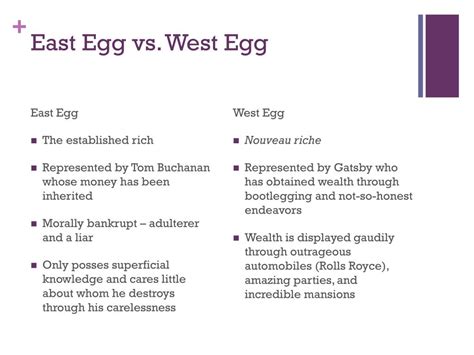
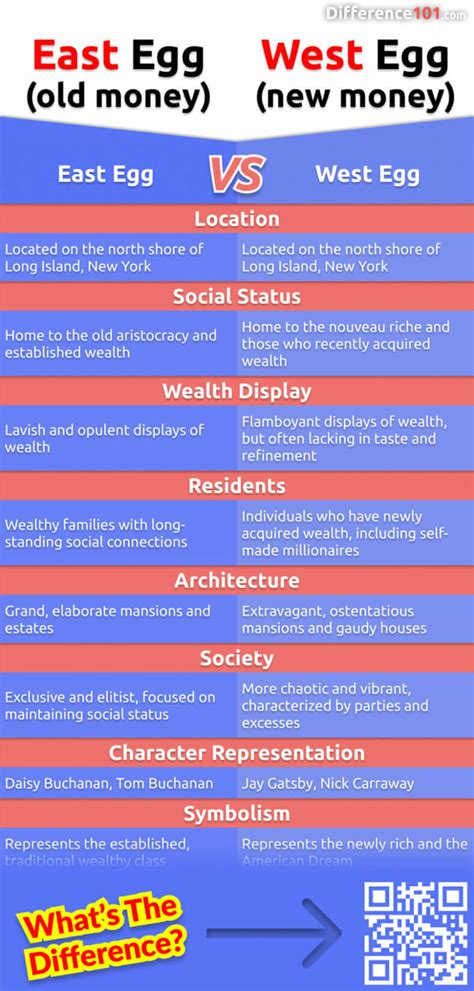
The historical context of West Egg and East Egg is deeply rooted in the societal norms of the 1920s. East Egg, with its grand, old-money mansions, embodies the traditional aristocracy, whereas West Egg is characterized by its newer, more extravagant homes, often built by individuals who have amassed their wealth through more recent, and sometimes dubious, means. Architecturally, East Egg’s homes are typically designed in a more classical, conservative style, reflecting the community’s emphasis on heritage and tradition. In contrast, West Egg’s residences are often more opulent and avant-garde, symbolizing the nouveaux riches’ desire to flaunt their wealth and challenge the established social order.
Social Dynamics and Class Distinctions
The social dynamics of West Egg and East Egg are defined by the old money versus new money dichotomy. East Egg is home to families like the Buchanans, who have inherited their wealth and social status. These individuals are often portrayed as being complacent, arrogant, and disapproving of those who have not been born into their privileged world. West Egg, on the other hand, is inhabited by self-made men like Jay Gatsby, who have acquired their wealth through their own efforts but are not accepted as equals by the old-money elite. This class distinction is a central theme of the novel, as Fitzgerald critiques the social stratification of the time and the barriers to upward mobility.
| Community | Characteristics | Social Status |
|---|---|---|
| East Egg | Old money, traditional, aristocratic | High |
| West Egg | New money, extravagant, self-made | Lower than East Egg |
Key Points
- The Great Gatsby's West Egg and East Egg represent two contrasting worlds of wealth and social status in the 1920s.
- East Egg embodies the old-money aristocracy with its traditional values and architectural styles, while West Egg symbolizes the nouveaux riches with their extravagant lifestyles and newer homes.
- The novel critiques the social stratification of the time, emphasizing the difficulties faced by self-made individuals in gaining acceptance into the old-money elite.
- Fitzgerald's work is a commentary on the American Dream, suggesting that wealth and material possessions do not necessarily guarantee happiness or social inclusion.
- The distinction between West Egg and East Egg serves as a metaphor for the broader societal issues of class, identity, and the corrupting influence of wealth.
In conclusion, the comparison between West Egg and East Egg in The Great Gatsby offers a nuanced exploration of the American class system, the implications of wealth on social status, and the challenges faced by individuals attempting to transcend their social origins. Through the vivid portrayal of these two communities, Fitzgerald provides a timeless commentary on the human experience, encouraging readers to reflect on the nature of class, identity, and the elusive American Dream.
What is the main difference between West Egg and East Egg in The Great Gatsby?
+The primary distinction between West Egg and East Egg lies in their representation of old money versus new money. East Egg is home to the traditional aristocracy, with families like the Buchanans embodying the old-money values and social status. In contrast, West Egg is characterized by its newer, more extravagant homes and is inhabited by self-made men like Jay Gatsby, who have acquired their wealth through their own efforts but are not accepted as equals by the old-money elite.
How does F. Scott Fitzgerald use the settings of West Egg and East Egg to comment on the American class system?
+Fitzgerald employs the contrast between West Egg and East Egg to critique the social stratification of the time, highlighting the barriers to upward mobility and the corrupting influence of wealth. The old-money communities of East Egg are portrayed as being exclusive and dismissive of those who have not been born into their world, while the new money of West Egg is depicted as being extravagant and lacking in tradition. This dichotomy serves as a commentary on the American Dream, suggesting that wealth and material possessions do not necessarily guarantee happiness or social inclusion.
What symbolic significance do the homes in West Egg and East Egg hold in the novel?
+The homes in West Egg and East Egg are symbolic of the values and social status of their inhabitants. The grand, old-money mansions of East Egg reflect the traditional values and heritage of the community, while the newer, more extravagant homes of West Egg symbolize the self-made wealth and desire for social acceptance of their inhabitants. Jay Gatsby’s home, in particular, serves as a symbol of his aspirations and his attempt to buy his way into the old-money elite.