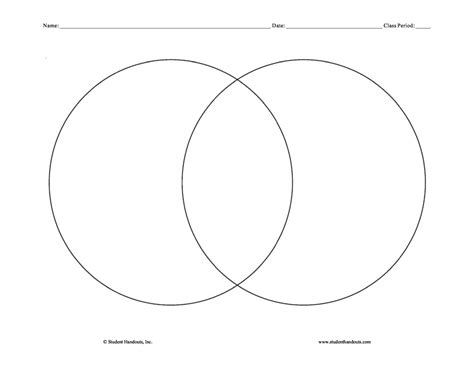
Venn diagrams are a powerful tool for visualizing complex relationships between different sets of information. They are commonly used in various fields such as mathematics, computer science, and business to illustrate the intersection, union, and difference between sets. Here, we will explore five Venn diagram templates that can be used for different purposes, along with examples and explanations to help you understand how to use them effectively.
Introduction to Venn Diagrams
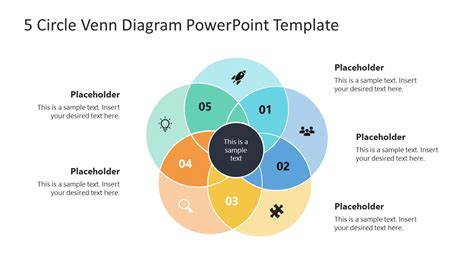
Venn diagrams consist of overlapping circles, each representing a set. The overlapping areas represent the elements that are common to the sets, while the non-overlapping areas represent the elements that are unique to each set. Venn diagrams can be used to visualize relationships between two or more sets, making them a useful tool for data analysis, decision-making, and problem-solving.
Key Points
- Venn diagrams are used to visualize relationships between sets of information.
- They consist of overlapping circles, each representing a set.
- The overlapping areas represent the elements that are common to the sets.
- Venn diagrams can be used for data analysis, decision-making, and problem-solving.
- They are commonly used in mathematics, computer science, and business.
Template 1: Two-Circle Venn Diagram
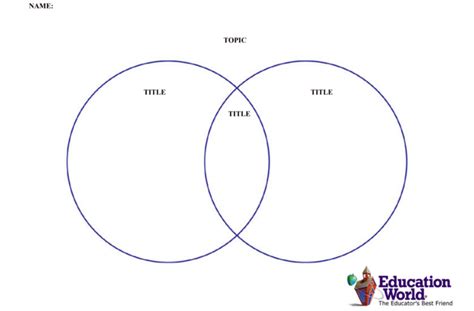
A two-circle Venn diagram is the most basic type of Venn diagram. It consists of two overlapping circles, each representing a set. The overlapping area represents the elements that are common to both sets. This template is useful for comparing two sets of information and identifying their similarities and differences.
| Set A | Set B | Intersection |
|---|---|---|
| Elements unique to Set A | Elements unique to Set B | Elements common to both sets |
Example Use Case
Suppose we want to compare the features of two different smartphones. We can use a two-circle Venn diagram to visualize the features that are common to both phones and the features that are unique to each phone.
Template 2: Three-Circle Venn Diagram
A three-circle Venn diagram is used to visualize the relationships between three sets of information. It consists of three overlapping circles, each representing a set. The overlapping areas represent the elements that are common to two or more sets. This template is useful for analyzing complex relationships between multiple sets of information.
| Set A | Set B | Set C | Intersection |
|---|---|---|---|
| Elements unique to Set A | Elements unique to Set B | Elements unique to Set C | Elements common to two or more sets |
Example Use Case
Suppose we want to analyze the relationships between three different marketing channels: social media, email, and search engine optimization (SEO). We can use a three-circle Venn diagram to visualize the channels that are commonly used together and the channels that are used independently.
Template 3: Four-Circle Venn Diagram
A four-circle Venn diagram is used to visualize the relationships between four sets of information. It consists of four overlapping circles, each representing a set. The overlapping areas represent the elements that are common to two or more sets. This template is useful for analyzing complex relationships between multiple sets of information.
| Set A | Set B | Set C | Set D | Intersection |
|---|---|---|---|---|
| Elements unique to Set A | Elements unique to Set B | Elements unique to Set C | Elements unique to Set D | Elements common to two or more sets |
Example Use Case
Suppose we want to analyze the relationships between four different customer segments: demographics, behavior, preferences, and loyalty. We can use a four-circle Venn diagram to visualize the segments that are commonly associated with each other and the segments that are unique to each customer group.
Template 4: Multi-Circle Venn Diagram
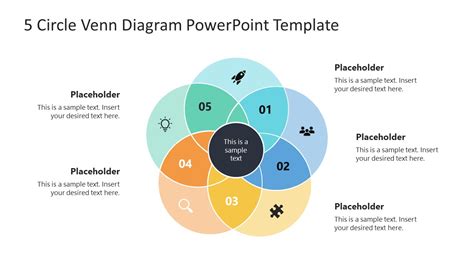
A multi-circle Venn diagram is used to visualize the relationships between multiple sets of information. It consists of multiple overlapping circles, each representing a set. The overlapping areas represent the elements that are common to two or more sets. This template is useful for analyzing complex relationships between multiple sets of information.
| Set 1 | Set 2 | Set 3 | ... | Set N | Intersection |
|---|---|---|---|---|---|
| Elements unique to Set 1 | Elements unique to Set 2 | Elements unique to Set 3 | ... | Elements unique to Set N | Elements common to two or more sets |
Example Use Case
Suppose we want to analyze the relationships between multiple different product features: price, quality, functionality, and design. We can use a multi-circle Venn diagram to visualize the features that are commonly associated with each other and the features that are unique to each product.
Template 5: Custom Venn Diagram
A custom Venn diagram is used to visualize the relationships between sets of information that do not fit into a standard template. It consists of overlapping circles, each representing a set, with customized overlapping areas to represent the elements that are common to two or more sets. This template is useful for analyzing complex relationships between multiple sets of information that require a unique visualization.
| Set 1 | Set 2 | Set 3 | ... | Set N | Intersection |
|---|---|---|---|---|---|
| Elements unique to Set 1 | Elements unique to Set 2 | Elements unique to Set 3 | ... | Elements unique to Set N | Elements common to two or more sets |
Example Use Case
Suppose we want to analyze the relationships between multiple different business processes: sales, marketing, customer service, and operations. We can use a custom Venn diagram to visualize the processes that are commonly associated with each other and the processes that are unique to each department.
What is a Venn diagram?
+A Venn diagram is a visual representation of the relationships between sets of information. It consists of overlapping circles, each representing a set, with the overlapping areas representing the elements that are common to two or more sets.
How do I use a Venn diagram?
+To use a Venn diagram, start by identifying the sets of information you want to compare. Then, draw overlapping circles to represent each set, with the overlapping areas representing the elements that are common to two or more sets. Finally, analyze the diagram to identify the relationships between the sets.
What are the benefits of using a Venn diagram?
+The benefits of using a Venn diagram include the ability to visualize complex relationships between sets of information, identify commonalities and differences between sets, and communicate complex information in a clear and concise manner.