The study of trigonometric functions and their derivatives is a fundamental aspect of calculus, playing a crucial role in various fields such as physics, engineering, and computer science. Among these, the inverse trigonometric functions and their derivatives are of particular importance, as they enable us to solve a wide range of problems involving right triangles, wave patterns, and periodic phenomena. In this article, we will delve into the world of inverse trigonometric derivatives, exploring their definitions, formulas, and applications, with a focus on the five primary inverse trigonometric functions: arcsine, arccosine, arctangent, arcsecant, and arccotangent.
Key Points
- The inverse trigonometric functions are essential in calculus, allowing us to find angles given the ratios of the sides of a right triangle.
- The derivatives of inverse trigonometric functions are used to find the rate of change of these angles with respect to the input variables.
- Each inverse trigonometric function has a specific domain and range, which are crucial for understanding their behavior and applications.
- The derivatives of arcsine, arccosine, arctangent, arcsecant, and arccotangent have distinct formulas, reflecting their unique properties and uses.
- These derivatives are applied in various fields, including physics, engineering, and computer science, to model real-world phenomena and solve complex problems.
Introduction to Inverse Trigonometric Functions
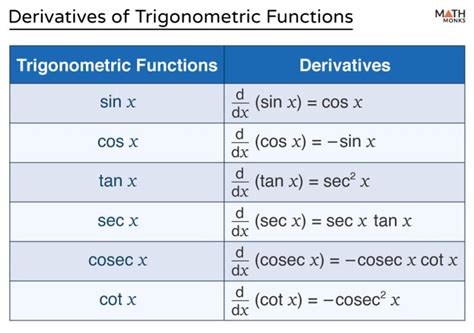
Before diving into the derivatives of inverse trigonometric functions, it’s essential to understand the functions themselves. The inverse trigonometric functions are defined as the inverse operations of the basic trigonometric functions: sine, cosine, tangent, secant, and cotangent. They allow us to determine the angle whose trigonometric function has a given value. For instance, the arcsine function, denoted as sin^{-1}(x) or arcsin(x), gives us the angle whose sine is x. Similarly, the arccosine, arctangent, arcsecant, and arccotangent functions provide the angles whose cosine, tangent, secant, and cotangent are given, respectively.
Derivatives of Inverse Trigonometric Functions
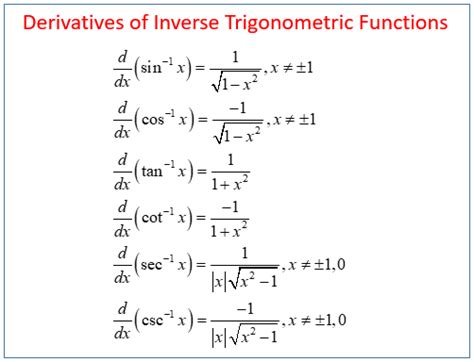
The derivatives of these inverse trigonometric functions can be found using various methods, including the use of implicit differentiation and the knowledge of the derivatives of the basic trigonometric functions. The derivative of the arcsine function, for example, is given by d(arcsin(x))/dx = 1/√(1-x^2), while the derivative of the arctangent function is d(arctan(x))/dx = 1/(1+x^2). The derivatives of the other inverse trigonometric functions follow similar patterns, with each having a distinct formula that reflects its unique properties.
| Function | Derivative |
|---|---|
| Arcsine (arcsin(x)) | 1/√(1-x^2) |
| Arccosine (arccos(x)) | -1/√(1-x^2) |
| Arctangent (arctan(x)) | 1/(1+x^2) |
| Arcsecant (arcsec(x)) | 1/(|x|√(x^2-1)) |
| Arccotangent (arccot(x)) | -1/(1+x^2) |
Applications of Inverse Trigonometric Derivatives
The derivatives of inverse trigonometric functions have numerous applications in physics, engineering, and computer science. For example, in physics, these derivatives are used to describe the motion of objects in terms of the rates of change of their positions, velocities, and accelerations. In engineering, they are applied in the design of systems that involve rotational motion, such as gears and motors. In computer science, inverse trigonometric derivatives are used in graphics and game development to create realistic models of motion and interaction.
Real-World Examples
A common real-world example of the application of inverse trigonometric derivatives is in the calculation of the trajectory of a projectile under the influence of gravity. By using the derivatives of the inverse trigonometric functions, one can determine the angle of launch that will result in the projectile reaching a specific target, taking into account factors such as the initial velocity and the height of the launch point.
Another example is in the field of computer-aided design (CAD), where inverse trigonometric derivatives are used to create complex curves and surfaces that are essential for designing objects with specific geometric properties. By manipulating the derivatives of the inverse trigonometric functions, designers can create models that are both aesthetically pleasing and functionally optimal.
What are the primary applications of inverse trigonometric derivatives?
+The primary applications of inverse trigonometric derivatives include physics, engineering, and computer science, particularly in the modeling of rotational motion, design of systems, and creation of realistic graphics and game models.
How are inverse trigonometric derivatives used in real-world problems?
+Inverse trigonometric derivatives are used in real-world problems such as calculating the trajectory of projectiles, designing systems with rotational motion, and creating complex curves and surfaces in computer-aided design.
What is the significance of understanding the derivatives of inverse trigonometric functions?
+Understanding the derivatives of inverse trigonometric functions is significant because it allows for the solution of complex problems involving rates of change and rotational motion, and it provides a deeper understanding of calculus and its applications.
In conclusion, the derivatives of inverse trigonometric functions are a fundamental aspect of calculus, with a wide range of applications in physics, engineering, and computer science. By understanding these derivatives and their applications, one can develop a deeper appreciation for the power and beauty of mathematics in describing and analyzing the world around us. Whether in the design of complex systems, the modeling of real-world phenomena, or the creation of realistic graphics and game models, the derivatives of inverse trigonometric functions play a critical role, making them an essential tool for anyone working in these fields.