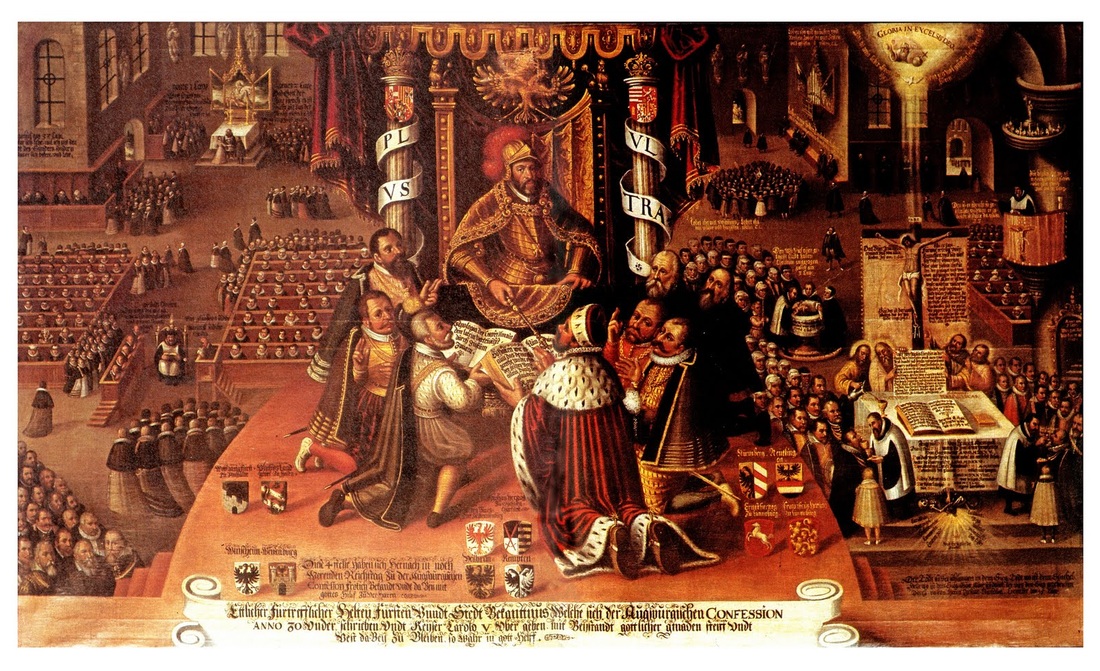
The Treaty of Augsburg, signed on September 25, 1555, was a pivotal agreement in European history, marking a significant milestone in the relationship between the Catholic Church and the emerging Protestant movements within the Holy Roman Empire. This treaty was the culmination of a series of conflicts and negotiations, particularly between Charles V, the Holy Roman Emperor, and the Protestant princes of the Empire, led by Maurice of Saxony. Here are five key facts about the Augsburg Treaty:
Background and Context

The mid-16th century was a time of great upheaval in Europe, with the Protestant Reformation challenging the authority of the Catholic Church. The Holy Roman Empire, which encompassed a vast territory including present-day Germany, Austria, Switzerland, and parts of France and Italy, was at the center of this conflict. Charles V, who ruled over a significant portion of Europe, including Spain, the Netherlands, and the Holy Roman Empire, was a staunch Catholic and initially opposed the Protestant movement. However, the military and political pressures exerted by Protestant princes, coupled with the failure of the Schmalkaldic War (a conflict between Catholic and Protestant forces within the Empire), necessitated a negotiated settlement.
Key Provisions of the Treaty
The Treaty of Augsburg was a compromise that recognized the right of each German state within the Holy Roman Empire to choose between Catholicism and Lutheranism. This principle, known as Cuius regio, eius religio (whose region, his religion), allowed rulers to decide the religion of their subjects, thereby legitimizing Lutheranism and providing a framework for coexistence between Catholics and Lutherans. This was a significant departure from the previous policy of attempting to suppress Protestantism through force and was a recognition of the political reality that Protestantism had become a lasting feature of the religious landscape of Europe.
| Year | Event | Outcome |
|---|---|---|
| 1546 | Start of the Schmalkaldic War | Defeat of Protestant forces, leading to the eventual negotiation of the Treaty of Augsburg |
| 1552 | Passage of the Treaty of Passau | Interim agreement that paved the way for the Treaty of Augsburg by granting freedoms to Protestants |
| 1555 | Signing of the Treaty of Augsburg | Official recognition of Lutheranism within the Holy Roman Empire and the principle of Cuius regio, eius religio |
Impact and Legacy

The Treaty of Augsburg had far-reaching implications for the political and religious landscape of Europe. By recognizing the legitimacy of Protestantism, it ended the idea of a unified Christendom under the Pope and the Holy Roman Emperor, paving the way for the modern system of nation-states with varying religious identities. However, it also contained the seeds of future conflict, as the principle of Cuius regio, eius religio could lead to the persecution of religious minorities within states that chose a different religion. This treaty did not address the rights of other Protestant denominations, such as Calvinists, or Catholics living in Protestant territories, leading to ongoing religious tensions and conflicts in the centuries that followed.
Limitations and Future Developments
Despite its significance, the Treaty of Augsburg had its limitations. It did not provide a comprehensive solution to the religious divisions within the Holy Roman Empire and beyond. The Peace of Westphalia in 1648, which ended the Thirty Years’ War, further developed the principles of sovereignty and non-interference in the internal affairs of other states, including religious matters, building upon the foundation laid by the Treaty of Augsburg. The legacy of Augsburg can be seen in the modern concept of religious freedom and the separation of church and state, though these principles evolved over time through additional conflicts, treaties, and philosophical developments.
Key Points
- The Treaty of Augsburg was signed on September 25, 1555, recognizing Lutheranism as a legitimate religion within the Holy Roman Empire.
- The treaty established the principle of Cuius regio, eius religio, allowing each state to choose between Catholicism and Lutheranism.
- It marked a significant step towards religious tolerance and the recognition of state sovereignty over religious matters.
- The treaty had limitations, including the exclusion of other Protestant denominations and the potential for persecution of religious minorities.
- The legacy of the Treaty of Augsburg can be seen in the modern concepts of religious freedom and the separation of church and state.
In conclusion, the Treaty of Augsburg was a landmark agreement that reflected the political and religious realities of 16th-century Europe. Its impact on the development of religious tolerance, state sovereignty, and the eventual separation of church and state has been profound, influencing the course of European and world history. Understanding the complexities and limitations of this treaty provides valuable insights into the evolution of religious freedom and political sovereignty.
What was the main outcome of the Treaty of Augsburg?
+The main outcome was the recognition of Lutheranism as a legitimate religion within the Holy Roman Empire, alongside Catholicism, and the establishment of the principle that each state could choose its official religion.
How did the Treaty of Augsburg influence the concept of religious freedom?
+The treaty marked an early step towards recognizing religious freedom by acknowledging the legitimacy of different religious beliefs within a single political entity. However, it was limited in scope, applying primarily to Lutherans and Catholics, and did not immediately lead to broad religious tolerance.
What were the limitations of the Treaty of Augsburg?
+The treaty’s limitations included the exclusion of other Protestant denominations, such as Calvinism, and the potential for religious minorities to face persecution in states where their religion was not the officially recognized one.