The total revenue formula is a fundamental concept in business and economics, representing the total income generated by a company or organization from its sales of goods or services. It is calculated by multiplying the number of units sold by the price per unit. Understanding the total revenue formula is crucial for businesses to make informed decisions about pricing, production, and investment. In this article, we will delve into the total revenue formula, exploring its components, calculations, and applications, as well as providing insights into how it can be maximized.
Key Points
- The total revenue formula is calculated as the product of the number of units sold and the price per unit.
- Pricing strategies can significantly impact total revenue, with elastic and inelastic demand curves influencing how changes in price affect sales volume.
- Production costs, including fixed and variable costs, must be considered when determining the optimal price and quantity for maximizing total revenue.
- Investment decisions, such as expanding production capacity or entering new markets, should be based on detailed analysis of potential returns on investment in relation to total revenue projections.
- Market trends and consumer behavior play a critical role in determining the effectiveness of pricing and production strategies aimed at maximizing total revenue.
Understanding the Total Revenue Formula
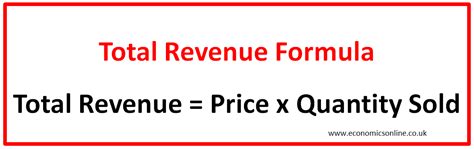
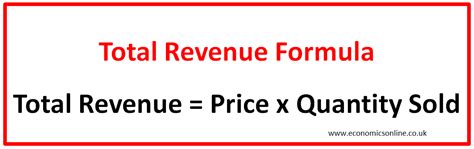
The total revenue formula is given by TR = P * Q, where TR is the total revenue, P is the price per unit, and Q is the number of units sold. This formula is straightforward but powerful, as it encapsulates the two primary levers that businesses can adjust to influence their revenue: the price of their products or services and the quantity they sell.
Components of the Total Revenue Formula
Both price (P) and quantity (Q) are critical components of the total revenue formula. The price per unit is determined by a variety of factors, including production costs, market conditions, and the pricing strategies of competitors. The quantity sold, on the other hand, is influenced by factors such as consumer demand, the availability of substitutes, and the marketing efforts of the company.
Calculating Total Revenue
To illustrate the calculation of total revenue, consider a company that sells 100 units of a product at 50 per unit. Using the total revenue formula, TR = P * Q, we find that TR = 50 * 100 = $5,000. This calculation provides a basic understanding of how total revenue is determined, but in real-world scenarios, businesses must consider more complex factors that affect both price and quantity sold.
| Price per Unit | Quantity Sold | Total Revenue |
|---|---|---|
| $50 | 100 units | $5,000 |
| $75 | 80 units | $6,000 |
| $40 | 120 units | $4,800 |
Maximizing Total Revenue
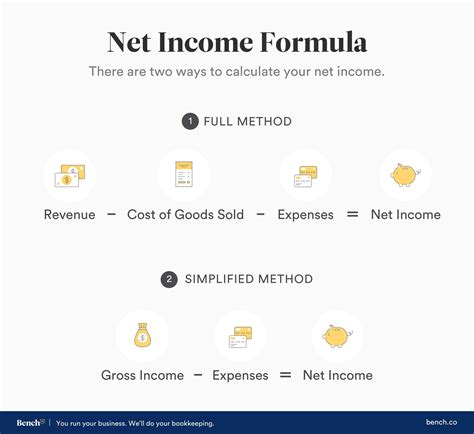
Maximizing total revenue involves finding the right balance between the price charged and the quantity sold. This can be achieved through various strategies, including pricing adjustments, improvements in product quality, targeted marketing campaigns, and expansion into new markets. Each of these strategies must be carefully considered in the context of the total revenue formula and the broader market environment.
Pricing Strategies
Pricing is a critical factor in determining total revenue. Businesses can employ different pricing strategies, such as penetration pricing, skimming, or competitive pricing, depending on their market position and goals. The choice of pricing strategy should be informed by an understanding of the demand curve, as changes in price can have differing effects on the quantity sold, thereby impacting total revenue.
Production and Investment Decisions
Production decisions, including the quantity to produce and the resources to allocate, are directly tied to total revenue. Businesses must weigh the costs of production against potential revenue to determine the optimal level of output. Investment decisions, such as expanding production capacity or entering new markets, should also be evaluated based on their potential impact on total revenue, considering both the costs and the expected returns.
Market Trends and Consumer Behavior
Market trends and consumer behavior play a significant role in determining the effectiveness of strategies aimed at maximizing total revenue. Understanding consumer preferences, demand elasticity, and market trends is essential for making informed decisions about pricing, production, and investment. Businesses that can adapt their strategies to align with changing market conditions and consumer behaviors are better positioned to achieve their revenue goals.
What is the total revenue formula?
+The total revenue formula is TR = P * Q, where TR is the total revenue, P is the price per unit, and Q is the number of units sold.
How do pricing strategies affect total revenue?
+Pricing strategies can significantly impact total revenue. Changes in price can affect the quantity sold, depending on the elasticity of demand. Businesses must choose pricing strategies that balance revenue goals with consumer demand and market conditions.
What factors influence production decisions in relation to total revenue?
+Production decisions are influenced by the costs of production, the expected price per unit, and the potential quantity sold. Businesses aim to produce at a level that maximizes total revenue while considering the constraints of production costs and market demand.
In conclusion, the total revenue formula provides a foundational understanding of how businesses generate income from the sale of goods or services. By grasping the interplay between price and quantity sold, and considering factors such as market trends, consumer behavior, and production costs, businesses can develop effective strategies to maximize their total revenue. Whether through pricing adjustments, improvements in product quality, or expansion into new markets, the key to success lies in a deep understanding of the total revenue formula and its applications in real-world business scenarios.