The city of Washington, D.C. is home to a plethora of think tanks, institutions that have been shaping policy and public discourse for decades. These organizations, often non-profit and non-partisan, are designed to provide a platform for experts and scholars to conduct research, analyze data, and develop innovative solutions to complex problems. With a wide range of focus areas, from foreign policy and national security to economics and social issues, D.C. think tanks have become an integral part of the nation's capital's intellectual and policy landscape.
One of the most well-known think tanks in D.C. is the Brookings Institution, founded in 1916. Brookings is a premier research organization that has been at the forefront of policy analysis and development, with a focus on issues such as economic policy, foreign policy, and governance. The institution is known for its unbiased and data-driven approach, making it a trusted source for policymakers, journalists, and scholars alike. Another prominent think tank is the Center for Strategic and International Studies (CSIS), which was established in 1962. CSIS is a leader in the field of international security and foreign policy, providing analysis and recommendations on issues such as terrorism, nuclear proliferation, and global governance.
Types of Think Tanks in D.C.

Think tanks in D.C. can be broadly categorized into several types, each with its own unique focus and approach. Some think tanks, such as the Heritage Foundation and the Cato Institute, are known for their conservative or libertarian perspectives, while others, like the Center for American Progress and the Economic Policy Institute, have a more progressive or liberal bent. There are also think tanks that specialize in specific areas, such as the Woodrow Wilson International Center for Scholars, which focuses on international affairs and global issues, and the Urban Institute, which concentrates on urban policy and social issues.
Think Tank Funding and Transparency
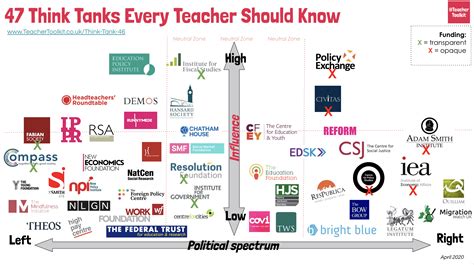
Think tanks in D.C. are often funded by a variety of sources, including private donations, grants, and government contracts. While some think tanks are transparent about their funding sources, others have faced criticism for their lack of disclosure. The issue of funding transparency has become increasingly important in recent years, as some think tanks have been accused of promoting the interests of their donors rather than conducting independent research. In response, some think tanks have begun to disclose their funding sources and implement stricter conflict-of-interest policies.
| Think Tank | Funding Source | Focus Area |
|---|---|---|
| Brookings Institution | Private donations, grants | Economic policy, foreign policy, governance |
| Center for Strategic and International Studies (CSIS) | Government contracts, private donations | International security, foreign policy, global governance |
| Heritage Foundation | Private donations, grants | Conservative policy, economic policy, national security |

Key Points
- Think tanks in D.C. are non-profit, non-partisan institutions that conduct research and analysis on a wide range of policy issues.
- Brookings Institution and CSIS are two of the most well-known think tanks in D.C., with a focus on economic policy, foreign policy, and international security.
- Think tanks can be categorized into different types, including conservative, progressive, and specialized institutions.
- Funding transparency is an important issue for think tanks, with some institutions facing criticism for their lack of disclosure.
- Think tanks play a vital role in shaping policy and public discourse, but also face potential pitfalls, including the influence of funding sources and the risk of bias.
Impact of Think Tanks on Policy

Think tanks in D.C. have a significant impact on policy, with many institutions providing research and analysis that informs decision-making at the highest levels of government. For example, the Brookings Institution’s research on economic policy has been cited by policymakers and journalists alike, while CSIS’s analysis of international security issues has influenced the development of national security strategy. Think tanks also provide a platform for experts and scholars to engage in public debate and discussion, helping to shape public opinion and inform the policy agenda.
Challenges Facing Think Tanks
Despite their influence, think tanks in D.C. face a number of challenges, including the need to maintain funding, ensure transparency and accountability, and navigate the complexities of the policy landscape. Additionally, think tanks must balance the need to provide independent research and analysis with the need to engage with policymakers and other stakeholders. As the policy landscape continues to evolve, think tanks must adapt and innovate, finding new ways to conduct research, communicate their findings, and influence policy and public discourse.
In conclusion, think tanks in D.C. play a vital role in shaping policy and public discourse, providing research and analysis on a wide range of issues. While they face challenges and criticisms, think tanks remain an essential part of the nation's capital's intellectual and policy landscape, helping to inform decision-making and promote a more nuanced understanding of complex policy issues.
What is the purpose of think tanks in D.C.?
+Think tanks in D.C. are designed to provide a platform for experts and scholars to conduct research, analyze data, and develop innovative solutions to complex problems. They play a vital role in shaping policy and public discourse, informing decision-making at the highest levels of government.
How are think tanks in D.C. funded?
+Think tanks in D.C. are often funded by a variety of sources, including private donations, grants, and government contracts. While some think tanks are transparent about their funding sources, others have faced criticism for their lack of disclosure.
What are some of the challenges facing think tanks in D.C.?
+Think tanks in D.C. face a number of challenges, including the need to maintain funding, ensure transparency and accountability, and navigate the complexities of the policy landscape. Additionally, think tanks must balance the need to provide independent research and analysis with the need to engage with policymakers and other stakeholders.
Meta description: “Discover the role of think tanks in D.C., including their purpose, funding, and impact on policy. Learn about the challenges facing these institutions and their importance in shaping public discourse.” (149 characters)