Understanding the differences between "there," "their," and "they're" is crucial for effective communication in English. These three words are often confused with one another due to their similar spellings and pronunciations, but they have distinct meanings and uses. In this article, we will delve into the proper usage of each word, providing examples and explanations to help clarify their roles in sentence construction.
Introduction to the Three Words
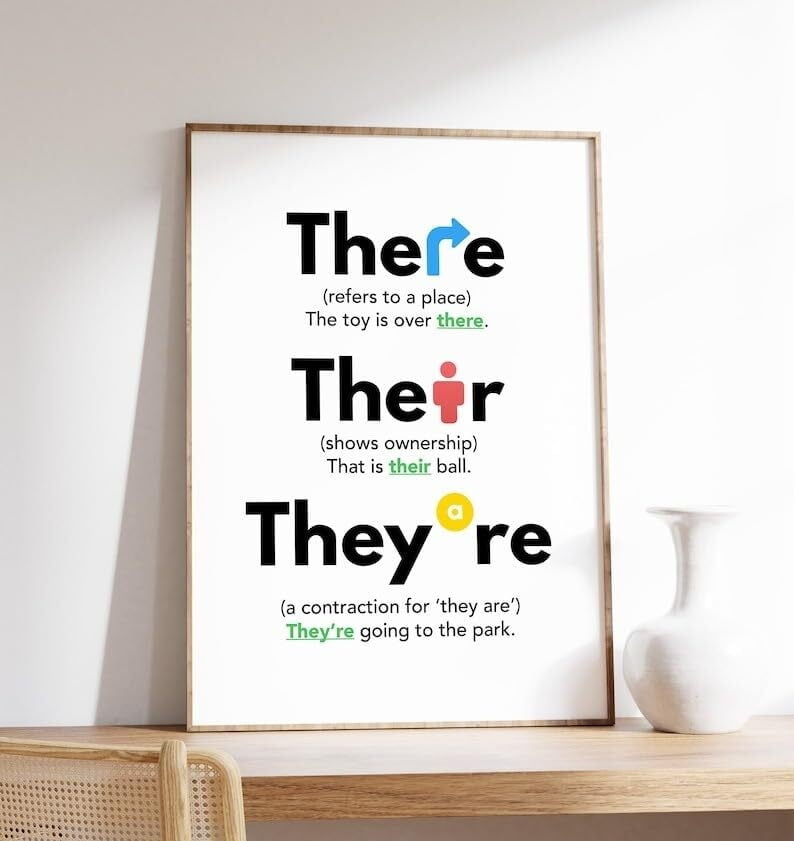
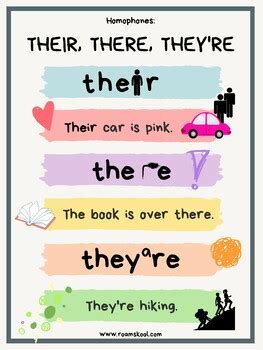
To begin with, it’s essential to understand the basic definitions of “there,” “their,” and “they’re.” “There” is typically used to indicate a direction or location, such as “put the book over there on the table.” On the other hand, “their” is a possessive pronoun, meaning something belongs to them, as in “their car is red.” Lastly, “they’re” is a contraction of “they are,” used in sentences like “they’re coming over tonight.”
Key Points
- Understanding the basic definitions of "there," "their," and "they're" is essential for proper usage.
- "There" indicates direction or location.
- "Their" is a possessive pronoun.
- "They're" is a contraction of "they are."
- Contextual examples help in distinguishing between the three words.
Using “There” Correctly
“There” is used to refer to a place or direction. For example, “I’m going over there to meet my friends.” It can also be used to start a sentence, as in “There are many reasons why I love reading.” A common mistake is using “their” instead of “there” when referring to a location. Remember, if you’re talking about a place, “there” is the correct choice.
Using “Their” Correctly
“Their” shows that something belongs to them. For instance, “Their house is very beautiful.” It’s a possessive pronoun, indicating that something is owned by “them.” A trick to remember the difference between “their” and “there” is to replace “their” with “my” or “your” in the sentence. If it makes sense, then “their” is the correct choice.
Using “They’re” Correctly
“They’re” is short for “they are.” It’s used in sentences like “They’re going to the movies tonight.” If you can replace “they’re” with “they are” in your sentence, then you’re using it correctly. For example, “They’re happy” can be rewritten as “They are happy,” which makes it clear that “they’re” is the correct choice.
| Word | Meaning | Example Sentence |
|---|---|---|
| There | Direction or Location | Put the book over there. |
| Their | Possessive Pronoun | Their car is very fast. |
| They're | Contraction of "they are" | They're coming over tonight. |
In conclusion, mastering the use of "there," "their," and "they're" requires practice and a good understanding of their definitions. By applying the tips and examples provided in this article, you can improve your English writing and speaking skills, ensuring that your communication is clear and effective.
What’s the easiest way to remember the difference between “there,” “their,” and “they’re”?
+A helpful trick is to try replacing the word in your sentence with “they are” for “they’re,” or think about ownership for “their,” and direction or location for “there.” This can help you decide which word is correct in the context of your sentence.
Can you provide more examples of how to use “there,” “their,” and “they’re” in sentences?
+Sure, here are a few more examples: “There is a book on the table,” showing location; “Their favorite food is pizza,” showing possession; and “They’re studying for their exam,” where “they’re” is a contraction of “they are.” Practicing with different sentences can help solidify your understanding.
How does understanding the difference between these three words impact my writing and speaking?
+Correctly using “there,” “their,” and “they’re” enhances the clarity and professionalism of your communication. It helps avoid confusion and ensures that your intended message is conveyed accurately, whether in personal, academic, or professional contexts.