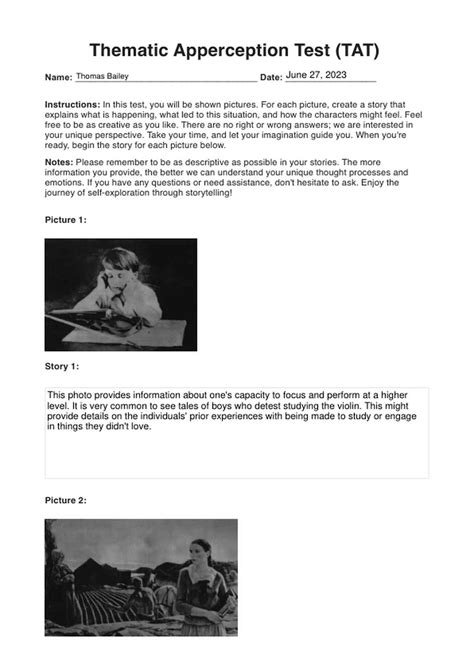
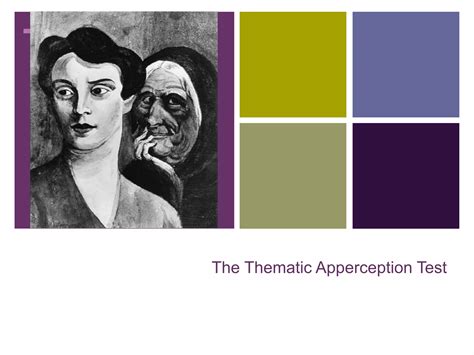
The Thematic Apperception Test (TAT) is a widely used projective psychological test that aims to explore an individual's unconscious thoughts, feelings, and motivations. Developed by Henry Murray and Christina Morgan in the 1930s, the TAT has been a cornerstone in the field of psychology, particularly in the realm of personality assessment. The test consists of a series of pictures, each depicting a scene or character, and the respondent is asked to create a narrative based on the image. This narrative is then analyzed to gain insight into the individual's underlying psychological dynamics.
The TAT is founded on the principle that an individual's responses to ambiguous stimuli can reveal hidden aspects of their personality, including their desires, fears, and conflicts. By examining the themes, emotions, and relationships that emerge in the respondent's stories, a skilled psychologist can identify patterns and trends that may not be immediately apparent through other assessment methods. The TAT has been employed in a variety of settings, including clinical, research, and forensic contexts, to assess personality, diagnose psychological disorders, and predict behavioral tendencies.
Key Points
- The TAT is a projective test that explores an individual's unconscious thoughts and feelings through narrative responses to a series of pictures.
- The test is based on the principle that responses to ambiguous stimuli can reveal hidden aspects of personality, including desires, fears, and conflicts.
- The TAT has been used in various contexts, including clinical, research, and forensic settings, to assess personality, diagnose psychological disorders, and predict behavioral tendencies.
- A skilled psychologist analyzes the themes, emotions, and relationships in the respondent's stories to identify patterns and trends that may not be immediately apparent.
- The TAT has been a cornerstone in the field of psychology, particularly in the realm of personality assessment, since its development in the 1930s.
Administration and Scoring of the TAT
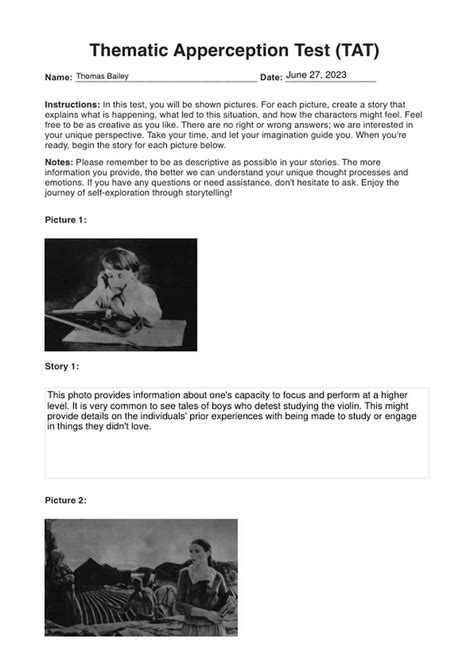
The administration of the TAT involves presenting the respondent with a series of pictures, typically 10-20, and asking them to create a narrative based on each image. The pictures are deliberately ambiguous, allowing the respondent to project their own thoughts, feelings, and experiences onto the scene. The stories are then recorded and transcribed, providing a rich source of data for analysis. The scoring of the TAT is a complex and nuanced process, requiring a deep understanding of psychological theory and practice. A skilled psychologist will examine the respondent’s stories, identifying themes, emotions, and relationships that emerge across the narratives.
Interpretation of TAT Responses
The interpretation of TAT responses is a critical aspect of the assessment process. A psychologist will analyze the respondent’s stories, looking for patterns and trends that may indicate underlying psychological dynamics. For example, a respondent who consistently creates stories featuring themes of aggression and conflict may be experiencing unconscious feelings of anger or hostility. Similarly, a respondent who produces stories with prominent themes of dependency and nurturing may be struggling with issues of autonomy and self-care. The TAT can also be used to assess an individual’s cognitive functioning, including their ability to think logically and solve problems.
| TAT Scoring Category | Description |
|---|---|
| Theme | The underlying idea or concept that emerges in the respondent's story. |
| Emotion | The feelings and emotional tone that are present in the respondent's narrative. |
| Relationships | The interactions and dynamics between characters in the respondent's story. |
| Cognitive Functioning | The respondent's ability to think logically, solve problems, and demonstrate cognitive flexibility. |
Criticisms and Limitations of the TAT
Despite its widespread use and acceptance, the TAT has faced criticism and controversy over the years. Some researchers have questioned the test’s reliability and validity, arguing that the results are too subjective and dependent on the examiner’s interpretation. Others have criticized the TAT for its lack of standardization, as the pictures and administration procedures can vary significantly from one test to another. Additionally, the TAT has been criticized for its cultural bias, as the pictures and themes may not be relevant or meaningful to individuals from diverse cultural backgrounds.
Future Directions for the TAT
Despite these limitations, the TAT remains a valuable tool in the field of psychology, offering a unique window into an individual’s unconscious thoughts and feelings. Future research should focus on developing more standardized and culturally sensitive versions of the test, as well as exploring new methods for analyzing and interpreting the results. The integration of the TAT with other assessment tools and techniques, such as cognitive-behavioral therapy and neuroimaging, may also provide new insights into the underlying psychological mechanisms that drive human behavior.
What is the primary purpose of the Thematic Apperception Test (TAT)?
+The primary purpose of the TAT is to explore an individual's unconscious thoughts, feelings, and motivations through narrative responses to a series of pictures.
How is the TAT administered and scored?
+The TAT is administered by presenting the respondent with a series of pictures and asking them to create a narrative based on each image. The stories are then recorded and transcribed, and a skilled psychologist analyzes the themes, emotions, and relationships that emerge in the respondent's stories to identify patterns and trends that may indicate underlying psychological dynamics.
What are some of the criticisms and limitations of the TAT?
+The TAT has faced criticism and controversy over the years, including questions about its reliability and validity, lack of standardization, and cultural bias. Despite these limitations, the TAT remains a valuable tool in the field of psychology, offering a unique window into an individual's unconscious thoughts and feelings.
Meta Description: The Thematic Apperception Test (TAT) is a projective psychological test that explores an individual’s unconscious thoughts, feelings, and motivations through narrative responses to a series of pictures. Learn more about the administration, scoring, and interpretation of the TAT, as well as its criticisms and limitations.