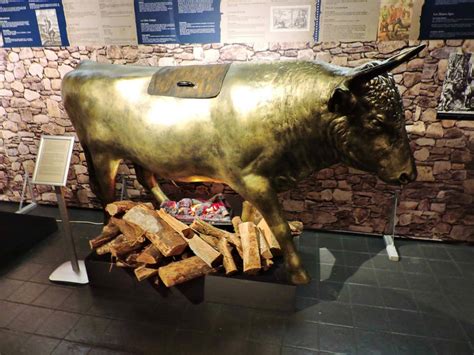
The Brazen Bull, a torture device of ancient Greek origin, is one of the most infamous and gruesome instruments of punishment in human history. Its design and intended use are a stark reflection of the brutal and often inhumane treatment of individuals deemed enemies of the state or criminals in ancient societies. The device's name is derived from its shape, resembling a bull, and its construction from bronze, a durable and conductive metal. This article delves into the history, design, and implications of the Brazen Bull, exploring its significance in the context of ancient torture methods and the ethical considerations surrounding its use.
Historical Context and Design
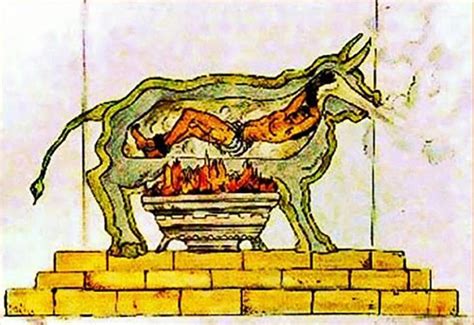
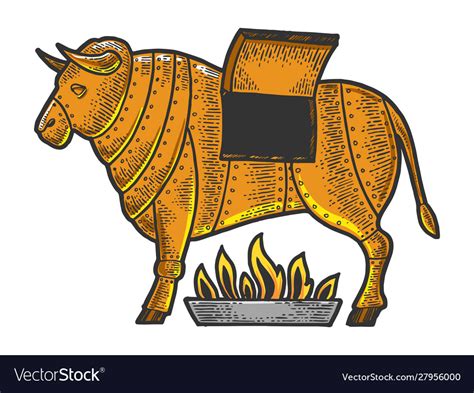
The Brazen Bull is often attributed to Perillos of Athens, a metalworker who, according to legend, designed the device for Phalaris, the tyrant of Akragas (modern-day Agrigento, Sicily), in the 6th century BC. The story goes that Perillos, seeking to ingratiate himself with Phalaris, presented him with the Brazen Bull as a means of executing enemies of the state in a particularly cruel and public manner. The device was hollow, with a door on one side, and once a person was placed inside, the door would be closed, and a fire would be lit underneath, causing the bronze to heat up. The screams of the person inside were said to sound like the bellowing of a bull, hence the name.
Construction and Mechanism
The construction of the Brazen Bull involved sophisticated metalworking techniques, given the time period. It was designed to be a self-contained device, with the person to be executed placed inside through a door that was then sealed. The outside of the bull was often decorated with details that enhanced its bull-like appearance. Once the fire was lit, the metal would conduct and distribute the heat evenly, ensuring a slow and agonizing death for the person inside. The device was also said to have musical pipes that would amplify and modify the sounds of the person’s screams, further enhancing the theatrical and intimidating effect of the execution.
| Component | Description |
|---|---|
| Hollow Bronze Body | Served as the main compartment where the victim was placed |
| Door | Allowed for the placement and sealing of the victim inside the bull |
| Fire Pit | Location where the fire was lit to heat the bronze |
| Musical Pipes | Amplified and modified the screams of the victim |
Implications and Ethical Considerations
The use of the Brazen Bull as a method of execution raises profound ethical questions about the treatment of prisoners, the nature of punishment, and the limits of human cruelty. The device’s design, intended to prolong suffering and make death a spectacle, is a stark example of how societies have sometimes resorted to inhumane practices in the name of justice or control. The historical context in which the Brazen Bull was used also highlights the power dynamics at play, with those in authority using such devices to assert their dominance and instill fear among their subjects.
Societal and Psychological Impact
Beyond the immediate physical suffering it inflicted, the Brazen Bull had a broader societal and psychological impact. It served as a tool of terror, meant to deter opposition and dissent through the threat of a horrific death. The public nature of such executions was also intended to reinforce the power of the ruling authority, demonstrating their ability to mete out extreme punishments. However, the use of such a device also reflects the darker aspects of human nature, revealing a capacity for cruelty and a willingness to inflict suffering for political or social control.
Key Points
- The Brazen Bull is an ancient Greek torture device attributed to Perillos of Athens, designed for Phalaris, the tyrant of Akragas.
- Its construction involved sophisticated metalworking techniques, with a hollow bronze body, a door for sealing the victim inside, a fire pit to heat the metal, and musical pipes to amplify and modify the victim's screams.
- The device was used as a means of public execution, intended to prolong suffering and make death a spectacle, raising profound ethical questions about the treatment of prisoners and the nature of punishment.
- The use of the Brazen Bull reflects the power dynamics of ancient societies, with those in authority using such devices to assert dominance and instill fear.
- Beyond its immediate physical impact, the Brazen Bull had a broader societal and psychological impact, serving as a tool of terror and reinforcing the power of ruling authorities.
In conclusion, the Brazen Bull is a stark reminder of the darker aspects of human history, highlighting the need for ongoing ethical considerations and reflections on the treatment of individuals within societal structures. Through its design and intended use, the Brazen Bull underscores the importance of human rights, dignity, and the ethical boundaries that should govern punishment and treatment of prisoners. As a historical artifact, it serves as a cautionary tale about the dangers of unchecked power and the importance of empathy and humanity in governance.
What was the primary purpose of the Brazen Bull in ancient societies?
+The primary purpose of the Brazen Bull was to serve as a means of public execution, intended to inflict extreme suffering and make death a spectacle, thereby deterring opposition and reinforcing the power of the ruling authority.
How did the Brazen Bull reflect the societal and psychological dynamics of ancient Greece?
+The Brazen Bull reflected the darker aspects of human nature, revealing a capacity for cruelty and a willingness to inflict suffering for political or social control. It also underscored the power dynamics at play, with those in authority using such devices to assert dominance and instill fear among their subjects.
What ethical considerations does the use of the Brazen Bull raise?
+The use of the Brazen Bull raises profound ethical questions about the treatment of prisoners, the nature of punishment, and the limits of human cruelty. It highlights the need for ongoing ethical reflections on the boundaries that should govern punishment and the importance of human rights and dignity.