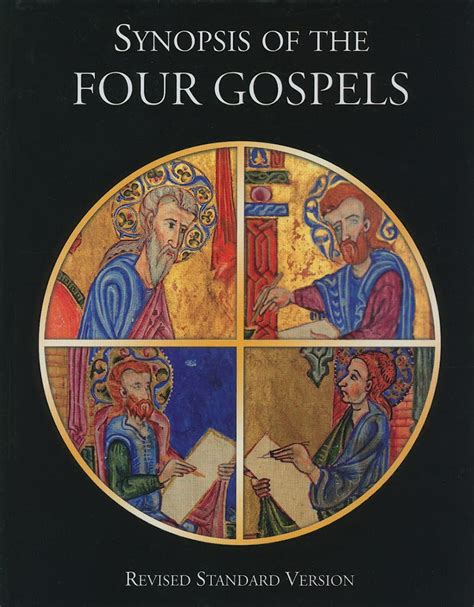
The 4 Gospels, namely Matthew, Mark, Luke, and John, are the foundation of the New Testament in the Bible, providing a comprehensive account of the life, teachings, death, and resurrection of Jesus Christ. These Gospels have been a subject of interest and study for centuries, with each one offering a unique perspective on the life and ministry of Jesus. In this article, we will delve into the distinct characteristics, themes, and emphasis of each Gospel, exploring their historical context, literary style, and theological significance.
Key Points
- The Gospel of Matthew emphasizes Jesus' fulfillment of Old Testament prophecies and his role as the Messiah.
- The Gospel of Mark focuses on the actions and deeds of Jesus, portraying him as a servant and suffering Messiah.
- The Gospel of Luke highlights Jesus' concern for the poor, the marginalized, and the outcasts, showcasing his compassionate and inclusive nature.
- The Gospel of John presents a more theological and philosophical approach, emphasizing Jesus' divinity and his role as the Word of God.
- The 4 Gospels provide a rich and complex portrait of Jesus, revealing his multifaceted personality, teachings, and mission.
The Gospel of Matthew
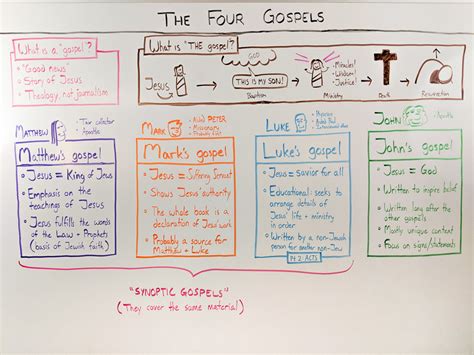
The Gospel of Matthew is often considered the most Jewish of the 4 Gospels, as it explicitly links Jesus to the Old Testament prophecies and emphasizes his role as the Messiah. Written primarily for a Jewish audience, Matthew’s Gospel highlights Jesus’ fulfillment of various prophetic expectations, such as his birth in Bethlehem (Matthew 2:5-6) and his ministry in Galilee (Matthew 4:12-17). The Gospel of Matthew also includes the famous Sermon on the Mount (Matthew 5-7), which showcases Jesus’ teachings on the Kingdom of God, morality, and spirituality.
The Structure and Style of Matthew’s Gospel
Matthew’s Gospel is structured around five discourses, each concluding with a phrase similar to “when Jesus had finished saying these things” (Matthew 7:28, 11:1, 13:53, 19:1, 26:1). This literary device emphasizes the importance of Jesus’ teachings and provides a framework for understanding his ministry. Matthew’s style is often described as formal and systematic, reflecting his background as a tax collector and his concern for accuracy and detail.
The Gospel of Mark
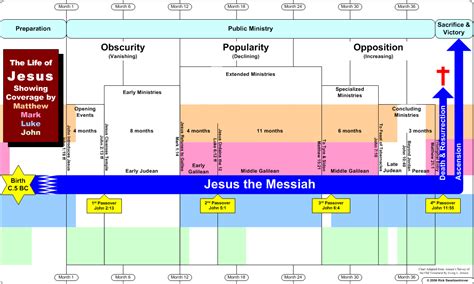
The Gospel of Mark is distinct from the other three Gospels in its focus on the actions and deeds of Jesus, rather than his teachings. Mark’s Gospel is often characterized as a “gospel of action,” with a rapid pace and an emphasis on Jesus’ miracles, healings, and exorcisms. This Gospel also introduces the concept of the “Messianic secret,” where Jesus orders his disciples and others to keep his identity as the Messiah hidden (Mark 1:34, 3:12, 5:43, 7:36, 8:30, 9:9). Mark’s Gospel concludes with the dramatic and enigmatic ending of the empty tomb, leaving the reader with a sense of mystery and awe.
The Christology of Mark’s Gospel
Mark’s Gospel presents a unique Christology, emphasizing Jesus’ role as a suffering servant and Messiah. This is evident in the repeated references to Jesus’ passion and death, as well as the emphasis on his servanthood and humility (Mark 10:45). Mark’s Gospel also highlights the importance of faith and trust in Jesus, as demonstrated by the various characters who encounter him, such as the blind man Bartimaeus (Mark 10:46-52) and the woman with the flow of blood (Mark 5:25-34).
The Gospel of Luke
The Gospel of Luke is notable for its emphasis on Jesus’ concern for the poor, the marginalized, and the outcasts. Luke’s Gospel includes a range of stories and parables that highlight Jesus’ compassion and inclusivity, such as the parable of the good Samaritan (Luke 10:25-37) and the story of the prodigal son (Luke 15:11-32). This Gospel also includes a unique emphasis on the role of women in Jesus’ ministry, including the accounts of Elizabeth and Mary (Luke 1:5-56) and the women who supported Jesus’ ministry (Luke 8:1-3).
The Social and Economic Context of Luke’s Gospel
Luke’s Gospel reflects a deep concern for the social and economic realities of the ancient world. The Gospel includes a range of stories and teachings that address issues such as poverty, wealth, and inequality, such as the parable of the rich fool (Luke 12:13-21) and the story of the rich man and Lazarus (Luke 16:19-31). Luke’s Gospel also emphasizes the importance of community and shared resources, as seen in the early Christian community in Jerusalem (Acts 2:42-47, 4:32-37).
The Gospel of John
The Gospel of John is distinct from the other three Gospels in its theological and philosophical approach. John’s Gospel emphasizes Jesus’ divinity and his role as the Word of God, introducing the concept of the Logos (John 1:1-18). This Gospel also includes a range of “I am” statements, where Jesus identifies himself with various metaphors and images, such as the bread of life (John 6:35), the light of the world (John 8:12), and the good shepherd (John 10:11-18). John’s Gospel concludes with the dramatic and poignant scene of Jesus’ crucifixion and resurrection, emphasizing the importance of faith and trust in Jesus as the Son of God.
The Theology of John’s Gospel
John’s Gospel presents a rich and complex theology, emphasizing Jesus’ divinity and his role as the Word of God. This Gospel also includes a range of themes and motifs, such as light and darkness, love and hate, and faith and unbelief. John’s Gospel emphasizes the importance of spiritual rebirth and regeneration, as seen in the encounter between Jesus and Nicodemus (John 3:1-21) and the story of the woman at the well (John 4:1-42).
| Gospel | Emphasis | Themes |
|---|---|---|
| Matthew | Fulfillment of Old Testament prophecies | Messiah, Kingdom of God, morality |
| Mark | Actions and deeds of Jesus | Suffering servant, Messiah, faith |
| Luke | Concern for the poor and marginalized | Compassion, inclusivity, community |
| John | Divinity of Jesus and his role as the Word of God | Light and darkness, love and hate, faith and unbelief |

What is the main emphasis of the Gospel of Matthew?
+The main emphasis of the Gospel of Matthew is the fulfillment of Old Testament prophecies and Jesus’ role as the Messiah.
What is the significance of the “Messianic secret” in Mark’s Gospel?
+The “Messianic secret” in Mark’s Gospel refers to Jesus’ orders to keep his identity as the Messiah hidden, emphasizing the importance of faith and trust in Jesus.
What is the unique emphasis of the Gospel of Luke?
+The unique emphasis of the Gospel of Luke is Jesus’ concern for the poor, the marginalized, and the outcasts, highlighting his compassion and inclusivity.
What is the theological significance of the Gospel of John?
+The theological significance of the Gospel of John is the emphasis on Jesus’ divinity and his role as the Word of God, introducing the concept of the Logos.
Why are the 4 Gospels important for understanding Jesus’ life and ministry?
+The 4 Gospels are important for understanding Jesus’ life and ministry because they provide a rich and complex portrait of Jesus, revealing his multifaceted personality, teachings, and mission.