Understanding the present tense in Spanish is crucial for effective communication, as it allows speakers to express actions, states, and events that are currently happening. The present tense, also known as "el presente" in Spanish, is used to describe routines, habits, general truths, and actions that are happening at the moment of speaking. One of the key aspects of the present tense is the verb "tener," which translates to "to have" in English. The conjugation of "tener" in the present tense is essential for expressing possession, age, and certain conditions or emotions. In this article, we will explore the conjugation of "tener" in the present tense and its various applications in Spanish language.
Introduction to Tener in the Present Tense
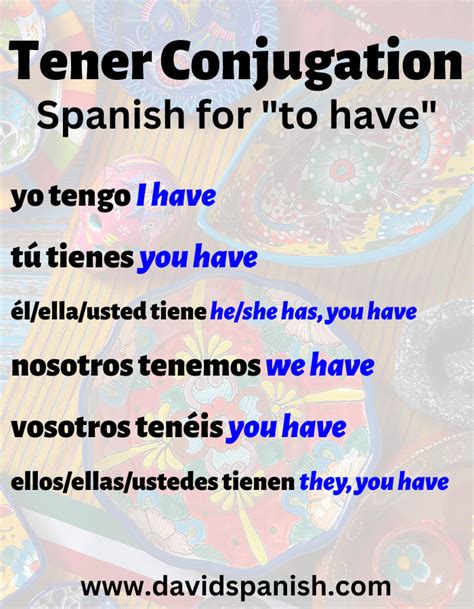
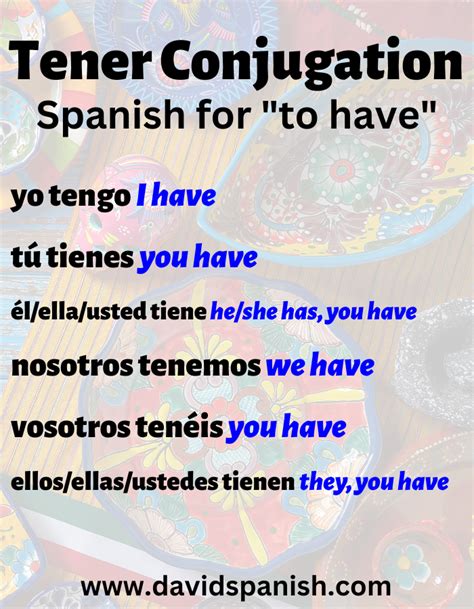
The verb “tener” is one of the most commonly used verbs in Spanish, and its conjugation in the present tense is relatively straightforward. To conjugate “tener” in the present tense, you need to drop the infinitive ending “-ar,” “-er,” or “-ir” and add the corresponding present tense ending. For “tener,” which is an “-er” verb, the conjugation is as follows: tengo (I have), tienes (you have), tiene (he/she/it has), tenemos (we have), tenéis (you all have), and tienen (they have). Understanding these conjugations is fundamental for constructing sentences that express possession, age, and other conditions.
Conjugation of Tener in the Present Tense
The conjugation of “tener” in the present tense varies depending on the subject pronoun. Here is a detailed breakdown of how “tener” is conjugated for each subject pronoun:
| Subject Pronoun | Conjugation of Tener |
|---|---|
| Yo (I) | tengo |
| Tú (You) | tienes |
| Él/Ella/Usted (He/She/You - formal) | tiene |
| Nosotros/Nosotras (We) | tenemos |
| Vosotros/Vosotras (You all - informal) | tenéis |
| Ellos/Ellas/Ustedes (They/You all - formal) | tienen |
This conjugation pattern allows speakers to express a wide range of ideas related to possession and condition. For example, "Tengo un libro" means "I have a book," and "Ella tiene un coche" means "She has a car."
5 Ways to Use Tener in the Present Tense
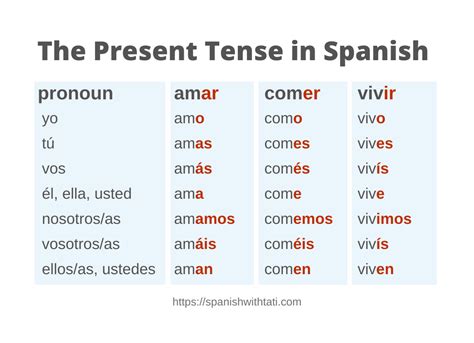
The present tense of “tener” is versatile and can be used in various contexts. Here are five ways to use “tener” in the present tense:
1. Expressing Possession: One of the primary uses of "tener" is to express possession or ownership. For example, "Tengo un perro" (I have a dog), "Ella tiene un teléfono nuevo" (She has a new phone), and "Ellos tienen una casa en la playa" (They have a house at the beach).
2. Describing Age: "Tener" is used to tell someone's age. For instance, "Tengo 30 años" (I am 30 years old), "Mi hermano tiene 12 años" (My brother is 12 years old), and "Ella tiene 50 años" (She is 50 years old).
3. Expressing Conditions or Emotions: "Tener" can be used to describe physical or emotional conditions. Examples include "Tengo sueño" (I am sleepy), "Ella tiene frío" (She is cold), and "Ellos tienen hambre" (They are hungry).
4. Talking About Relationships: "Tener" can be used to talk about relationships. For example, "Tengo una novia" (I have a girlfriend), "Ella tiene un novio" (She has a boyfriend), and "Ellos tienen hijos" (They have children).
5. Describing Health: Finally, "tener" is used to describe health conditions. For instance, "Tengo dolor de cabeza" (I have a headache), "Ella tiene un resfriado" (She has a cold), and "Ellos tienen alergias" (They have allergies).
Key Points
- The verb "tener" is conjugated in the present tense as tengo, tienes, tiene, tenemos, tenéis, and tienen.
- "Tener" is used to express possession, age, conditions, emotions, and relationships.
- The conjugation of "tener" varies depending on the subject pronoun.
- Understanding "tener" in the present tense is crucial for effective communication in Spanish.
- "Tener" has various applications, including describing health conditions and talking about relationships.
Common Mistakes and Tips for Improvement
When using “tener” in the present tense, it’s essential to avoid common mistakes such as incorrect conjugation or using “tener” in contexts where it doesn’t apply. Here are a few tips for improvement:
1. Practice Conjugation: Make sure to practice the conjugation of "tener" in the present tense regularly to ensure you understand the different forms and how they are used.
2. Listen to Native Speakers: Listening to native Spanish speakers use "tener" in context can help you better understand its nuances and applications.
3. Read Spanish Texts: Reading Spanish texts, such as books, articles, or news, can expose you to various uses of "tener" in the present tense, helping you to improve your comprehension and usage.
4. Speak with a Language Partner: Speaking with a language partner or tutor can provide you with the opportunity to practice using "tener" in the present tense in conversations, receiving feedback on your usage and pronunciation.
What is the conjugation of "tener" in the present tense for the subject pronoun "yo"?
+The conjugation of "tener" in the present tense for "yo" is "tengo."
Can "tener" be used to express age in Spanish?
+How can I improve my understanding and usage of "tener" in the present tense?
+You can improve by practicing conjugation, listening to native speakers, reading Spanish texts, and speaking with a language partner or tutor.
In conclusion, the conjugation and usage of “tener” in the present tense are fundamental aspects of the Spanish language, allowing speakers to express a wide range of ideas related to possession, age, conditions, and relationships. By understanding and practicing the conjugation of “tener” and being aware of its various applications, learners can improve their communication skills in Spanish and enhance their ability to express themselves effectively in different contexts.