Spanish indirect object pronouns can be a challenging topic for many language learners. However, with a clear understanding of their usage and practice, they can become an essential tool for effective communication in Spanish. In this article, we will delve into the world of Spanish indirect object pronouns, exploring their definition, usage, and practical applications.
Key Points
- Spanish indirect object pronouns are used to indicate the recipient of an action.
- The pronouns me, te, le, nos, os, and les are used as indirect object pronouns.
- The placement of indirect object pronouns can vary depending on the sentence structure.
- Understanding the difference between direct and indirect objects is crucial for correct pronoun usage.
- Practice and context are key to mastering Spanish indirect object pronouns.
Understanding Spanish Indirect Object Pronouns
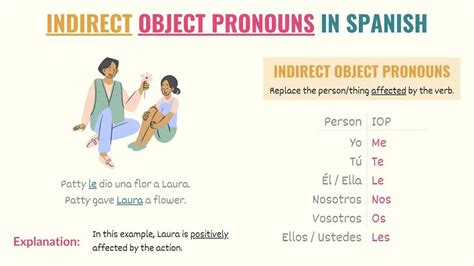
Indirect object pronouns in Spanish are used to indicate the recipient of an action. They are used to answer the question “to whom” or “for whom” the action is being performed. For example, in the sentence “I give the book to my friend,” the word “friend” is the indirect object because it receives the action of the verb “give.” In Spanish, the indirect object pronoun le would be used to replace “my friend” in this context.
Spanish Indirect Object Pronoun Forms
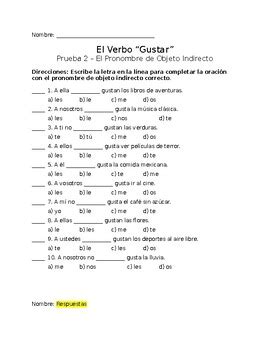
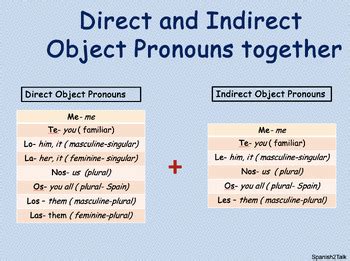
The Spanish indirect object pronouns are me (me), te (you), le (him/her/you formal), nos (us), os (you plural), and les (them/you plural formal). These pronouns are used to replace the indirect object noun in a sentence, making the sentence more concise and clear.
| Indirect Object Pronoun | English Equivalent |
|---|---|
| Me | Me |
| Te | You |
| Le | Him/Her/You (formal) |
| Nos | Us |
| Os | You (plural) |
| Les | Them/You (plural formal) |
Placement of Indirect Object Pronouns
The placement of indirect object pronouns in Spanish can vary depending on the sentence structure. In general, the pronoun is placed before the conjugated verb. For example, “I give the book to my friend” would become “Le doy el libro” (I give him/her the book). However, when using the present participle or the imperative, the pronoun can be attached to the end of the verb or placed before it, respectively.
Practice and Context
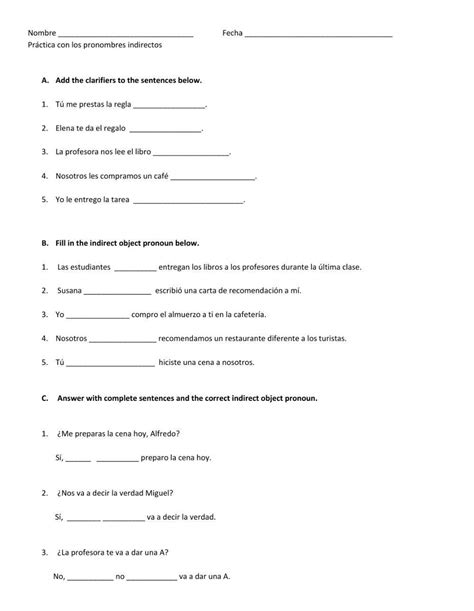
Mastering Spanish indirect object pronouns requires practice and context. It’s crucial to understand the difference between direct and indirect objects and to practice using the pronouns in various sentence structures. By reading Spanish texts, listening to native speakers, and engaging in conversations, learners can develop a deeper understanding of how indirect object pronouns are used in context.
Common Mistakes and Challenges
One of the most common mistakes when using Spanish indirect object pronouns is confusing them with direct object pronouns. It’s essential to remember that indirect object pronouns indicate the recipient of the action, while direct object pronouns indicate the object being acted upon. Another challenge is the variation in pronoun placement, which can depend on the sentence structure and the emphasis desired.
What is the main difference between direct and indirect object pronouns in Spanish?
+The main difference is that direct object pronouns indicate the object being acted upon, while indirect object pronouns indicate the recipient of the action.
How do I know when to use the indirect object pronoun le versus les?
+The pronoun le is used for singular indirect objects, while les is used for plural indirect objects. Additionally, les is used as a formal plural you, similar to ustedes.
Can indirect object pronouns be used with all verbs in Spanish?
+While indirect object pronouns can be used with many verbs, there are some exceptions, especially with verbs that do not typically take indirect objects. It's essential to learn the specific verb constructions and practice their usage.
In conclusion, Spanish indirect object pronouns are a vital component of the Spanish language, allowing for clear and effective communication. By understanding their definition, usage, and practice, learners can enhance their language skills and better navigate the complexities of Spanish grammar. Remember, mastering indirect object pronouns takes time and practice, but with dedication and the right resources, anyone can become proficient in their use.