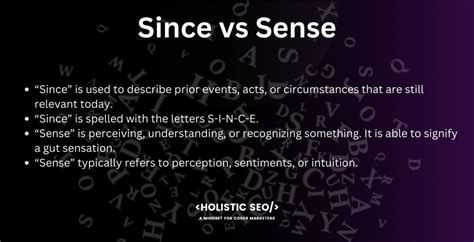
The terms "since" and "sense" are often confused with one another due to their similar spellings, but they have distinct meanings and uses in the English language. Understanding the differences between these two words is crucial for effective communication and clear expression of thoughts. In this article, we will delve into the meanings, uses, and grammatical applications of "since" and "sense" to provide a comprehensive explanation of their roles in language.
Key Points
- The word "since" is a conjunction used to indicate a point in time or a cause-and-effect relationship.
- "Sense", on the other hand, can be a noun or a verb, referring to the faculties of perception, a feeling or opinion, or the act of perceiving.
- Correct usage of "since" and "sense" depends on the context and intended meaning of the sentence.
- Improper substitution of one word for the other can lead to confusion and alter the meaning of the sentence entirely.
- Understanding the nuances of each word is essential for clear and effective communication.
Understanding “Since”
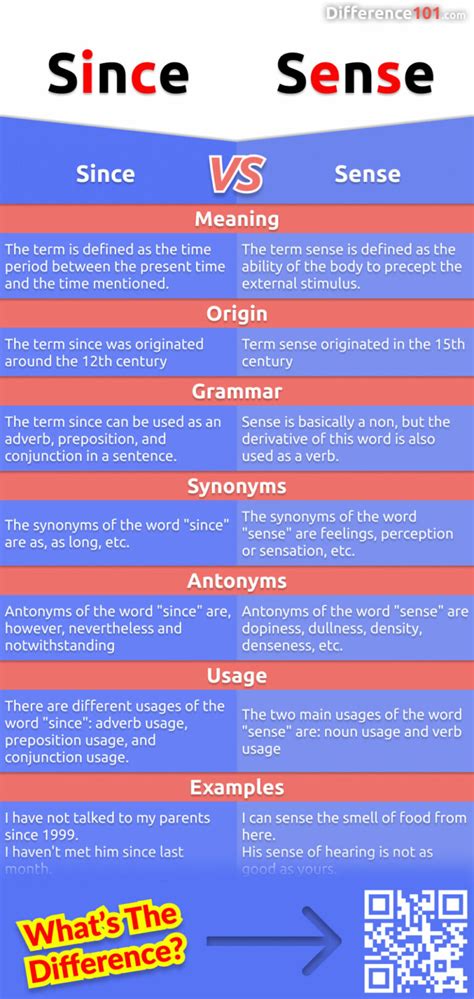
The word “since” is a conjunction that serves several purposes in sentence construction. It can be used to indicate a point in time, showing when something started or happened. For example, “I have been studying English since I was 10 years old.” Here, “since” marks the beginning of the time period during which the action of studying English has been ongoing. Additionally, “since” can introduce a cause-and-effect relationship or provide a reason for something. In the sentence “Since it’s raining, we’ll stay indoors,” the rain is the reason for staying indoors, demonstrating a causal link.
Temporal Use of “Since”
In its temporal sense, “since” is often used in conjunction with the present perfect tense to denote an action that started in the past and continues up to the present moment. For instance, “She has been working at the company since 2010” indicates that her employment began in 2010 and is still ongoing. This usage highlights the continuity of an action over a period.
Causal Use of “Since”
When used to express cause or reason, “since” introduces a clause that provides the rationale behind an action or decision. In “Since the weather forecast predicts rain, we should take an umbrella,” the prediction of rain is the reason for taking an umbrella. This demonstrates how “since” can connect two clauses to show a logical or causal relationship between them.
Exploring “Sense”

“Sense” is a multifaceted word that can function as both a noun and a verb. As a noun, it refers to the faculties of perception, such as sight, sound, touch, taste, and smell. For example, “The sense of smell is highly developed in dogs” highlights the capability of dogs to perceive odors. “Sense” can also denote a feeling or opinion, as in “I have a sense that something is wrong,” where it indicates a vague but persistent intuition.
Noun Usage of “Sense”
When “sense” is used as a noun to refer to the senses, it is often in the context of discussing how we perceive the world around us. Each sense allows us to experience and interpret our environment in unique ways. For instance, “The sense of touch allows us to feel different textures” illustrates how one of our senses enables us to perceive and distinguish various sensations.
Verb Usage of “Sense”
As a verb, “sense” means to perceive or feel something, often in a way that is not necessarily tangible or concrete. In “I sense a change in the air,” the speaker is suggesting that they perceive or intuit a shift or difference, even if it cannot be explicitly defined or measured. This usage of “sense” underscores its role in expressing subtle or indefinable perceptions.
| Word | Part of Speech | Meaning/Use |
|---|---|---|
| Since | Conjunction | Indicates time or cause-and-effect |
| Sense | Noun/Verb | Refers to perception faculties, feelings/opinions, or the act of perceiving |
Conclusion and Future Implications
In conclusion, “since” and “sense” are two distinct words with unique meanings and applications in language. “Since” is primarily used to indicate time or cause, while “sense” can refer to perception, feelings, or the act of perceiving. The correct usage of these words is essential for conveying intended meanings accurately and avoiding confusion. As language continues to evolve, recognizing the specific roles and nuances of “since” and “sense” will remain vital for effective communication and expression.
What is the primary difference between "since" and "sense"?
+The primary difference lies in their meanings and uses; "since" is a conjunction indicating time or cause, while "sense" is a noun or verb related to perception or feelings.
How do you determine when to use "since" versus "sense" in a sentence?
+Determine the intended meaning of the sentence. If you're referring to a point in time or a cause-and-effect relationship, use "since". If you're discussing perception, feelings, or opinions, use "sense".
Can "since" and "sense" ever be used interchangeably?
+No, "since" and "sense" have distinct meanings and uses, and substituting one for the other can alter the sentence's meaning and potentially lead to confusion.
Meta Description: Understand the difference between “since” and “sense” to improve your communication skills. Learn how to use these words correctly in sentences to convey your intended meaning accurately.