The Short Faced Bear, also known as Arctodus simus, is an extinct species of bear that once roamed North America during the Pleistocene epoch. This massive carnivore is of great interest to paleontologists and wildlife enthusiasts due to its enormous size and powerful build. To put its size into perspective, the Short Faced Bear is considered one of the largest known bear species to have ever existed, with some specimens estimated to weigh over 2,000 pounds (approximately 900 kilograms). In comparison, the largest bear species alive today, the polar bear (Ursus maritimus), typically weighs between 700-1,500 pounds (approximately 318-680 kilograms).
Key Points
- The Short Faced Bear is an extinct species of bear that lived during the Pleistocene epoch.
- It is considered one of the largest known bear species, with estimated weights over 2,000 pounds.
- In comparison, the largest bear species alive today, the polar bear, weighs between 700-1,500 pounds.
- The Short Faced Bear's size is a subject of interest among paleontologists and wildlife enthusiasts.
- Its massive size and powerful build indicate a formidable predator in its time.
Size Comparison with Modern Bear Species
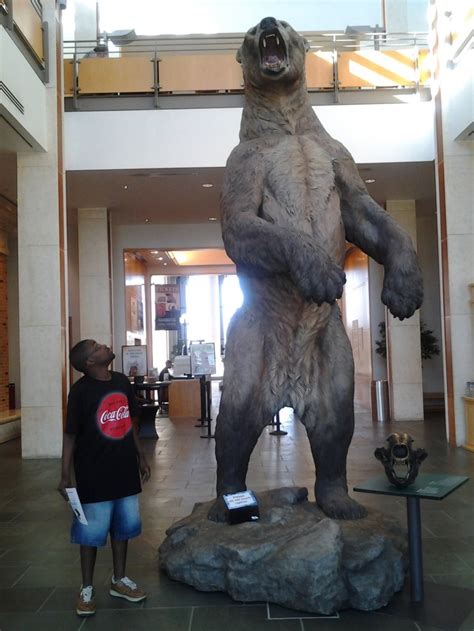
A comparison of the Short Faced Bear’s size with that of modern bear species provides a clearer understanding of its massive proportions. The grizzly bear (Ursus arctos horribilis), for example, is a large and powerful bear species found in North America, with males typically weighing between 300-700 pounds (approximately 136-318 kilograms). In contrast, the Short Faced Bear could weigh up to three times as much as a large male grizzly bear, highlighting its enormity. Furthermore, the American black bear (Ursus americanus), one of the most common bear species in North America, typically weighs between 150-500 pounds (approximately 68-227 kilograms), which is significantly less than the estimated weight of the Short Faced Bear.
Body Length and Shoulder Height Comparison
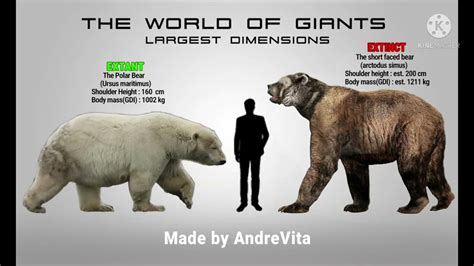
Beyond weight, the body length and shoulder height of the Short Faced Bear also demonstrate its massive size. While the polar bear, the largest of the modern bear species, can reach lengths of up to 9 feet (approximately 2.7 meters) and shoulder heights of about 5 feet (approximately 1.5 meters), the Short Faced Bear is estimated to have reached lengths of over 12 feet (approximately 3.6 meters) and shoulder heights of around 6 feet (approximately 1.8 meters). This significant difference in size underscores the Short Faced Bear’s position as one of the largest bear species to have existed.
| Bear Species | Estimated Weight | Body Length | Shoulder Height |
|---|---|---|---|
| Short Faced Bear | Over 2,000 pounds | Over 12 feet | Around 6 feet |
| Polar Bear | 700-1,500 pounds | Up to 9 feet | About 5 feet |
| Grizzly Bear | 300-700 pounds | Up to 9 feet | About 4 feet |
| American Black Bear | 150-500 pounds | Up to 6 feet | About 3 feet |
Habitat and Diet Implications
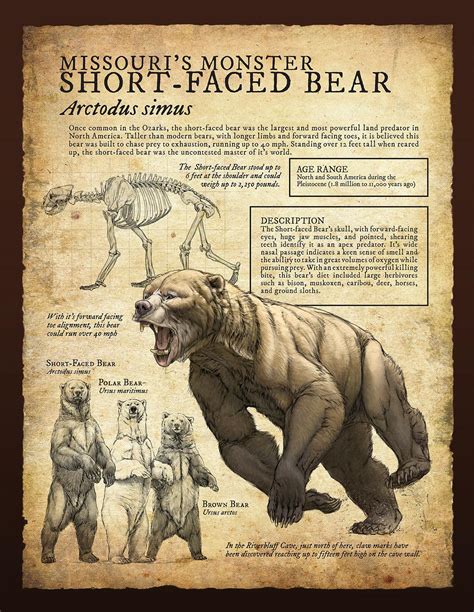
The enormous size of the Short Faced Bear has significant implications for its habitat and diet. Such a large predator would require vast territories with abundant food sources to sustain itself. The Short Faced Bear is believed to have inhabited areas with rich wildlife, including large herbivores like bison and camels, which would have been its primary prey. The bear’s size and strength would have allowed it to hunt and kill prey much larger than itself, a feat that few modern predators can achieve. This predatory capability would have placed the Short Faced Bear at the top of its food chain, influencing the population dynamics of its prey species and, by extension, the structure of its ecosystem.
Paleontological Significance
The study of the Short Faced Bear provides valuable insights into the evolutionary history of bears and the ecosystems of the Pleistocene epoch. The bear’s massive size and powerful build are of particular interest to paleontologists, as they offer clues about the bear’s diet, habitat, and behavior. Furthermore, the comparison of the Short Faced Bear with modern bear species helps scientists understand the adaptive changes that have occurred over time in response to environmental pressures and the availability of food resources. This knowledge contributes to a broader understanding of biodiversity and the complex interactions within ecosystems, both past and present.
What was the estimated weight of the Short Faced Bear?
+The Short Faced Bear is estimated to have weighed over 2,000 pounds, making it one of the largest known bear species.
How does the size of the Short Faced Bear compare to modern bear species?
+The Short Faced Bear was significantly larger than all modern bear species, including the polar bear, which is the largest bear species alive today.
What were the primary prey species of the Short Faced Bear?
+The Short Faced Bear likely preyed upon large herbivores, such as bison and camels, which were abundant in its habitat during the Pleistocene epoch.
In conclusion, the Short Faced Bear’s massive size is a fascinating aspect of its biology, offering insights into its ecological role, diet, and evolutionary history. Through comparisons with modern bear species and the study of its paleontological context, scientists can better understand the complexities of ecosystems past and present, and the factors that have influenced the evolution of life on Earth.