The human eye is a complex and fascinating organ, capable of detecting a wide range of colors, shapes, and sizes. At the heart of this complex system are two types of photoreceptor cells: rods and cones. While both types of cells play a crucial role in our ability to see, they have distinct differences in terms of their structure, function, and distribution within the retina. In this article, we will delve into the world of rods and cones, exploring five key facts that highlight their unique characteristics and importance in our visual system.
Key Points
- Rods and cones are the two primary types of photoreceptor cells in the human eye, each with distinct structures and functions.
- Rods are more sensitive to light and are responsible for peripheral and night vision, while cones are responsible for color vision and are concentrated in the central part of the retina.
- There are three types of cones, each sensitive to different wavelengths of light, allowing us to perceive a wide range of colors.
- Rods and cones have different signal transduction pathways, with rods being more sensitive to movement and changes in light levels.
- Diseases such as retinitis pigmentosa and macular degeneration can affect the health and function of rods and cones, leading to vision loss and blindness.
Structure and Function of Rods and Cones
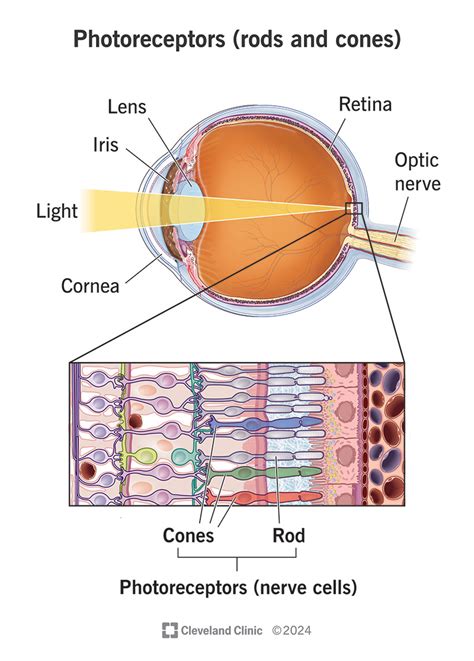
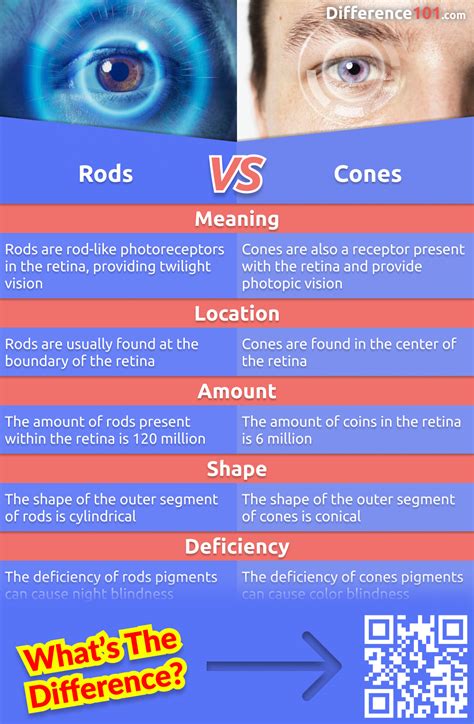
Rods and cones are both photoreceptor cells, but they have distinct differences in terms of their structure and function. Rods are longer and thinner than cones, with a single type of photopigment that is sensitive to low light levels. Cones, on the other hand, are shorter and thicker, with three types of photopigments that are sensitive to different wavelengths of light. This allows cones to detect a wide range of colors, from red to violet.
Distribution and Density of Rods and Cones
The distribution and density of rods and cones within the retina are also different. Rods are more numerous than cones, with approximately 120 million rods compared to 6 million cones. Rods are also more densely packed in the peripheral retina, where they are responsible for detecting movement and changes in light levels. Cones, on the other hand, are concentrated in the central part of the retina, where they are responsible for detecting fine details and colors.
| Type of Cell | Number of Cells | Function |
|---|---|---|
| Rods | 120 million | Peripheral and night vision |
| Cones | 6 million | Color vision and central vision |
Signal Transduction Pathways of Rods and Cones

Rods and cones have different signal transduction pathways, which allow them to respond to different types of visual stimuli. Rods are more sensitive to movement and changes in light levels, while cones are more sensitive to color and fine details. This difference in sensitivity is due to the different types of photopigments found in rods and cones, as well as the different signal transduction pathways that are used to transmit visual information to the brain.
Diseases Affecting Rods and Cones
Diseases such as retinitis pigmentosa and macular degeneration can affect the health and function of rods and cones, leading to vision loss and blindness. Retinitis pigmentosa is a genetic disorder that affects the rods, causing them to degenerate and leading to night blindness and loss of peripheral vision. Macular degeneration, on the other hand, affects the cones, causing them to degenerate and leading to loss of central vision and fine details.
What is the main difference between rods and cones?
+The main difference between rods and cones is their structure and function. Rods are more sensitive to light and are responsible for peripheral and night vision, while cones are responsible for color vision and are concentrated in the central part of the retina.
How many types of cones are there?
+There are three types of cones, each sensitive to different wavelengths of light. This allows us to perceive a wide range of colors, from red to violet.
What diseases can affect the health and function of rods and cones?
+Diseases such as retinitis pigmentosa and macular degeneration can affect the health and function of rods and cones, leading to vision loss and blindness.
In conclusion, the unique characteristics and functions of rods and cones play a crucial role in our ability to see and interpret the world around us. By understanding the differences between these two types of photoreceptor cells, we can appreciate the complexity and beauty of the human visual system. Whether we are detecting movement and changes in light levels or perceiving a wide range of colors and fine details, rods and cones work together to create a wide range of visual experiences that are essential to our daily lives.