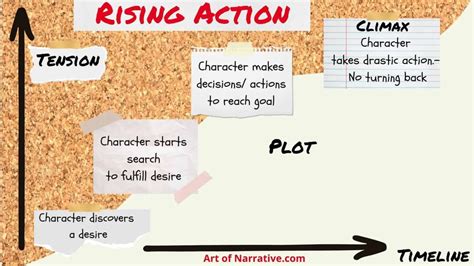
The concept of rising action is a fundamental element in storytelling, serving as the series of events that build upon one another to create tension and conflict, ultimately leading to the climax of the story. It is a critical component in narrative structure, as it engages the audience, develops the plot, and provides insight into the characters' motivations and growth. In essence, the rising action is where the story gains momentum, keeping the audience invested in the outcome.
Understanding Rising Action

Rising action is characterized by its ability to escalate the stakes, deepen character development, and introduce obstacles that the protagonist must overcome. It is during this phase of the narrative that the audience becomes fully immersed in the story, empathizing with the characters’ struggles and rooting for their success. The rising action is not limited to any particular genre; it is a versatile narrative device that can be found in literature, film, theater, and even in the structure of video games.
Rising Action in Literature
In literature, the rising action is often where the author’s skill in crafting a compelling narrative is most evident. For example, in William Shakespeare’s “Romeo and Juliet,” the rising action begins after the two protagonists declare their love for each other. The series of events that follow, including the fight between Tybalt and Mercutio, Romeo’s subsequent banishment, and Juliet’s fake death, all contribute to the escalating tension and tragic outcome. This sequence of events not only builds upon the initial conflict but also explores themes of love, loyalty, and the destructive nature of hate.
| Literary Element | Description |
|---|---|
| Exposition | Introduction to the story, setting, and characters |
| Rising Action | Series of events that create tension and conflict |
| Climax | Most intense moment in the story, turning point for the characters |
| Falling Action | Events following the climax, leading to the resolution |
| Resolution | Conclusion of the story, where loose ends are tied |
Rising Action in Film

In filmmaking, the rising action is equally crucial, as it provides the visual and auditory elements that bring the story to life. For instance, in the movie “The Lord of the Rings: The Fellowship of the Ring,” the rising action commences after the Fellowship sets out on their perilous journey to destroy the One Ring. The challenges they face, including navigating treacherous landscapes, battling formidable enemies, and dealing with internal conflicts, all serve to heighten the stakes and deepen the audience’s emotional investment in the characters’ quest.
Rising Action in Storytelling Across Mediums
The versatility of the rising action is evident in its application across various storytelling mediums. Whether in novels, movies, plays, or even video games, the principle remains the same: to create a sequence of events that captivates the audience, develops the plot, and leads to the climactic moment. This narrative device is not confined to fiction; it can also be observed in non-fictional accounts, where the building of events towards a significant moment or conclusion is essential for engaging the reader or listener.
Key Points
- The rising action is a critical component of narrative structure, found in all forms of storytelling.
- It serves to escalate tension, develop characters, and introduce obstacles, leading to the climax of the story.
- The rising action can be observed in literature, film, theater, and other mediums, showcasing its versatility and importance in engaging audiences.
- Effective rising action requires a balance between building tension and providing moments of release, ensuring the narrative remains compelling without becoming overwhelming.
- The application of rising action is not limited to fiction; it is also a crucial element in non-fictional storytelling, where it helps to build towards a significant conclusion or moment.
In conclusion, the rising action is a fundamental element in the narrative structure of stories, regardless of the medium through which they are told. Its role in creating tension, developing characters, and engaging the audience is indispensable, making it a cornerstone of effective storytelling. By understanding and skillfully employing the rising action, storytellers can craft compelling narratives that captivate and resonate with their audience.
What is the primary function of the rising action in a story?
+The primary function of the rising action is to build upon the initial conflict or problem, creating a series of events that escalate tension and lead to the climax of the story. It is during this phase that the characters face obstacles, make crucial decisions, and experience significant developments that shape the narrative’s outcome.
Can the rising action be found in non-fictional stories?
+Yes, the rising action is not exclusive to fictional narratives. In non-fiction, such as biographies, historical accounts, or memoirs, the rising action refers to the sequence of real events that build towards a significant moment or conclusion. This narrative device helps to engage the reader and provide a structured progression of events.
How does the rising action contribute to character development?
+The rising action plays a crucial role in character development by presenting characters with challenges and conflicts that test their abilities, beliefs, and relationships. Through their actions, decisions, and interactions during the rising action, characters evolve, revealing their strengths, weaknesses, and motivations, which in turn deepens the audience’s understanding and emotional connection to them.