Ringer's lactate and normal saline are two of the most commonly used intravenous fluids in medical settings. Both solutions have their own unique characteristics, advantages, and disadvantages, and the choice between them depends on various factors, including the patient's condition, the underlying cause of fluid loss, and the desired therapeutic effect. In this article, we will delve into the composition, indications, and contraindications of Ringer's lactate and normal saline, and explore the key differences between these two solutions.
Key Points
- Ringer's lactate and normal saline are two commonly used intravenous fluids with distinct compositions and indications.
- Ringer's lactate contains electrolytes, including sodium, potassium, calcium, and lactate, whereas normal saline is a solution of sodium chloride in water.
- Ringer's lactate is often used in patients with significant blood loss, burns, or severe dehydration, while normal saline is commonly used for maintenance fluids or to treat mild dehydration.
- The choice between Ringer's lactate and normal saline depends on various factors, including the patient's condition, the underlying cause of fluid loss, and the desired therapeutic effect.
- Both solutions have potential side effects and complications, including fluid overload, electrolyte imbalances, and allergic reactions.
Composition and Indications
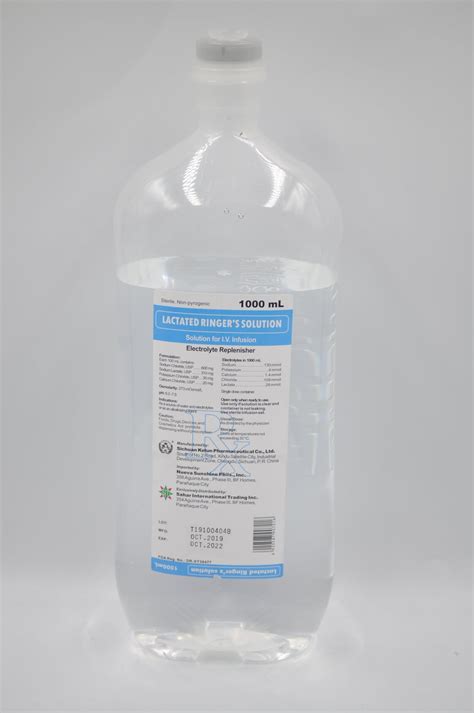
Ringer’s lactate, also known as lactated Ringer’s solution, is a crystalloid fluid that contains sodium chloride, sodium lactate, potassium chloride, and calcium chloride in specific concentrations. The solution is designed to mimic the electrolyte composition of human plasma, with a pH range of 6.5-7.5. Ringer’s lactate is often used in patients with significant blood loss, burns, or severe dehydration, as it helps to restore the balance of electrolytes and fluids in the body.
Normal saline, on the other hand, is a solution of sodium chloride (0.9%) in water, with a pH range of 4.5-7.0. It is commonly used as a maintenance fluid or to treat mild dehydration, as it provides a balanced amount of sodium and chloride ions. Normal saline is also often used as a vehicle for administering medications or as a flush solution for intravenous lines.
Electrolyte Composition
The electrolyte composition of Ringer’s lactate and normal saline is an important factor to consider when choosing between these two solutions. Ringer’s lactate contains a balanced mix of electrolytes, including sodium (130 mEq/L), potassium (4 mEq/L), calcium (3 mEq/L), and lactate (28 mEq/L). In contrast, normal saline contains only sodium (154 mEq/L) and chloride (154 mEq/L) ions.
| Electrolyte | Ringer's Lactate | Normal Saline |
|---|---|---|
| Sodium (mEq/L) | 130 | 154 |
| Potassium (mEq/L) | 4 | 0 |
| Calcium (mEq/L) | 3 | 0 |
| Lactate (mEq/L) | 28 | 0 |
| Chloride (mEq/L) | 109 | 154 |

Contraindications and Side Effects
Both Ringer’s lactate and normal saline have potential side effects and contraindications. Ringer’s lactate is contraindicated in patients with severe liver disease, as the lactate can exacerbate lactic acidosis. It is also contraindicated in patients with hyperkalemia, as the potassium content can worsen the condition.
Normal saline, on the other hand, is contraindicated in patients with severe hypernatremia, as the high sodium content can worsen the condition. It is also contraindicated in patients with heart failure, as the fluid can exacerbate fluid overload.
Common side effects of both solutions include fluid overload, electrolyte imbalances, and allergic reactions. It is essential to monitor patients closely during infusion and adjust the rate and type of fluid accordingly.
Clinical Applications
Ringer’s lactate and normal saline have various clinical applications. Ringer’s lactate is often used in the treatment of burns, trauma, and severe dehydration, as it helps to restore the balance of electrolytes and fluids in the body. It is also used as a maintenance fluid in patients undergoing surgery or with significant blood loss.
Normal saline, on the other hand, is commonly used as a maintenance fluid or to treat mild dehydration. It is also used as a vehicle for administering medications or as a flush solution for intravenous lines.
What is the primary difference between Ringer's lactate and normal saline?
+The primary difference between Ringer's lactate and normal saline is the electrolyte composition. Ringer's lactate contains a balanced mix of electrolytes, including sodium, potassium, calcium, and lactate, whereas normal saline contains only sodium and chloride ions.
When should Ringer's lactate be used instead of normal saline?
+Ringer's lactate should be used instead of normal saline in patients with significant blood loss, burns, or severe dehydration, as it helps to restore the balance of electrolytes and fluids in the body.
What are the potential side effects of Ringer's lactate and normal saline?
+Both Ringer's lactate and normal saline have potential side effects, including fluid overload, electrolyte imbalances, and allergic reactions. It is essential to monitor patients closely during infusion and adjust the rate and type of fluid accordingly.
Meta Description: Ringer’s lactate and normal saline are two commonly used intravenous fluids with distinct compositions and indications. Learn about the key differences between these two solutions and how to choose the right one for your patients. (147 characters)