
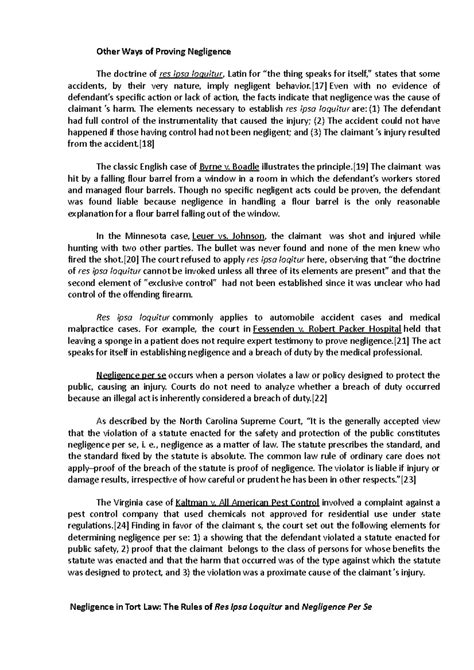
The concept of Res Ipsa Loquitur, a Latin phrase meaning "the thing speaks for itself," is a fundamental principle in the realm of tort law. This doctrine is applied in cases where the injury or harm would not have occurred without negligence, and the defendant's actions or omissions are the most likely cause of the incident. The purpose of Res Ipsa Loquitur is to establish a prima facie case of negligence, allowing the plaintiff to proceed with their claim without having to provide direct evidence of the defendant's breach of duty.
Historically, the concept of Res Ipsa Loquitur emerged in the late 19th century, with the landmark case of Byrne v. Boadle (1863) being a seminal moment in its development. In this case, a barrel of flour fell from a window and struck the plaintiff, resulting in injuries. The court ruled that the accident would not have occurred without negligence, and therefore, the defendant was liable. This decision set the stage for the widespread adoption of Res Ipsa Loquitur in tort law, with the doctrine being refined and expanded upon in subsequent cases.
Key Points
- Res Ipsa Loquitur is a doctrine that allows a plaintiff to establish a prima facie case of negligence without direct evidence of the defendant's breach of duty.
- The doctrine is applied in cases where the injury or harm would not have occurred without negligence, and the defendant's actions or omissions are the most likely cause of the incident.
- Res Ipsa Loquitur is often used in cases involving accidents or injuries that are unlikely to occur without negligence, such as a surgeon leaving a foreign object inside a patient or a driver losing control of their vehicle.
- The doctrine is not a substitute for proof of negligence, but rather a means of establishing a rebuttable presumption of negligence.
- Defendants can rebut the presumption of negligence by providing evidence that they were not negligent or that the accident was caused by an unavoidable event.
Elements of Res Ipsa Loquitur

To apply the doctrine of Res Ipsa Loquitur, the plaintiff must establish three key elements: (1) the injury or harm was of a type that would not normally occur without negligence; (2) the injury or harm was caused by an instrumentality or agency within the defendant’s exclusive control; and (3) the plaintiff did not contribute to the injury or harm through their own negligence. These elements must be proven by a preponderance of the evidence, and the plaintiff must demonstrate that the defendant’s actions or omissions were the most likely cause of the incident.
Application of Res Ipsa Loquitur
Res Ipsa Loquitur is commonly applied in cases involving medical malpractice, product liability, and accidents. For example, if a patient undergoes surgery and wakes up with a foreign object inside their body, the doctrine of Res Ipsa Loquitur may be applied to establish a prima facie case of negligence against the surgeon or hospital. Similarly, if a consumer purchases a product that malfunctions and causes injury, the doctrine may be used to establish a case against the manufacturer or seller.
| Case Type | Application of Res Ipsa Loquitur |
|---|---|
| Medical Malpractice | Applied in cases where a foreign object is left inside a patient or a surgical instrument is used incorrectly. |
| Product Liability | Applied in cases where a product malfunctions and causes injury, and the manufacturer or seller is responsible for the defect. |
| Accidents | Applied in cases where a driver loses control of their vehicle or a pedestrian is struck by a car, and the defendant's actions or omissions are the most likely cause of the incident. |
Defenses to Res Ipsa Loquitur

While Res Ipsa Loquitur can be a powerful tool for plaintiffs, defendants can still rebut the presumption of negligence by providing evidence that they were not negligent or that the accident was caused by an unavoidable event. For example, a defendant may argue that the plaintiff’s own negligence contributed to the injury or that the accident was caused by a third party. In such cases, the burden of proof shifts to the defendant to provide evidence that rebuts the presumption of negligence.
Rebutting the Presumption of Negligence
To rebut the presumption of negligence, defendants must provide evidence that is sufficient to overcome the plaintiff’s prima facie case. This may involve presenting expert testimony, documentary evidence, or witness statements that contradict the plaintiff’s allegations. The defendant must also demonstrate that their actions or omissions were reasonable and did not contribute to the injury or harm.
In conclusion, the doctrine of Res Ipsa Loquitur is a fundamental principle in tort law that allows plaintiffs to establish a prima facie case of negligence without direct evidence of the defendant's breach of duty. By understanding the elements and application of Res Ipsa Loquitur, plaintiffs and defendants can better navigate the complexities of tort law and ensure that justice is served.
What is the purpose of Res Ipsa Loquitur?
+The purpose of Res Ipsa Loquitur is to establish a prima facie case of negligence, allowing the plaintiff to proceed with their claim without having to provide direct evidence of the defendant’s breach of duty.
What are the elements of Res Ipsa Loquitur?
+The elements of Res Ipsa Loquitur are: (1) the injury or harm was of a type that would not normally occur without negligence; (2) the injury or harm was caused by an instrumentality or agency within the defendant’s exclusive control; and (3) the plaintiff did not contribute to the injury or harm through their own negligence.
How can defendants rebut the presumption of negligence?
+Defendants can rebut the presumption of negligence by providing evidence that they were not negligent or that the accident was caused by an unavoidable event. This may involve presenting expert testimony, documentary evidence, or witness statements that contradict the plaintiff’s allegations.