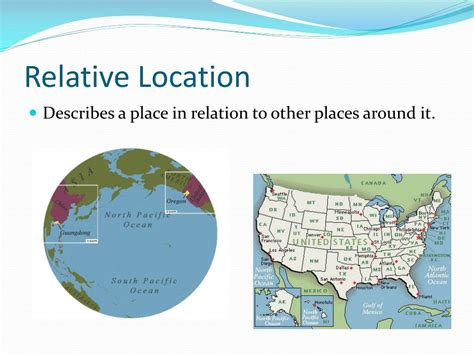
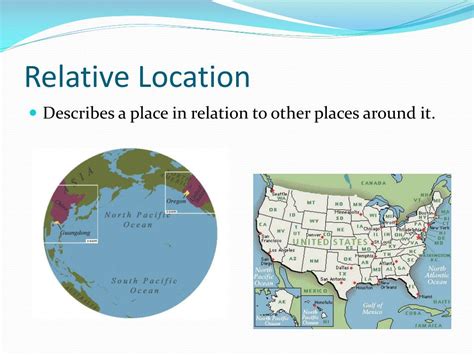
Understanding the concept of relative location is essential in various fields, including geography, urban planning, and navigation. At its core, relative location refers to the position of a place or object in relation to other places or objects. This concept is crucial because it helps us understand how different locations are connected and how they interact with each other. For instance, when we describe a city as being "near" a major highway or "close to" a body of water, we are using relative location to convey its spatial relationship with other significant features.
In a broader sense, relative location is about understanding the spatial relationships between different places and how these relationships impact the characteristics and development of these locations. It takes into account the accessibility, visibility, and interaction between places, which in turn influence their economic, social, and environmental aspects. For example, a city located near a port may develop a strong maritime trade industry due to its relative location, which provides easy access to international markets. Similarly, a town situated in a valley may have a distinct climate and ecosystem compared to a town located on a mountain, due to the differences in their relative locations.
Key Points
- Relative location is defined as the position of a place in relation to other places or objects.
- It is crucial for understanding spatial relationships and interactions between locations.
- Relative location influences the characteristics and development of places, including economic, social, and environmental aspects.
- Accessibility, visibility, and interaction between places are key factors in determining their relative locations.
- Understanding relative location is essential in fields like geography, urban planning, and navigation.
Understanding Relative Location in Context
To fully grasp the concept of relative location, it’s essential to consider it within the context of absolute location, which refers to the exact position of a place on the Earth’s surface, usually defined by its latitude and longitude coordinates. While absolute location provides a precise point on the map, relative location offers a more nuanced understanding of how that place interacts with its surroundings. For instance, the absolute location of a city might be defined by its GPS coordinates, but its relative location would describe its proximity to neighboring cities, natural features, or transportation hubs.
Factors Influencing Relative Location
Several factors contribute to the relative location of a place, including geographical features, transportation networks, and human activities. Geographical features like mountains, rivers, and coastlines can significantly impact the relative location of a place by affecting its accessibility and visibility. Transportation networks, such as highways, railways, and airports, also play a crucial role in defining the relative location of a place by facilitating the movement of goods and people. Human activities, including urbanization, agriculture, and industry, further influence the relative location of a place by shaping its economic, social, and environmental characteristics.
| Factor | Influence on Relative Location |
|---|---|
| Geographical Features | Affect accessibility and visibility |
| Transportation Networks | Facilitate movement of goods and people |
| Human Activities | Shape economic, social, and environmental characteristics |
Applications of Relative Location
The concept of relative location has numerous applications across various disciplines. In urban planning, understanding the relative location of a city or town is essential for designing efficient transportation systems, managing urban growth, and preserving environmental quality. In economics, relative location is crucial for analyzing trade patterns, investment opportunities, and market accessibility. In environmental conservation, recognizing the relative location of ecosystems and natural resources helps in developing effective strategies for protection and management.
In addition to these applications, relative location is also a key consideration in emergency response planning, where the proximity of emergency services to potential disaster zones can significantly impact response times and effectiveness. Similarly, in the context of public health, understanding the relative location of healthcare facilities, disease outbreaks, and vulnerable populations is critical for targeted interventions and resource allocation.
Case Studies
A variety of case studies illustrate the practical importance of relative location. For example, the city of Singapore, due to its strategic relative location at the southern tip of the Malay Peninsula, has developed into a major trade and financial hub. Similarly, the relative location of the Panama Canal, connecting the Atlantic and Pacific Oceans, has made it a critical passage for international shipping, significantly influencing global trade routes and patterns.
How does relative location affect economic development?
+Relative location can significantly impact economic development by influencing accessibility to markets, resources, and transportation networks. Places with favorable relative locations, such as being near major transportation hubs or natural resources, often experience higher economic growth due to increased trade and investment opportunities.
What role does relative location play in environmental conservation?
+Relative location is crucial in environmental conservation as it helps in identifying areas of high conservation value and managing the impact of human activities on the environment. Understanding the relative location of ecosystems and natural resources allows for more effective protection and management strategies.
How is relative location used in urban planning?
+In urban planning, relative location is used to design efficient cities by considering the spatial relationships between different urban elements such as residential areas, commercial centers, and transportation infrastructure. This helps in creating livable and sustainable urban environments.
In conclusion, relative location is a fundamental concept that underpins our understanding of how places interact with each other and their surroundings. Its applications are diverse and critical, influencing fields from urban planning and economics to environmental conservation and emergency response. As the world continues to evolve, understanding and leveraging the relative location of places will remain essential for addressing global challenges and promoting sustainable development.