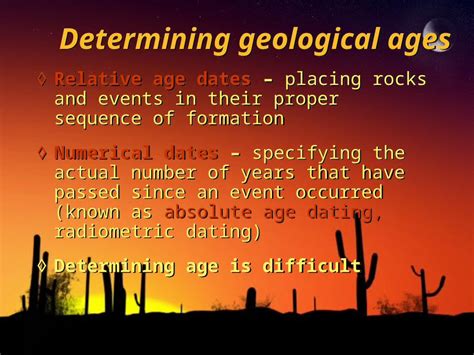
The concept of relative age is a fundamental aspect of geology, paleontology, and archaeology, allowing scientists to understand the temporal relationships between different rock layers, fossils, and cultural artifacts. At its core, relative age refers to the determination of whether one geological or archaeological feature is older or younger than another, without necessarily knowing their absolute ages. This concept is crucial for reconstructing the Earth's history, understanding evolutionary processes, and dating human settlements and artifacts.
Relative age definition is based on several key principles, including the law of superposition, the law of original horizontality, and the law of cross-cutting relationships. The law of superposition states that in any undisturbed sequence of rocks deposited in layers, the youngest layer is on top and the oldest on the bottom, each layer being younger than the one beneath it and older than the one above it. The law of original horizontality posits that layers of sediment are deposited in a horizontal position, allowing for the interpretation of tilting and folding events in the geological history of an area. Lastly, the law of cross-cutting relationships indicates that any geological feature that cuts across other layers or features must be younger than what it cuts across.
Key Points
- Relative age is about determining if one feature is older or younger than another without knowing absolute ages.
- The law of superposition, original horizontality, and cross-cutting relationships are foundational principles.
- These principles help in understanding temporal relationships and reconstructing the Earth's and human history.
- Relative age is distinct from absolute age, which provides a specific age in years.
- Both relative and absolute dating methods are essential for a comprehensive understanding of geological and archaeological phenomena.
Understanding Relative Age Through Geological Principles
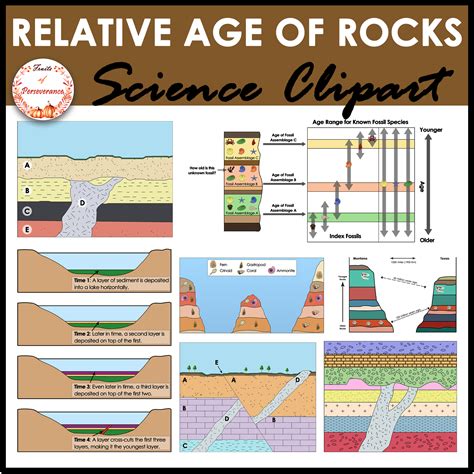
The application of relative age principles is widespread in geology, from understanding the sequence of events in the formation of mountain ranges to deciphering the history of ancient rivers and seas. By examining the layering of sedimentary rocks, the orientation of rock layers, and the presence of faults and other geological structures, scientists can piece together a detailed narrative of the geological past. This information is vital for understanding not just the history of the Earth but also for locating natural resources, assessing geological hazards, and managing environmental impacts.
The Law of Superposition in Action
A practical example of the law of superposition can be observed in the Grand Canyon, where nearly 2 billion years of Earth's geological history are visible in the rock layers exposed in the canyon walls. The sequence of rock layers, from the ancient Vishnu Basement Rocks at the bottom to the much younger Kaibab Limestone at the top, illustrates the principle of superposition perfectly. Each layer represents a specific period in the Earth's history, with the deeper layers being older than those above them. This layered sequence provides invaluable insights into the geological and climatic conditions of the past, including periods of sea-level change, volcanic activity, and erosion.
| Geological Feature | Description | Age |
|---|---|---|
| Vishnu Basement Rocks | Ancient metamorphic and igneous rocks | Approximately 1.8 billion years old |
| Tonto Group | Sedimentary rocks including limestone, sandstone, and shale | Approximately 520 million years old |
| Kaibab Limestone | Layer of limestone formed from calcium carbonate (CaCO3) | Approximately 270 million years old |
Relative Age in Archaeology and Paleontology
Beyond geology, the concept of relative age is also vital in archaeology and paleontology. In archaeology, relative dating techniques, such as stratigraphy and typology, are used to determine the age of artifacts and sites relative to each other. Stratigraphy, similar to its application in geology, involves analyzing the layers in which artifacts are found to understand the sequence of human occupation and activity. Typology, on the other hand, involves the study of the types of artifacts and how they change over time, providing a relative chronology of different cultures and civilizations.
In paleontology, relative age is used to understand the evolution of life on Earth. By dating fossils relative to each other, scientists can reconstruct evolutionary histories, understand the diversity of ancient life forms, and even predict the existence of undiscovered species based on gaps in the fossil record. The principles of relative age, combined with absolute dating methods like radiocarbon dating and potassium-argon dating, offer a powerful toolkit for exploring the history of life on our planet.
Typology and Stratigraphy in Action
A notable example of the application of relative age principles in archaeology can be seen in the excavation of ancient cities like Pompeii and Herculaneum. The layering of volcanic ash, pumice, and other deposits, combined with the typological analysis of artifacts found within these layers, has allowed archaeologists to reconstruct a detailed timeline of the cities' histories, including their destruction by the eruption of Mount Vesuvius in 79 AD. Similarly, in paleontology, the relative dating of fossils in the Burgess Shale formation has provided significant insights into the Cambrian explosion, a period of rapid evolutionary diversification that occurred approximately 541 million years ago.
What is the primary difference between relative and absolute age?
+Relative age determines if one feature is older or younger than another, while absolute age provides a specific age in years through methods like radiometric dating.
How is relative age used in archaeology?
+Relative age in archaeology is used through techniques like stratigraphy and typology to understand the sequence of human occupation and activity at sites.
What is an example of relative age in paleontology?
+The relative dating of fossils in formations like the Burgess Shale has provided insights into evolutionary events, such as the Cambrian explosion.
In conclusion, the concept of relative age is a powerful tool for understanding the Earth’s history, the evolution of life, and human cultures. Through the application of principles like superposition, original horizontality, and cross-cutting relationships, scientists can piece together a detailed narrative of the past, even in the absence of exact dates. As our understanding of the Earth and its history continues to evolve, the importance of relative age in guiding our inquiries and interpretations will only continue to grow.