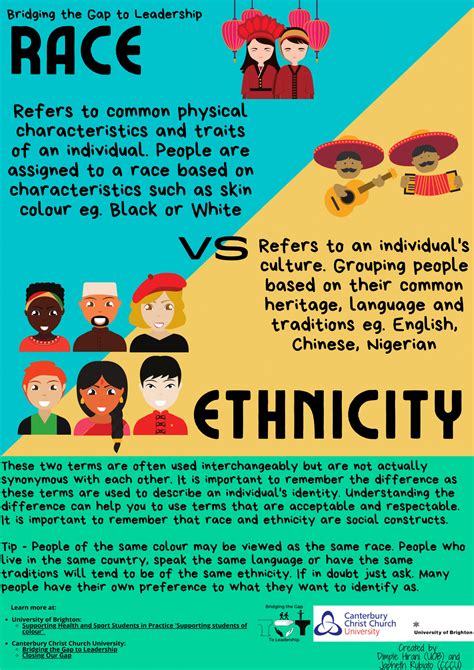
The terms "race" and "ethnicity" are often used interchangeably, but they have distinct meanings and connotations. Understanding the difference between these two concepts is essential for navigating discussions about identity, culture, and social justice. In this article, we will delve into the nuances of race and ethnicity, exploring their definitions, historical contexts, and implications for individuals and society.
Defining Race and Ethnicity
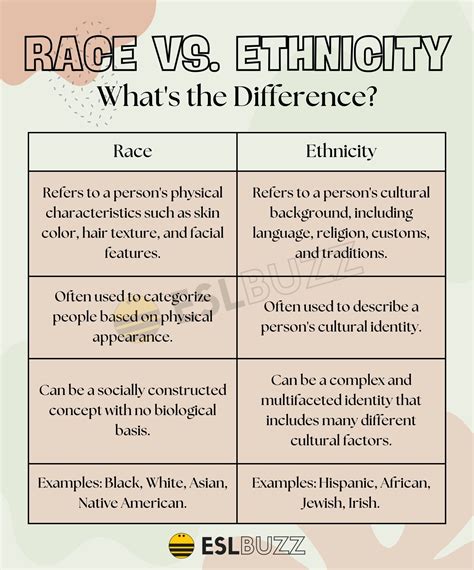
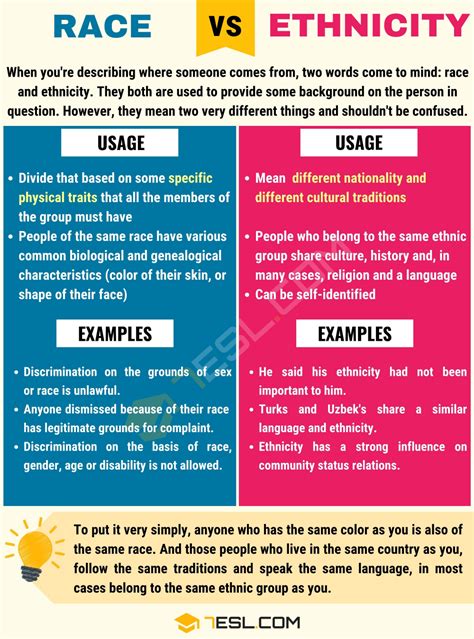
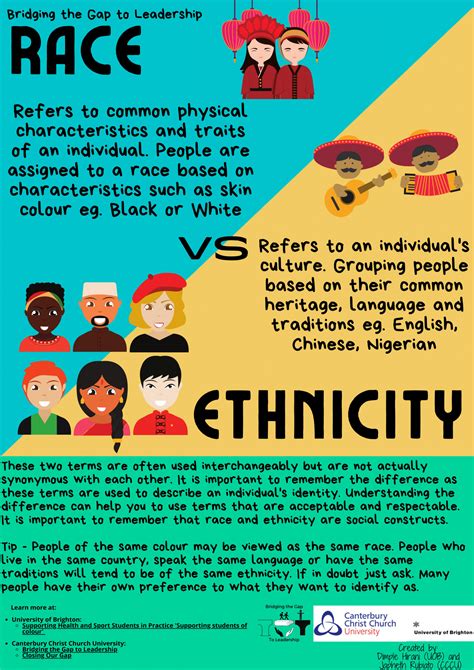
Race refers to the physical characteristics that distinguish one group of people from another, such as skin color, hair texture, and facial features. These characteristics are often used to categorize people into distinct groups, such as White, Black, Asian, or Indigenous. However, the concept of race is complex and has been widely criticized for being socially constructed, rather than a scientifically proven fact. The idea of race has been used to justify discrimination, oppression, and inequality throughout history.
Ethnicity, on the other hand, refers to a person's cultural identity, including their nationality, language, customs, and traditions. Ethnicity is often tied to a person's ancestry and heritage, and it can be a source of pride and identity. Unlike race, ethnicity is not necessarily tied to physical characteristics, and people of the same ethnicity can have diverse physical appearances.
Race vs Ethnicity: Key Distinctions
A key distinction between race and ethnicity is that race is often imposed upon individuals by society, while ethnicity is a self-identified aspect of a person’s identity. For example, a person may be perceived as Black or Asian based on their physical characteristics, but they may identify as African American, Nigerian, or Chinese, reflecting their cultural heritage and ethnicity.
| Category | Race | Ethnicity |
|---|---|---|
| Definition | Physical characteristics | Cultural identity |
| Examples | White, Black, Asian | African American, Nigerian, Chinese |
| Implications | Socially constructed, often used to justify discrimination | Tied to ancestry and heritage, source of pride and identity |
Historical Context and Evolution
The concepts of race and ethnicity have evolved over time, reflecting changing social, cultural, and economic contexts. In the United States, for example, the notion of race has been used to justify slavery, segregation, and discrimination against people of color. The Civil Rights Movement of the 1960s and subsequent social justice movements have challenged these notions, promoting greater recognition and acceptance of diversity.
Ethnicity, on the other hand, has become an increasingly important aspect of identity, as people seek to connect with their heritage and cultural traditions. The growth of ethnic studies programs, cultural festivals, and community organizations has helped to promote greater understanding and appreciation of diverse ethnicities.
Implications for Individuals and Society
The distinction between race and ethnicity has significant implications for individuals and society. Recognizing and respecting people’s ethnic identities can help to promote greater inclusivity and diversity, while also acknowledging the historical and ongoing impacts of racism and discrimination.
Key Points
- Race and ethnicity are distinct concepts, with race referring to physical characteristics and ethnicity referring to cultural identity.
- Understanding the difference between race and ethnicity is crucial for promoting diversity, equity, and inclusion.
- The concepts of race and ethnicity have evolved over time, reflecting changing social, cultural, and economic contexts.
- Recognizing and respecting people's ethnic identities can help to promote greater inclusivity and diversity.
- The distinction between race and ethnicity has significant implications for individuals and society, including the need to address ongoing racism and discrimination.
Conclusion and Future Directions
In conclusion, the difference between race and ethnicity is a complex and multifaceted issue, with significant implications for individuals and society. By recognizing and respecting people’s ethnic identities, we can work to promote greater inclusivity and diversity, while also addressing the ongoing impacts of racism and discrimination. As we move forward, it is essential to continue exploring and understanding the nuances of these concepts, and to work towards a more just and equitable society for all.
What is the main difference between race and ethnicity?
+The main difference between race and ethnicity is that race refers to physical characteristics, while ethnicity refers to cultural identity, including nationality, language, customs, and traditions.
How have the concepts of race and ethnicity evolved over time?
+The concepts of race and ethnicity have evolved over time, reflecting changing social, cultural, and economic contexts. The notion of race has been used to justify discrimination and oppression, while ethnicity has become an increasingly important aspect of identity, as people seek to connect with their heritage and cultural traditions.
What are the implications of recognizing and respecting people's ethnic identities?
+Recognizing and respecting people's ethnic identities can help to promote greater inclusivity and diversity, while also acknowledging the historical and ongoing impacts of racism and discrimination. This can lead to greater empathy, understanding, and social justice.
Meta Description: Understand the difference between race and ethnicity, and how these concepts impact individuals and society. Learn about the historical context and evolution of these terms, and their implications for diversity, equity, and inclusion. (147 characters)