The Spanish language is renowned for its complex conjugation system, and one of the most fundamental aspects of mastering Spanish is understanding the preterite form of the verb "estar," which translates to "to be" in English. The preterite tense is used to describe completed actions in the past, and "estar" is a crucial verb for expressing states of being, locations, and conditions. In this article, we will delve into the preterite form of "estar," exploring its conjugation, usage, and providing examples to illustrate its application in real-world scenarios.
Key Points
- The preterite form of "estar" is used to describe completed states of being or conditions in the past.
- The conjugation of "estar" in the preterite tense is irregular and must be memorized.
- "Estar" in the preterite form is used to talk about temporary or changing conditions, whereas "ser" is used for permanent or inherent qualities.
- Mastering the preterite form of "estar" is essential for effective communication in Spanish, as it allows speakers to express complex ideas and narratives about past events.
- Practice and contextual examples are crucial for understanding the nuances of "estar" in the preterite tense.
Conjugation of Estar in the Preterite Tense
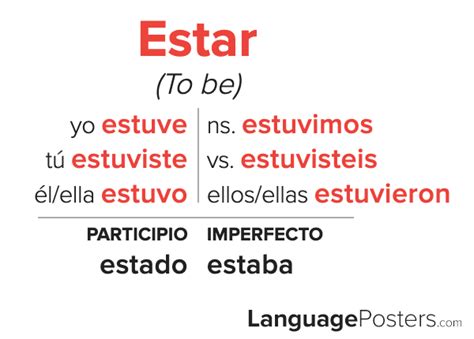
The conjugation of “estar” in the preterite tense is as follows: yo estuve, tú estuviste, él/ella/usted estuvo, nosotros/nosotras estuvimos, vosotros/vosotras estuvisteis, and ellos/ellas/ustedes estuvieron. It’s essential to note that this conjugation is irregular and does not follow the typical patterns of regular -ar, -er, and -ir verbs. The preterite form of “estar” is used to describe a state of being or a condition that existed at a specific point in the past and has since changed or been completed.
Usage of Estar in the Preterite Tense
The preterite form of “estar” is used to talk about temporary or changing conditions, such as emotions, locations, or physical states. For example, “Estuve cansado ayer” (I was tired yesterday), “Ella estuvo en Madrid el año pasado” (She was in Madrid last year), or “Ellos estuvieron de acuerdo con la propuesta” (They agreed with the proposal). This highlights the importance of “estar” in expressing how things were in the past, especially when describing situations that have since changed.
| Subject | Preterite Form of Estar |
|---|---|
| Yo | estuve |
| Tú | estuviste |
| Él/Ella/Usted | estuvo |
| Nosotros/Nosotras | estuvimos |
| Vosotros/Vosotras | estuvisteis |
| Ellos/Ellas/Ustedes | estuvieron |
Examples and Practice
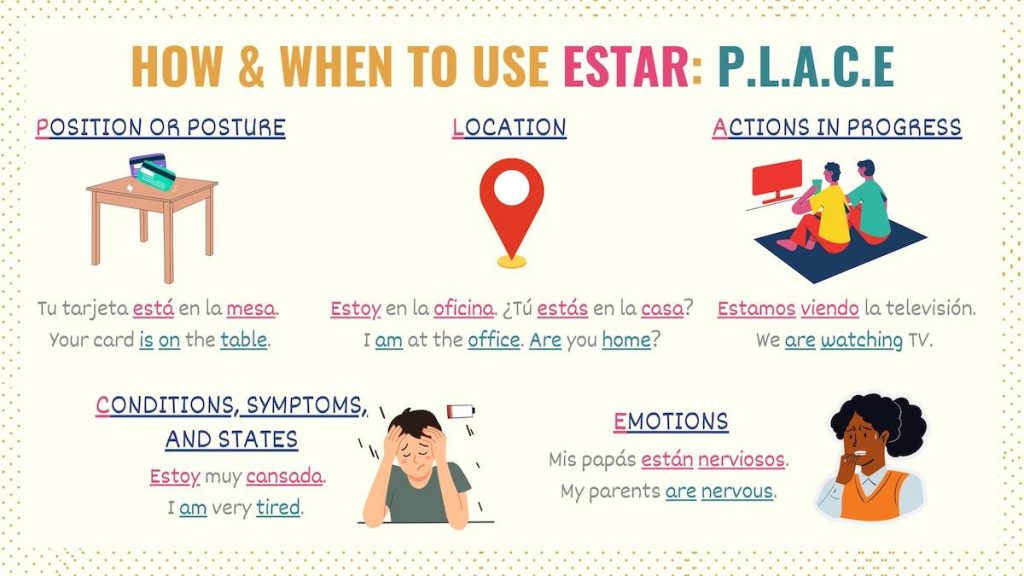
To solidify the understanding of “estar” in the preterite form, it’s essential to practice with real-world examples. Consider the following sentences: “Mi abuela estuvo muy enferma el invierno pasado” (My grandmother was very sick last winter), “Nosotros estuvimos de vacaciones en el Caribe” (We were on vacation in the Caribbean), or “Ella estuvo muy contenta con su regalo de cumpleaños” (She was very happy with her birthday gift). These examples illustrate how “estar” in the preterite tense is used to describe past states or conditions that have since changed.
Common Mistakes and Tips
A common mistake for learners of Spanish is confusing “ser” and “estar” or incorrectly conjugating “estar” in the preterite tense. To avoid these mistakes, it’s crucial to practice the conjugation of “estar” in context and to understand the nuances of when to use “ser” versus “estar.” A helpful tip is to focus on the permanence of the condition being described: if it’s temporary or changing, “estar” is likely the correct choice.
What is the primary use of the preterite form of "estar"?
+The primary use of the preterite form of "estar" is to describe completed states of being or conditions in the past that have since changed or been completed.
How does the conjugation of "estar" in the preterite tense differ from other verbs?
+The conjugation of "estar" in the preterite tense is irregular and does not follow the typical patterns of regular -ar, -er, and -ir verbs, requiring it to be memorized.
What is the difference between using "ser" and "estar" to describe states of being?
+"Ser" is used to describe permanent or inherent qualities, whereas "estar" is used for temporary or changing conditions. Understanding this difference is crucial for accurate expression in Spanish.
In conclusion, mastering the preterite form of “estar” is essential for any learner of Spanish, as it enables the expression of complex ideas and narratives about past events with precision and nuance. Through practice, examples, and a deep understanding of the differences between “ser” and “estar,” learners can improve their proficiency in Spanish and enhance their ability to communicate effectively. The preterite form of “estar” is a fundamental aspect of the Spanish language, and its correct usage can significantly impact the clarity and effectiveness of communication.