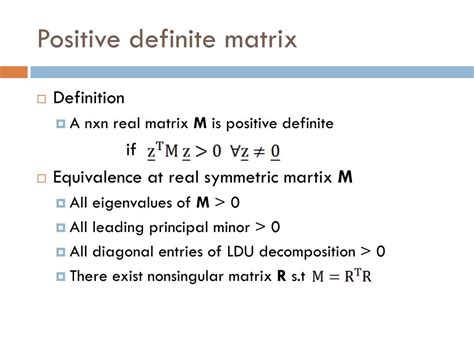
The concept of positive definiteness is a fundamental idea in linear algebra, and it plays a crucial role in various fields, including mathematics, physics, engineering, and computer science. In essence, a matrix is said to be positive definite if it represents a quadratic form that is always positive, except when the input vector is zero. This concept has numerous applications in optimization problems, statistics, and machine learning, among others. In this article, we will delve into the world of positive definite matrices, exploring their definition, properties, and significance in different areas of study.
Key Points
- A matrix is positive definite if it represents a quadratic form that is always positive, except when the input vector is zero.
- Positive definite matrices have all positive eigenvalues and a positive determinant.
- They play a crucial role in optimization problems, statistics, and machine learning.
- Positive definite matrices can be used to model covariance and correlation in statistics.
- They are essential in machine learning algorithms, such as Gaussian mixture models and kernel methods.
Definition and Properties of Positive Definite Matrices
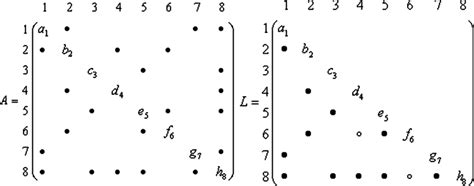
A square matrix A is said to be positive definite if for any non-zero vector x, the quadratic form x^T Ax is always positive. This can be expressed mathematically as x^T Ax > 0 for all x \neq 0. A matrix is said to be positive semi-definite if x^T Ax \geq 0 for all x. Positive definite matrices have several important properties, including:
- All eigenvalues are positive.
- The determinant is positive.
- The matrix is symmetric.
- The matrix is invertible.
These properties make positive definite matrices useful in a wide range of applications, from optimization problems to statistical modeling.
Examples of Positive Definite Matrices
One of the simplest examples of a positive definite matrix is the identity matrix I, where I_{ij} = 1 if i = j and I_{ij} = 0 otherwise. Another example is the matrix A = \begin{bmatrix} 2 & 1 \\ 1 & 2 \end{bmatrix}, which represents a quadratic form that is always positive, except when the input vector is zero.
| Matrix | Quadratic Form |
|---|---|
| \begin{bmatrix} 2 & 1 \\ 1 & 2 \end{bmatrix} | 2x_1^2 + 2x_2^2 + 2x_1x_2 |
| \begin{bmatrix} 1 & 0 \\ 0 & 1 \end{bmatrix} | x_1^2 + x_2^2 |
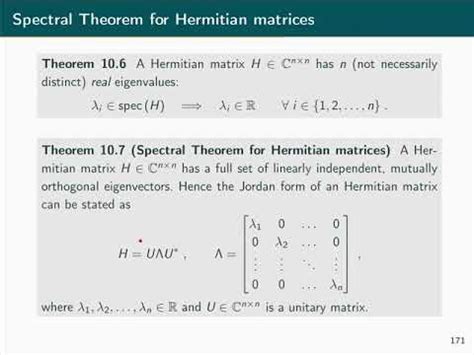
These examples illustrate the concept of positive definiteness and demonstrate how it can be applied to different matrices.
Applications of Positive Definite Matrices
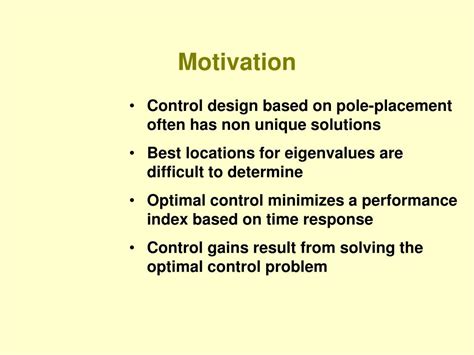
Positive definite matrices have numerous applications in various fields, including:
- Optimization problems: Positive definite matrices are used to model quadratic objective functions, which are essential in optimization problems.
- Statistics: Positive definite matrices are used to model covariance and correlation in statistics, which is crucial in understanding the relationships between variables.
- Machine learning: Positive definite matrices are used in machine learning algorithms, such as Gaussian mixture models and kernel methods, which are essential in pattern recognition and classification tasks.
These applications demonstrate the significance of positive definite matrices in different areas of study and highlight their importance in modeling and analyzing complex systems.
Positive Definite Matrices in Machine Learning
In machine learning, positive definite matrices are used to model the covariance structure of the data, which is essential in understanding the relationships between variables. For example, in Gaussian mixture models, positive definite matrices are used to model the covariance of each component, which allows for the estimation of the probability density function of the data.
Another example is kernel methods, which use positive definite matrices to model the similarity between data points. This allows for the construction of a feature space that captures the underlying structure of the data, which is essential in classification and regression tasks.
What is the difference between a positive definite and a positive semi-definite matrix?
+A positive definite matrix has all positive eigenvalues, while a positive semi-definite matrix has all non-negative eigenvalues. This means that a positive semi-definite matrix can have zero eigenvalues, while a positive definite matrix cannot.
How are positive definite matrices used in optimization problems?
+Positive definite matrices are used to model quadratic objective functions, which are essential in optimization problems. The quadratic form represented by a positive definite matrix is always positive, except when the input vector is zero, which allows for the construction of a convex optimization problem.
What is the significance of positive definite matrices in machine learning?
+Positive definite matrices are used to model the covariance structure of the data, which is essential in understanding the relationships between variables. They are also used in kernel methods to model the similarity between data points, which allows for the construction of a feature space that captures the underlying structure of the data.
In conclusion, positive definite matrices are a fundamental concept in linear algebra, with numerous applications in optimization problems, statistics, and machine learning. Their properties, such as having all positive eigenvalues and a positive determinant, make them useful in modeling and analyzing complex systems. By understanding the concept of positive definiteness, researchers and practitioners can develop more effective algorithms and models that capture the underlying structure of the data, leading to better decision-making and problem-solving in various fields.