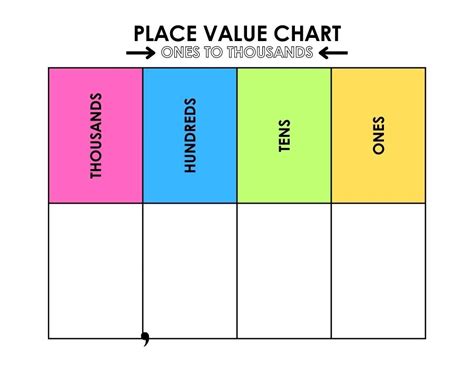
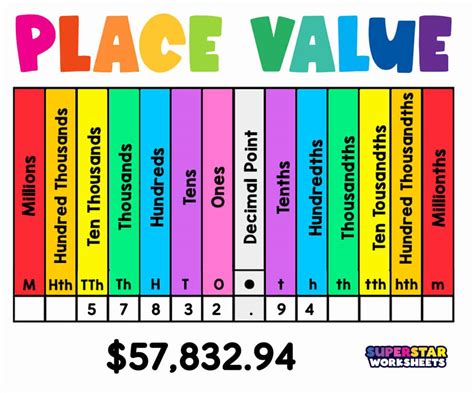
Understanding place value is a fundamental concept in mathematics, and place value charts are a powerful tool for visualizing and grasping this idea. A place value chart is a table or diagram that shows the place value of each digit in a number. In this article, we will explore five ways to use place value charts to enhance math education and improve students' understanding of numerical concepts.
Key Points
- Place value charts help students understand the concept of place value and its application in numerical operations.
- These charts can be used to teach addition, subtraction, multiplication, and division in a more visual and interactive way.
- Place value charts are essential for understanding more complex mathematical concepts, such as decimals and fractions.
- They can be customized to fit different learning styles and abilities, making them an inclusive tool for math education.
- Regular practice with place value charts can improve students' fluency and accuracy in mathematical operations.
Using Place Value Charts for Basic Operations
Place value charts are particularly useful for teaching basic arithmetic operations such as addition and subtraction. By using a place value chart, students can visualize how numbers are constructed and how they change when performing these operations. For example, when adding two numbers, students can use the chart to see how the digits in each place value position are combined. This visual representation helps students understand the process of regrouping and carrying over, which are essential skills for performing arithmetic operations accurately.
Customizing Place Value Charts for Different Learning Styles
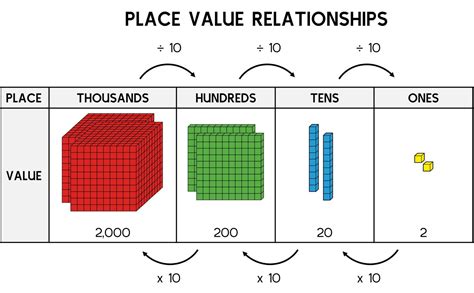
One of the advantages of place value charts is their versatility. They can be customized to fit different learning styles and abilities, making them an inclusive tool for math education. For students who are visual learners, place value charts can be colored or highlighted to emphasize different place value positions. For students who prefer a more hands-on approach, manipulatives such as base-ten blocks can be used in conjunction with the chart to provide a tangible representation of place value. This adaptability ensures that place value charts can be effective for a wide range of learners.
| Operation | Place Value Chart Application |
|---|---|
| Addition | Visualizing regrouping and carrying over |
| Subtraction | Understanding borrowing and place value relationships |
| Multiplication | Recognizing patterns in place value multiplication |
| Division | Understanding place value relationships in division |
Advanced Applications of Place Value Charts
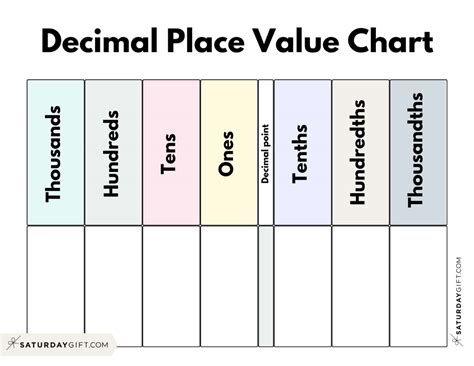
As students progress in their math education, place value charts can continue to play a significant role in their learning. For example, when introducing decimals, a place value chart can be extended to include decimal places, helping students understand how the value of digits changes when moving to the right of the decimal point. Similarly, for fractions, a place value chart can help students visualize the relationship between the numerator and the denominator and how it affects the value of the fraction. This demonstrates the versatility and depth of place value charts in supporting math education across different levels of complexity.
Regular Practice with Place Value Charts
Regular practice with place value charts is essential for reinforcing the concepts of place value and improving fluency in arithmetic operations. By consistently using these charts, students develop a deeper understanding of how numbers are structured and how they interact during different operations. This practice can be incorporated into daily math routines, either as a classroom activity or as homework, ensuring that students continually engage with and reinforce their knowledge of place value concepts.
What is the primary benefit of using place value charts in math education?
+The primary benefit of using place value charts is that they provide a visual and interactive way for students to understand the concept of place value, which is fundamental to performing arithmetic operations accurately.
How can place value charts be adapted for different learning styles?
+Place value charts can be adapted for different learning styles by using colors, highlights, or manipulatives such as base-ten blocks. This adaptability makes them an effective tool for a wide range of learners.
What role do place value charts play in introducing more complex mathematical concepts?
+Place value charts play a significant role in introducing more complex mathematical concepts, such as decimals and fractions, by providing a visual framework for understanding place value relationships in these contexts.
In conclusion, place value charts are a valuable tool in math education, offering a visual and interactive means of understanding the concept of place value. Their applications span from basic arithmetic operations to more complex mathematical concepts, and they can be customized to fit different learning styles and abilities. By incorporating place value charts into math education, educators can provide students with a deeper understanding of numerical concepts, improving their fluency and accuracy in mathematical operations.