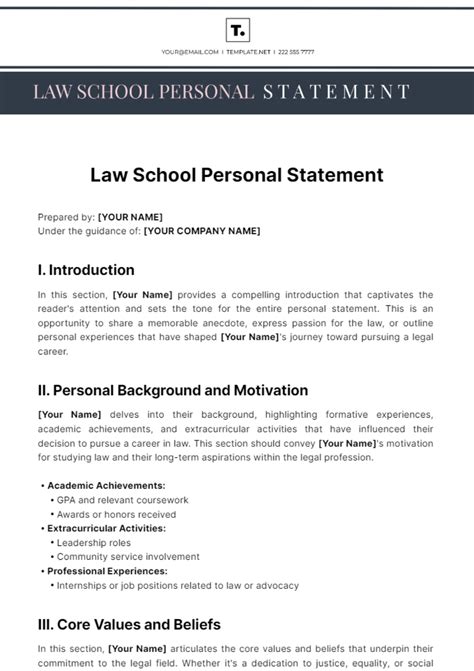
When applying to law school, a well-crafted personal statement is crucial in showcasing an applicant's unique experiences, skills, and motivations to the admissions committee. The personal statement is an opportunity for applicants to tell their story, highlighting their strengths, passions, and career aspirations. In this guide, we will explore the key elements of a successful law school personal statement, providing tips and strategies for crafting a compelling narrative that sets applicants apart from the competition.
Key Points
- Understand the purpose and audience of the personal statement
- Develop a clear and concise writing style
- Showcase unique experiences and skills
- Demonstrate passion for the law and a clear career vision
- Edit and refine the statement multiple times
- Seek feedback from mentors, advisors, or peers
Understanding the Purpose and Audience
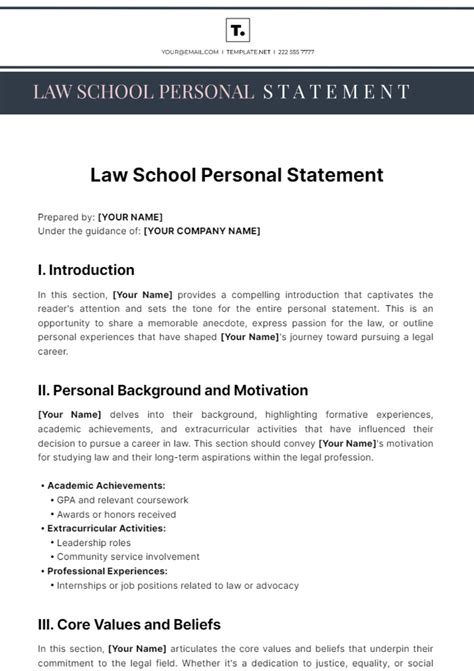
The primary purpose of the personal statement is to provide the admissions committee with a deeper understanding of the applicant’s background, motivations, and goals. The audience for the personal statement is the law school admissions committee, which typically consists of faculty members, admissions staff, and sometimes current law students. To effectively communicate with this audience, applicants should use clear and concise language, avoiding jargon and technical terms that may be unfamiliar to non-experts.
Developing a Clear and Concise Writing Style
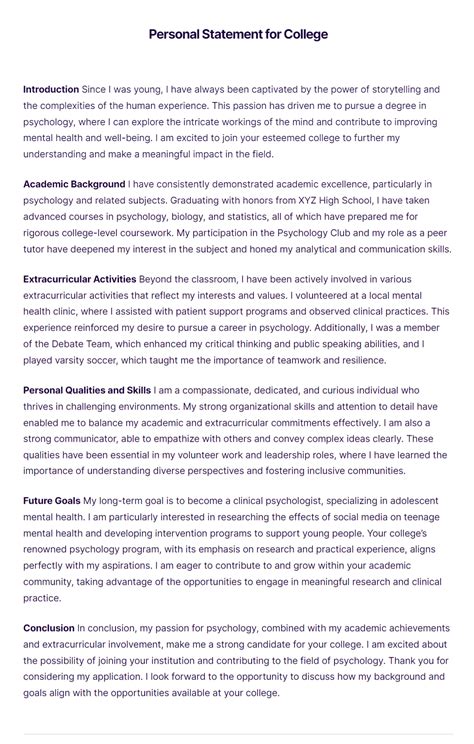
A strong personal statement begins with a clear and concise writing style. Applicants should use active voice, vary sentence structure, and avoid unnecessary words or phrases. A good rule of thumb is to use simple language to convey complex ideas, rather than using complex language to convey simple ideas. Additionally, applicants should use specific examples and anecdotes to illustrate their points, making the statement more engaging and memorable.
For example, instead of saying "I have always been interested in the law," an applicant could say "My experience volunteering at a local legal aid clinic sparked my passion for the law, and I have since been driven to pursue a career in public interest law." This revised statement provides more context and specificity, giving the reader a clearer understanding of the applicant's motivations and goals.
| Writing Style Tips | Best Practices |
|---|---|
| Use active voice | Avoid passive voice, which can make the writing seem less engaging |
| Vary sentence structure | Use a mix of short and long sentences to create a sense of rhythm |
| Avoid jargon and technical terms | Use simple language to convey complex ideas, rather than using complex language to convey simple ideas |
Showcasing Unique Experiences and Skills
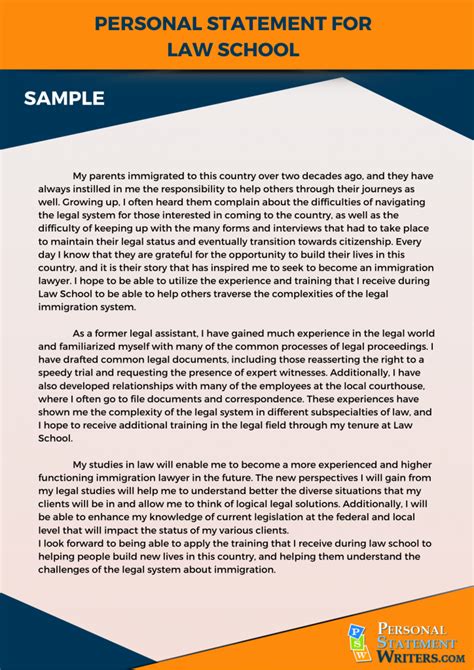
The personal statement is an opportunity for applicants to showcase their unique experiences and skills. This could include relevant work experience, academic achievements, or personal accomplishments. Applicants should use specific examples to demonstrate their skills and experiences, rather than simply listing them. For example, instead of saying “I have strong research skills,” an applicant could say “In my research position at a university, I developed and implemented a research project that resulted in a published paper, demonstrating my ability to design and execute a research study.”
Applicants should also highlight any unique experiences or perspectives they bring to the table. This could include experiences related to diversity, equity, and inclusion, or perspectives shaped by their cultural or socioeconomic background. By showcasing these unique experiences and perspectives, applicants can demonstrate their ability to contribute to a diverse and inclusive law school community.
Demonstrating Passion for the Law and a Clear Career Vision
A strong personal statement should demonstrate the applicant’s passion for the law and a clear career vision. Applicants should explain why they want to attend law school and how it aligns with their career goals. They should also discuss their understanding of the legal profession and their potential contributions to it. For example, an applicant could say “I am drawn to the law because of its ability to shape and influence society, and I believe that my skills and experiences make me well-suited to a career in public interest law.”
Applicants should also demonstrate their knowledge of the law school and its programs. They should research the school's curriculum, faculty, and extracurricular activities, and explain how they align with their interests and goals. This shows that the applicant has done their due diligence and is genuinely interested in attending the school.
For instance, an applicant could say "I am impressed by the law school's strong reputation for producing graduates who are committed to public service, and I am excited about the opportunity to be part of a community that shares my values and goals." This statement demonstrates the applicant's knowledge of the school and its programs, as well as their passion for public service.
Editing and Refining the Statement
Once the personal statement is drafted, it is essential to edit and refine it multiple times. Applicants should review their statement for clarity, grammar, and spelling, and make sure it is free of errors. They should also seek feedback from mentors, advisors, or peers, and be open to constructive criticism and suggestions for improvement.
Applicants should also consider having a professional editor or writing coach review their statement, especially if they are not confident in their writing abilities. A professional editor can help refine the statement, ensuring it is polished and effective in conveying the applicant's message.
What is the purpose of the personal statement in a law school application?
+The purpose of the personal statement is to provide the admissions committee with a deeper understanding of the applicant's background, motivations, and goals. It is an opportunity for applicants to tell their story, highlighting their strengths, passions, and career aspirations.
How long should the personal statement be?
+The length of the personal statement can vary, but it is typically around 2-3 pages, double-spaced. However, it is essential to check the specific requirements of the law school, as some may have different length or formatting requirements.
What should I include in my personal statement?
+Your personal statement should include a clear and concise writing style, unique experiences and skills, and a demonstration of your passion for the law and a clear career vision. You should also research the law school and its programs, and explain how they align with your interests and goals.
In conclusion, a well-crafted personal statement is essential for a successful law school application. By understanding the purpose and audience of the statement, developing a clear and concise writing style, showcasing unique experiences and skills, demonstrating passion for the law and a clear career vision, and editing and refining the statement, applicants can create a compelling narrative that sets them apart from the competition. Remember to seek feedback from mentors, advisors, or peers, and be open to constructive criticism and suggestions for improvement. With careful planning, research, and execution, applicants can create a personal statement that effectively communicates their story and helps them achieve their goals.