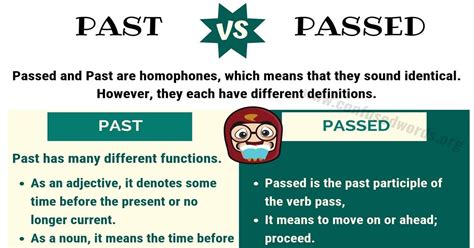
The terms "pass" and "past" are often confused with each other due to their similarities in spelling and pronunciation. However, they have distinct meanings and uses in the English language. Understanding the difference between "pass" and "past" is crucial for effective communication and to avoid grammatical errors in writing and speech.
Key Points
- The word "pass" can be used as a verb, meaning to move past something or someone, or to complete a test or examination successfully.
- The word "past" can be used as an adjective, adverb, or noun, referring to a period of time that has gone by or a person's history.
- The correct usage of "pass" and "past" depends on the context in which they are used.
- Mastering the difference between "pass" and "past" is essential for clear and accurate communication in English.
- Common errors in using "pass" and "past" can be avoided by paying attention to the grammatical context and intended meaning.
Understanding the Verb “Pass”
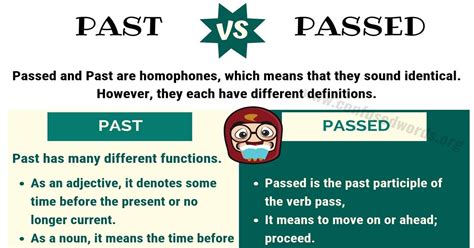
The verb “pass” has several meanings, including to move past something or someone, to complete a test or examination successfully, or to give something to someone. For example, “I will pass the ball to my teammate” or “She passed the driving test on her first attempt.” In these contexts, “pass” is used to describe an action or an achievement.
Using “Pass” in Different Contexts
In addition to its uses as a verb, “pass” can also be used as a noun, referring to a mountain pass or a pass in a sport. For instance, “The hikers had to navigate through a treacherous mountain pass” or “The football player made a pass to his teammate.” The meaning of “pass” varies depending on the context in which it is used, making it a versatile word in the English language.
| Verb Form | Meaning |
|---|---|
| Pass (base form) | To move past something or someone |
| Passed (past tense) | To have moved past something or someone |
| Passing (present participle) | To be moving past something or someone |
Exploring the Word “Past”
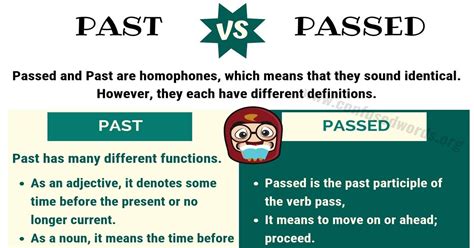
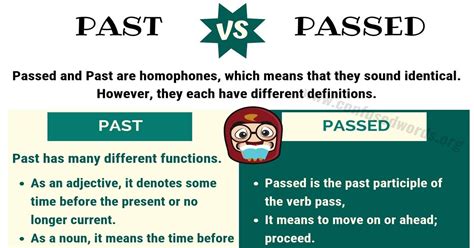
The word “past” has several functions in the English language, including as an adjective, adverb, or noun. As an adjective, “past” refers to something that is no longer current or has gone by, such as “past experiences” or “past relationships.” As an adverb, “past” indicates a location or direction, as in “The car drove past the house.” As a noun, “past” refers to a period of time that has gone by or a person’s history, such as “The company’s past performance has been impressive” or “Her past is marked by significant achievements.”
Using “Past” in Different Contexts
The word “past” is often used to describe a period of time that has gone by or to refer to someone’s history. For example, “The past few years have been challenging for the economy” or “Her past experiences have shaped her into the person she is today.” In these contexts, “past” is used to provide background information or to describe a situation that has occurred previously.
| Part of Speech | Meaning |
|---|---|
| Adjective | Something that is no longer current or has gone by |
| Adverb | A location or direction |
| Noun | A period of time that has gone by or a person's history |
Common Errors and Confusions
One of the most common errors in using “pass” and “past” is confusing the two words due to their similarities in spelling and pronunciation. For example, saying “I past the test” instead of “I passed the test” or “The car drove pass the house” instead of “The car drove past the house.” These errors can be avoided by paying attention to the grammatical context and the intended meaning.
Avoiding Common Mistakes
To avoid common mistakes when using “pass” and “past,” it’s essential to understand the differences between the two words and to use them in the correct context. For instance, “pass” should be used when describing an action or an achievement, while “past” should be used when referring to a period of time that has gone by or a person’s history. By mastering the differences between “pass” and “past,” individuals can improve their communication skills and avoid grammatical errors in writing and speech.
What is the main difference between "pass" and "past"?
+The main difference between "pass" and "past" is their meaning and usage in the English language. "Pass" is often used as a verb, while "past" is used as an adjective, adverb, or noun.
How can I avoid confusing "pass" and "past"?
+To avoid confusing "pass" and "past," it's essential to understand the differences between the two words and to use them in the correct context. Paying attention to the grammatical context and the intended meaning can also help avoid common mistakes.
What are some common errors when using "pass" and "past"?
+Common errors when using "pass" and "past" include confusing the two words due to their similarities in spelling and pronunciation, resulting in incorrect usage such as "I past the test" instead of "I passed the test" or "The car drove pass the house" instead of "The car drove past the house."
In conclusion, mastering the difference between “pass” and “past” is essential for effective communication and to avoid grammatical errors in writing and speech. By understanding the meanings and uses of these two words, individuals can improve their language skills and convey their intended message with clarity and precision. Whether used as a verb, adjective, adverb, or noun, “pass” and “past” play important roles in the English language, and their correct usage is crucial for clear and accurate communication.