
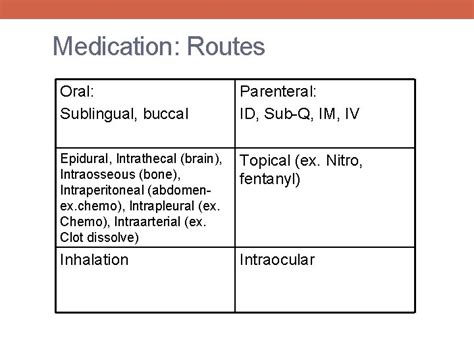
Parenteral medication refers to the administration of drugs through routes other than the digestive tract, such as intravenous, intramuscular, subcutaneous, or intradermal injections. This method of drug delivery is crucial in various medical situations, including emergency care, surgery, and the treatment of severe infections. Parenteral medication allows for the rapid achievement of therapeutic drug levels, which is essential in critical care settings. The development and use of parenteral medications have evolved significantly over the years, with advancements in pharmaceutical technology and a deeper understanding of pharmacokinetics and pharmacodynamics.
The history of parenteral medication dates back to the late 19th century, when the first vaccines and sera were administered parenterally. Since then, the scope of parenteral medications has expanded to include a wide range of therapeutic agents, from antibiotics and analgesics to anticancer drugs and immunoglobulins. The choice of parenteral route depends on the specific drug, the desired onset of action, and the patient's condition. For instance, intravenous administration is preferred for drugs that require rapid action, such as in the management of status epilepticus or anaphylaxis, whereas intramuscular injections may be used for vaccines or depot preparations of drugs like antipsychotics.
Key Points
- Parenteral medication involves the administration of drugs through injection, bypassing the digestive tract.
- The method allows for rapid achievement of therapeutic drug levels, crucial in emergency and critical care situations.
- Routes of administration include intravenous, intramuscular, subcutaneous, and intradermal injections, each chosen based on the drug, desired onset of action, and patient condition.
- Parenteral medications encompass a broad spectrum of therapeutic agents, including antibiotics, analgesics, anticancer drugs, and immunoglobulins.
- The development of parenteral medications has been influenced by advancements in pharmaceutical technology and pharmacological sciences.
Pharmacological Basis of Parenteral Medication
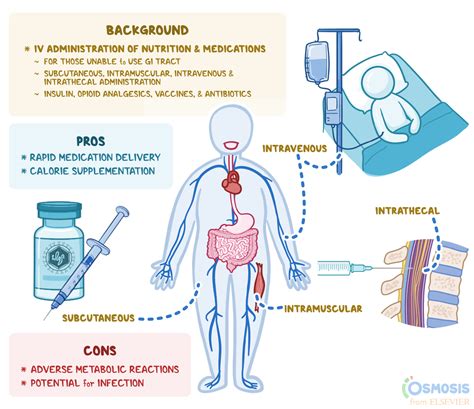
The pharmacological effectiveness of parenteral medications depends on several factors, including the drug’s molecular size, lipid solubility, and the presence of specific transport mechanisms. Drugs administered parenterally bypass the first-pass metabolism, which occurs in the liver for orally ingested drugs. This bypass can lead to higher bioavailability and faster onset of action. However, it also necessitates careful consideration of the drug’s dosage and potential for adverse effects, as the therapeutic window may be narrower compared to oral medications.
Routes of Parenteral Administration
The selection of the parenteral route is critical and depends on the drug’s formulation, the desired rate of absorption, and the clinical context. Intravenous (IV) administration provides the most rapid onset of action, as the drug is delivered directly into the bloodstream. This route is typically used for emergencies, during surgery, or for drugs that require precise control over plasma concentrations, such as certain antibiotics or anticonvulsants. Intramuscular (IM) injections, on the other hand, are absorbed more slowly and are often used for vaccinations or for drugs with a longer duration of action, like depot neuroleptics.
| Route of Administration | Characteristics | Examples of Medications |
|---|---|---|
| Intravenous (IV) | Rapid onset, direct delivery into bloodstream | Antibiotics, anticonvulsants, emergency medications |
| Intramuscular (IM) | Slower absorption, used for vaccinations and depot preparations | Vaccines, depot antipsychotics, certain antibiotics |
| Subcutaneous (SC) | Slow absorption, used for insulin, heparin, and growth hormone | Insulin, heparin, growth hormone |
| Intradermal (ID) | Used for diagnostic purposes, such as tuberculin test | Tuberculin, allergen extracts for skin testing |
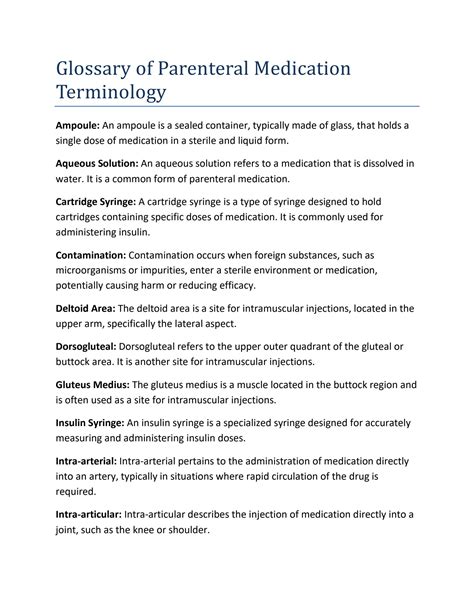
Challenges and Considerations in Parenteral Medication
Despite the advantages of parenteral medication, there are several challenges and considerations that healthcare professionals must address. These include the risk of infection, nerve damage, or other local reactions at the injection site, as well as systemic adverse effects. The preparation and administration of parenteral medications require strict aseptic technique to prevent contamination and infection. Furthermore, the compatibility of drugs and their formulations with the administration materials (e.g., needles, syringes, IV tubing) must be ensured to prevent chemical incompatibilities or physical incompatibilities like precipitation.
Safety and Efficacy Considerations
The safety and efficacy of parenteral medications are of paramount importance. Healthcare professionals must be knowledgeable about the medications they administer, including their indications, dosages, potential side effects, and interactions with other drugs. Patient education is also crucial, especially for those receiving parenteral medications on an ongoing basis, such as insulin or immunoglobulins. The development of biosimilar products has introduced new considerations in the field of parenteral medication, offering potentially more affordable alternatives to biologic therapies but also requiring careful evaluation of their safety and efficacy profiles.
In conclusion, parenteral medication plays a vital role in modern healthcare, offering a rapid and effective means of drug delivery in a variety of clinical settings. The choice of parenteral route and the specific medication used depend on a complex interplay of factors, including the drug's pharmacological properties, the patient's condition, and the desired therapeutic outcome. As the field of parenteral medication continues to evolve, driven by advancements in pharmaceutical science and technology, healthcare professionals must remain informed about the latest developments and best practices to ensure the safe and effective use of these medications.
What is the primary advantage of parenteral medication over oral medication?
+The primary advantage of parenteral medication is its ability to achieve rapid therapeutic drug levels, bypassing the first-pass metabolism and allowing for faster onset of action compared to oral medications.
Which route of parenteral administration is used for vaccinations and depot preparations of drugs?
+The intramuscular (IM) route is commonly used for vaccinations and depot preparations of drugs, as it allows for slow absorption and a longer duration of action.
What are some key considerations for the safe administration of parenteral medications?
+Key considerations include strict aseptic technique to prevent infection, ensuring drug compatibility with administration materials, and careful patient monitoring for potential adverse effects.