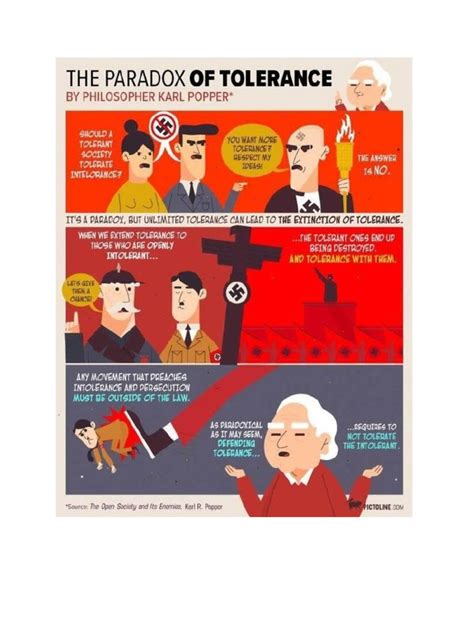
The paradox of tolerance, a concept introduced by philosopher Karl Popper, presents a fascinating and complex dilemma that has sparked intense debates among scholars, philosophers, and policymakers. At its core, the paradox questions whether a tolerant society should tolerate intolerance, and if so, to what extent. This conundrum has far-reaching implications for modern democratic societies, where the balance between preserving individual freedoms and maintaining social cohesion is continually challenged.
In essence, the paradox of tolerance revolves around the idea that if a society is fully tolerant, it must also tolerate those who are intolerant. However, if it tolerates intolerance, it risks undermining its own tolerant foundations, potentially leading to the erosion of the very principles that define it. This creates a self-referential problem, where the tolerant society is faced with the daunting task of deciding how to handle intolerant groups or individuals without compromising its commitment to tolerance.
Key Points
- The paradox of tolerance questions whether a tolerant society should tolerate intolerance.
- Unlimited tolerance can lead to the suppression of tolerant groups by intolerant ones.
- A balance between tolerance and intolerance is necessary for the survival of a tolerant society.
- Establishing limits to tolerance is crucial to prevent the undermining of democratic principles.
- The paradox of tolerance highlights the importance of critical thinking and nuanced decision-making in governance.
Understanding the Paradox
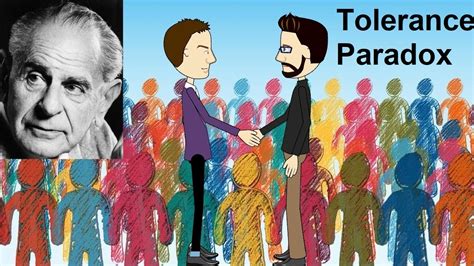
To grasp the paradox of tolerance fully, it’s essential to consider the nature of tolerance itself. Tolerance, in a societal context, refers to the acceptance and respect for different beliefs, practices, and lifestyles, even if they differ significantly from one’s own. This concept is fundamental to democratic societies, where diversity and freedom of expression are highly valued. However, the challenge arises when dealing with groups or individuals who do not reciprocate this tolerance, instead advocating for the suppression or eradication of opposing views.
The Dangers of Unlimited Tolerance
Popper’s formulation of the paradox highlights the dangers of unlimited tolerance. If a society tolerates everything, including intolerance, it may ultimately succumb to the forces of intolerance. This is because intolerant groups, by their nature, seek to impose their views on others, often through coercion or violence. By tolerating such behavior, a society inadvertently creates an environment where intolerant groups can flourish, potentially at the expense of tolerant ones. This scenario is eerily illustrated by historical examples, such as the rise of fascist regimes in the early 20th century, which often exploited democratic freedoms to dismantle democratic systems.
| Concept | Definition |
|---|---|
| Tolerance | The acceptance and respect for different beliefs, practices, and lifestyles. |
| Intolerance | The rejection or suppression of different beliefs, practices, and lifestyles. |
| Paradox of Tolerance | The dilemma of whether a tolerant society should tolerate intolerance. |
Resolving the Paradox
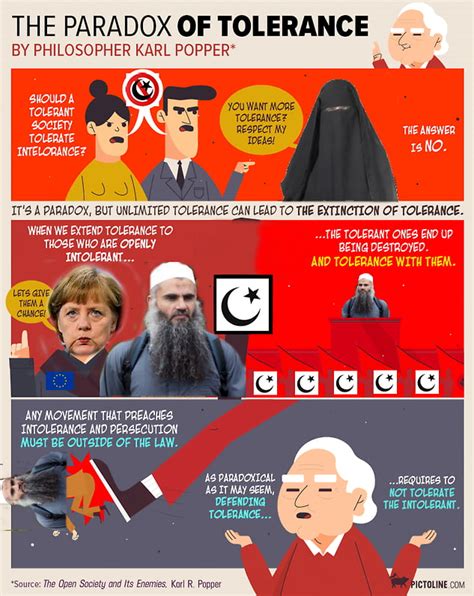
So, how can a tolerant society resolve this paradox? The answer lies in establishing limits to tolerance. This does not mean abandoning the principle of tolerance but rather recognizing that tolerance, like any other right, is not absolute. Societies must draw a line between what can be tolerated and what cannot, based on the potential harm that intolerant actions or ideologies may inflict on others or on the fabric of society itself. This approach requires careful consideration and ongoing debate, as the boundaries between tolerance and intolerance are often blurry and context-dependent.
Implications for Democratic Societies
The paradox of tolerance has significant implications for democratic societies. It highlights the importance of protecting democratic principles and the rule of law, even if it means limiting the expression of certain views or the actions of intolerant groups. This is not about curtailing freedom of speech or imposing censorship but about ensuring that the rights of all individuals are respected and that no group can exploit democratic freedoms to undermine democracy itself. The challenge for policymakers and citizens alike is to navigate these complex issues in a way that upholds the values of tolerance, diversity, and freedom, while also safeguarding the integrity of democratic systems.
What is the paradox of tolerance?
+The paradox of tolerance refers to the dilemma of whether a tolerant society should tolerate intolerance. It questions the limits of tolerance and how a society should handle intolerant groups or individuals without compromising its tolerant foundations.
Why is it important to establish limits to tolerance?
+Establishing limits to tolerance is crucial to prevent the undermining of democratic principles by intolerant groups. Unlimited tolerance can lead to the suppression of tolerant groups by intolerant ones, ultimately threatening the survival of a tolerant society.
How can a society balance tolerance with the need to protect itself from intolerance?
+A society can balance tolerance with the need to protect itself by engaging in ongoing debates and discussions about the limits of tolerance. This involves considering the potential harm of intolerant actions or ideologies and making informed decisions about what can and cannot be tolerated, based on democratic principles and the rule of law.
In conclusion, the paradox of tolerance presents a profound challenge to modern democratic societies. It demands a nuanced understanding of the delicate balance between tolerance and intolerance and the establishment of clear limits to tolerance to safeguard democratic principles. Through careful consideration, critical thinking, and a commitment to protecting the rights of all individuals, societies can navigate this paradox and ensure the long-term survival of tolerant and democratic systems.